|
Updated by Reginald Davey 10/01/23
Sieve Meaning and Overview
Sieving or screening is a method of separating a mixture or grains or particles into 2 or more size fractions, the oversized materials are trapped above the screen, while undersized materials can pass through the screen.
Sieves can be used in stacks with different mesh sizes, to divide samples into various size fractions and hence determine particle size distributions.
Sieves and screens are usually used for larger particle-sized materials, i.e., greater than approximately 50µm (0.050mm).
Industrial Sieve Types and Uses
Sieves are used in multiple industries. There are several types of sieves used for a number of industrial applications.
Check sieves are the most common type used in industry and are usually applied for uses such as removing lumps, packaging remnants, contaminants, and biological contaminants such as insect eggs. Typically composed of a single screen, the fine product which is not removed and passes through the mesh is retained.
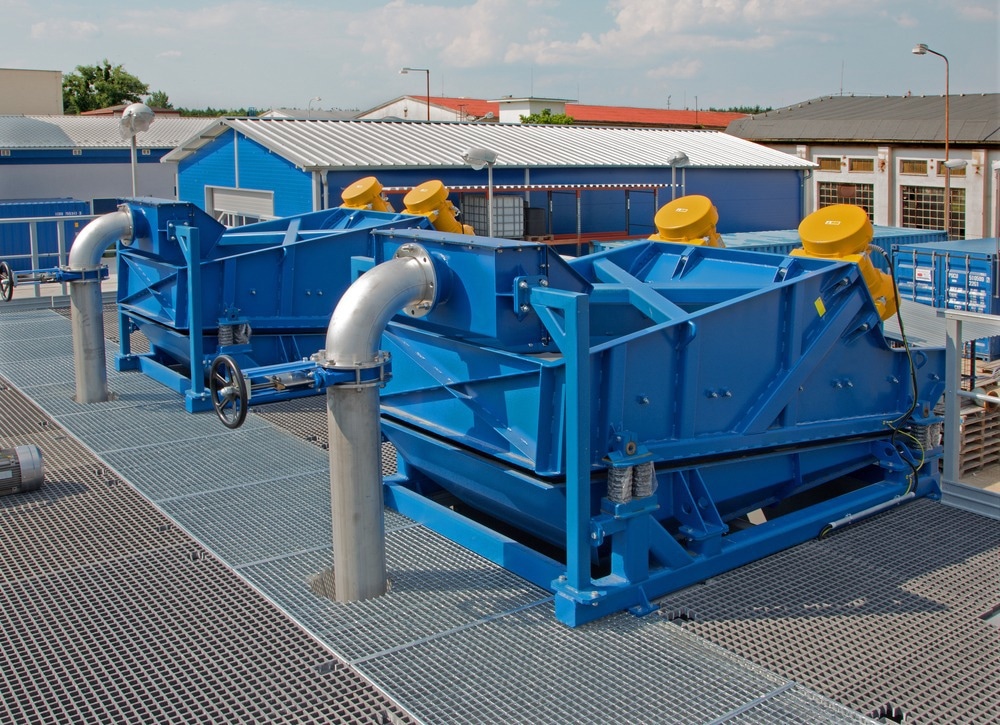
Image Credit: Renata Sedmakova/Shutterstock.com
Check sieves are used at the beginning of a process line to remove any contaminants. They are also used during quality checks before the packaging stage of the process line. Check sieves can be used to remove undersized and broken products.
Grading sieves are similar to check sieves. The aim of a grading sieve is to separate products into different particle sizes, thereby improving the grading of the final product. Up to four meshes are used with decreasing aperture sizes in grading sieves. Whilst generally slower than check sieves, the speed of grading sieves can be compensated through fine-tuning or by using larger mesh areas.
Linear vibrating sieves move products linearly and differ from circular sieves as they use rectangular screens. Linear sieves can replace a conventional conveyor belt to separate products efficiently. They are used for applications such as dewatering and for products that contain a lot of oversized particles.
Other types of industrial sieve include rotary and centrifugal sieves, vacuum and pressure sieves, and batch sieves. Different products have different processing challenges, such as line throughput, environmental variations, and equipment finishing. These challenges influence which type of sieve is used.
Size Equivalents
Two scales are used to classify particle sizes. These are the US Sieve Series and Tyler Equivalent, sometimes called Tyler Mesh Size or Tyler Standard Sieve Series. The most common mesh opening sizes for these scales are given in the table below and provide an indication of particle sizes.
|
|
|
-
|
2½ Mesh
|
8.00
|
0.312
|
|
-
|
3 Mesh
|
6.73
|
0.265
|
|
No. 3½
|
3½ Mesh
|
5.66
|
0.233
|
|
No. 4
|
4 Mesh
|
4.76
|
0.187
|
|
No. 5
|
5 Mesh
|
4.00
|
0.157
|
|
No. 6
|
6 Mesh
|
3.36
|
0.132
|
|
No. 7
|
7 Mesh
|
2.83
|
0.111
|
|
No. 8
|
8 Mesh
|
2.38
|
0.0937
|
|
No.10
|
9 Mesh
|
2.00
|
0.0787
|
|
No. 12
|
10 Mesh
|
1.68
|
0.0661
|
|
No. 14
|
12 Mesh
|
1.41
|
0.0555
|
|
No. 16
|
14 Mesh
|
1.19
|
0.0469
|
|
No. 18
|
16 Mesh
|
1.00
|
0.0394
|
|
No. 20
|
20 Mesh
|
0.841
|
0.0331
|
|
No. 25
|
24 Mesh
|
0.707
|
0.0278
|
|
No. 30
|
28 Mesh
|
0.595
|
0.0234
|
|
No. 35
|
32 Mesh
|
0.500
|
0.0197
|
|
No. 40
|
35 Mesh
|
0.420
|
0.0165
|
|
No. 45
|
42 Mesh
|
0.354
|
0.0139
|
|
No. 50
|
48 Mesh
|
0.297
|
0.0117
|
|
No. 60
|
60 Mesh
|
0.250
|
0.0098
|
|
No. 70
|
65 Mesh
|
0.210
|
0.0083
|
|
No. 80
|
80 Mesh
|
0.177
|
0.0070
|
|
No.100
|
100 Mesh
|
0.149
|
0.0059
|
|
No. 120
|
115 Mesh
|
0.125
|
0.0049
|
|
No. 140
|
150 Mesh
|
0.105
|
0.0041
|
|
No. 170
|
170 Mesh
|
0.088
|
0.0035
|
|
No. 200
|
200 Mesh
|
0.074
|
0.0029
|
|
No. 230
|
250 Mesh
|
0.063
|
0.0025
|
|
No. 270
|
270 Mesh
|
0.053
|
0.0021
|
|
No. 325
|
325 Mesh
|
0.044
|
0.0017
|
|
No. 400
|
400 Mesh
|
0.037
|
0.0015
|
The mesh number system is a measure of how many openings there are per linear inch in a screen. Sizes vary by a factor of √2. This can easily be determined as screens are made from wires of standard diameters, however, opening sizes can vary slightly due to wear and distortion.
US sieve sizes differ from Tyler Screen sizes in that thay are arbitrary numbers.
|