Engine oils and lubricants need to provide a good layer thickness by having sufficient viscosity, without giving significant frictional effects from the viscosity being too high. The ideal viscosity range of an engine oil is therefore quite narrow.
Image Credits: Tomasz Majchrowicz/shutterstock.com
Temperature Dependent Viscosity
Mineral Oils
Mineral oils generally have a very temperature dependent viscosity and so need to be modified.
Viscostatic Oils
Viscostatic oils (where viscosity is entirely independent of temperature) can be created by adding polymeric compounds that open up their conformation at higher temperatures. When heated, the increase of viscosity of the polymer additive counteracts the fall in viscosity of the oil.
Effect Of Viscosity Variations
In this experiment, we can measure the viscosity of the oil at all working temperatures and determine whether it will be sufficiently ‘thin’ when cold, for say, an engine to start, or sufficiently ‘thick’ to lubricate well when hot.
Interpretation Of Viscosity Versus Temperature
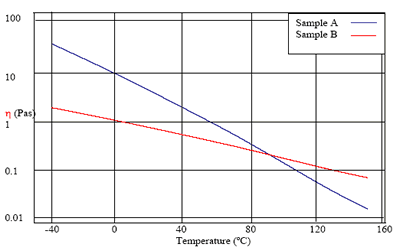
The results show that Sample A’s low temperature viscosity is much higher than that of Sample B and therefore it will be much more difficult to circulate in an engine on start-up. Conversely, Sample B showed a higher viscosity than Sample A when hot, indicating that it would give more lubrication when up to temperature.
|
|
|
Figure 1. Variation in viscosity over a range of temperatures.
|
Conclusion
The temperature dependence of a lubricant is one of the most important factors in determining its efficacy. Using a Bohlin rheometer, the viscosity can be accurately measured over a wide temperature range. Results are also referenced against nationally recognised standards.
Measurement Conditions
| Samples |
Oils and lubricants |
| Geometry |
Parallel Plate 40 mm with the Extended Temperature Cell |
| Single Shear-Shear Rate |
10s-1 |
| Gap |
1 mm |
| Temperature Ramp |
Range of interest (e.g. -20oC-90oC at 3o/min) |

This information has been sourced, reviewed and adapted from materials provided by Malvern Panalytical.
For more information on this source, please visit Malvern Panalytical.