Thixotropy is a decrease in the apparent viscosity under shearing, followed by a gradual recovery when the shear is removed. The effect is time dependent. If the viscosity reduces and immediately returns after shearing, the material is not thixotropic but just 'shear thinning'. It is important to recognise thixotropy in materials, otherwise the shear history of the sample may adversely affect the accuracy and reproducibility of the test.
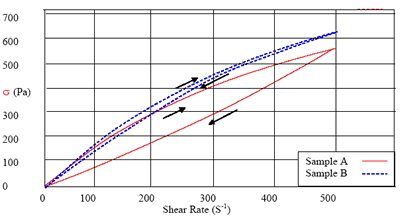
Figure 1. Hysteresis Loop Test.
Interpretation
In this hysteresis loop test, the sample is subjected to increasing shear and then reducing shear. The results give an indication whether the sample is thixotropic. Sample A has a high degree of thixotropy, so a loop is seen between the UP and DOWN curves, i.e. the samples behave differently before and after shearing.
Sample B appears to have only a shear thinning nature, as the UP and DOWN curves almost overlay each other.
Traditionally, users have related the degree of thixotropy to the magnitude of the integrated loop area, although there are now other techniques as indicated below which give more meaningful results.
Conclusion
If the coating is found to be thixotropic, this should be taken into account when carrying out subsequent tests. Sample application will need to be carried out in a reproducible way, or the samples should be pre-sheared so that they all have the same shear history.
To quantify thixotropy in a more meaningful way, it is usual to perform a dynamic test.
Measurement Conditions
Samples: Paints
Geometry: Cone and plate system 4° / 40 mm with a solvent trap
Shear rate sweep: 1 - 500 S-1 Up/Down Linear
Ramp time: 120 seconds

This information has been sourced, reviewed and adapted from materials provided by Malvern Panalytical.
For more information on this source, please visit Malvern Panalytical.