|
CRAIC Technologies is the worlds leading developer of UV-visible-NIR range scientific instruments for microanalysis. These include the QDI series UV-visible-NIR microspectrophotometer instruments designed to help you non-destructively measure the optical properties of microscopic samples. CRAIC's UVM series microscopes cover the UV, visible and NIR range and help you analyze with sub-micron resolutions far beyond the visible range. CRAIC Technologies also has the CTR series Raman microspectrometer for non-destructive analysis of microscopic samples. And don't forget that CRAIC proudly backs our microspectrometer and microscope products with unmatched service and support.
Image Credit: Shutterstock/Andrus Ciprian
|
UV-Visible-NIR Microspectroscopy of Textile Fibers
|
|
UV-visible-NIR microspectroscopy of textile fibers is one of the most common applications of the technique. In the visible-NIR range, detailed spectral information is recovered from the sample about the dyes and pigments used to color the fiber. In the UV region, information about the dyes, any additives, and about the fiber substrate itself can be acquired. In addition, fluorescence microspectroscopy can give information about brighteners and the fiber dyes with the correct excitation. Since the technique is non-destructive and the sample preparation in minimal, UV-visible-NIR microspectroscopy has become the mainstay for a number of fields. This includes both the textile manufacturing industry and forensic analysis of trace evidence. The purpose of this paper is to detail the utility of the technique and to show some sample results.
Experimental and Results
A fragment of a dyed fiber is place on a CRAIC Technologies spectral grade quartz slide and immersed in glycerin mounting media. A CRAIC spectral grade quartz coverslip is placed over the sample and the sample is now ready to analyze via microspectroscopy.
Microspectrophotometer Details
A QDI 1000™ UV-visible-NIR range microspectrophotometer was used for the analysis. The Quantum Detection Instrument series (QDI) of microspectrophotometers is designed to detect the smallest changes in the spectra of microscopic samples. The QDI 1000™ microspectrophotometer features a scientific grade array detector, TE cooling, high spectral resolution, long-term stability, low noise, and the ability to acquire transmission, reflectance, and fluorescence spectra of samples as small as 1 x 1 microns.
Absorbance Spectra Acquisition
The sample is placed on the QDI 1000™ and the image is acquired. The microscope is set up for Koehler illumination with transmission illumination. Figure 1 displays an image of the fiber analyzed. The software automatically optimizes the instrument and the spectra are acquired by simply placing the black square over the area of the fiber to be analyzed. A spectrum is acquired and the result is printed.
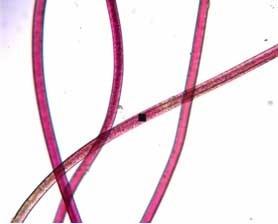
Figure 1. Image of fiber after mounting on quartz microscope slide. The black square is the microspectrophotometer aperture.
Absorbance Spectra Obtained from the Textile Fiber
The Figure 2 shows the result of the scan. This is an absorbance spectrum of the red fiber in question. The spectral range is from 200 to 850 nm using a UV-visible light source and a specially modified Leica DMR microscope. The spectrum is the average of 50 scans at 10 milliseconds per scan.
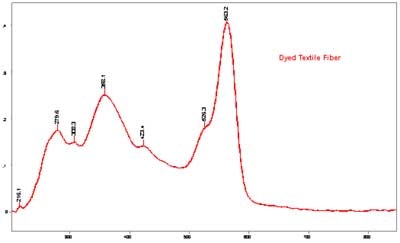
Figure 2. The absorbance spectra from the textile fiber sample.
Conclusion
It is simple to acquire spectral information about the dyes contained in textile fibers non-destructively. The quality of the results from the QDI 1000™ microspectrophotometer, both in terms of the spectra and the high-resolution images, back this assertion.
|
|
Primary author: Dr. Paul Martin
For more information on this source please visit CRAIC Technologies.
|

This information has been sourced, reviewed and adapted from materials provided by CRAIC Technologies.
For more information on this source, please visit CRAIC Technologies.