Dec 18 2001
remotevfx.com / Shutterstock
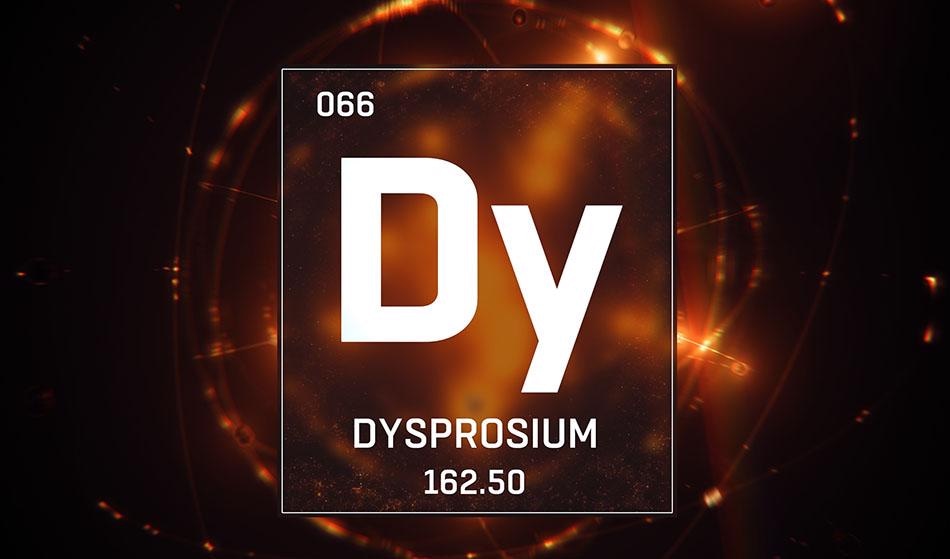
Dysprosium (Dy) is a chemical element belonging to the actinide series. Lecoq de Boisbaudran discovered this element in 1886 but was not able to isolate it. Later in 1950, Spedding and colleagues isolated the element using techniques like metallographic reduction and ion-exchange separation.
Dysprosium occurs in combination with other so-called rare-earth elements in many different minerals like blomstrandine, polycrase, euxenite, gadolinite, fergusonite, and xenotime. The most significant sources of dysprosium are bastnasite and monazite. Dysprosium can be prepared by reducing the trifluoride with calcium.
Appearance and Properties
Dysprosium has a bright metallic silver luster. The metal is sufficiently soft to be cut with a knife and can be machined, provided it is not overheated. The element is paramagnetic, and trace amounts of impurities can considerably impact its physical characteristics. When compared to other cerium metals, dysprosium has greater corrosion resistance.
Dysprosium is also comparatively stable in air, at room temperature. The element is instantly attacked and dissolved by both dilute and concentrated mineral acids, with the evolution of hydrogen.
Applications
Dysprosium is utilized in ferrites and magnetic alloys for microwave use. Special stainless steels alloyed with dysprosium are used in nuclear control applications, that is, nuclear reactor control rods. Dysprosium is also used as a cermet (dysprosium oxide-nickel) that cools nuclear reactor control rods, whereby it readily absorbs neutrons without contracting or swelling under prolonged neutron bombardment.
Dysprosium is also used as a laser material by combining it with rare-earth metals, including vanadium. Dysprosium-cadmium chalcogenides are a source of infrared radiation.