Jul 15 2008
Scientists from the Universidad Carlos III of Madrid (UC3M) and the Consejo Superior de Investigaciones Científicas (CSIC) have developed an environmentally friendly cooling technology that does not harm the ozone layer. This is achieved by using solar energy and therefore reducing the use of greenhouse gases.
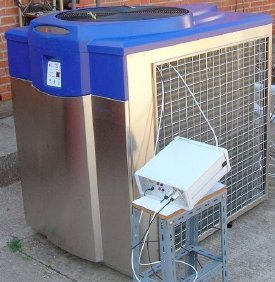
A research team has designed and built an absorption chiller capable of using solar and residual heat as an energy source to drive the cooling system. The technology used in this machine, which looks like an ordinary air-conditioning system, minimises its environmental impact by combining the use of a lithium bromide solution, which does not damage the ozone layer or increase the greenhouse effect, with a reduction in the use of water by the machine.
The team, managed by Professor Marcelo Izquierdo from the Department of Thermal Engineering and Fluid Mechanics of the UC3M, who is also a researcher at the Instituto de Ciencias de la Construcción Eduardo Torroja (IETCC) of the CSIC, is building a solar cooling system that unlike the existing machines on the market, uses an improved absorption mechanism capable of producing cold water at a range of temperatures from 7º C to 18º C when the exterior temperature ranges from 33º C to 43º C.
Residential use
Professor Marcelo Izquierdo states that the conclusions reached by a study with a commercial air condensed absorption machine prove that given an outside temperature ranging from 28ºC and 34ºC, the machine can produce cold water at a range of 12 to 16ºC, with a source temperature at the generator between 80ºC to 95ºC. Under these conditions, the cold water produced can be used for climate control applications in houses by combining it with a water-to-air heat exchanger (fan coil).
Quoting Raquel Lizarte, a researcher at the Department of Thermal Engineering and Fluid Mechanics of the UC3M, “There are few absorption machines at a commercial level that are adapted for residential use”, and since it is very hard to go without climate control, it is important to find a cooling technology that has minimal environmental impact. “The machine that we're studying produces enough cold water to cool down a room of 40 m2 of floor area and with a volume of 120 m3”, she states.
In 2007, 191 countries were involved in the Montreal protocol; a signed agreement to avoid the use of ozone depleting substances such as the HCFC refrigerants used in the air-conditioning industry as well as to set a limit such that by the year 2010 the energy consumption should be just 25% of the level that was allowed in 1996. Also, by the year 2020 all the HCFC refrigerants used in developed countries will have to be replaced with substitutes. This protocol makes research into this kind of technology extremely important for the near future.
The study has been published in the current edition of the magazine Applied Thermal Engineering under the title: ‘Air conditioning using an air-cooled single effect lithium bromide absorption chiller: Results of a trial conducted in Madrid in August 2005’. In this investigation scientists from the Universidad Carlos III of Madrid and Universidad Nacional de Educación a Distancia have collaborated under the coordination of the Instituto de Ciencias de la Construcción Eduardo Torroja-CSIC.