Nov 10 2009
Two independent teams have, for the first time, created Bose-Einstein condensates of strontium atoms. The ability to cool strontium to very low temperatures and control its motion could lead to increasingly precise clocks and may advance our progress toward quantum computers and novel experiments in ultracold chemistry. The new Bose-Einstein condensate is reported in two papers in Physical Review Letters and highlighted with a Viewpoint in the November 9 issue of Physics.
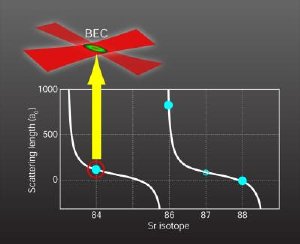
When certain types of atoms are densely packed, then cooled to less than a millionth of a degree above absolute zero, they suddenly drop into a single quantum state called a Bose-Einstein condensate. In effect, the atoms combine to behave as one object rather than a group of individual pieces. This strange phase of matter was first observed in 1995 with atoms that had one electron in their outer shells. Since then researchers have achieved Bose-Einstein condensates with atoms that have two outer shell electrons, but a Bose-Einstein condensate of strontium, one of these atoms, has remained elusive.
Now Simon Stellmer and colleagues at the Universität Innsbruck in Austria and Natali Martinez de Escobar and colleagues at Rice University in Texas have used lasers to trap and cool atoms of the isotope strontium-84 to form a Bose-Einstein condensate. If researchers can extend this achievement to other isotopes of strontium, the new Bose-Einstein condensate could improve ultra-accurate clocks, store information in quantum computers, or help test fundamental constants of nature.