Mar 26 2009
Vadym Mochalin, Senior Researcher, and Yury Gogotsi, Trustee Chair Professor of Materials Science + Engineering at Drexel University, have produced a strongly hydrophobic nanodiamond material that shows bright blue fluorescence, just as macroscopic diamonds do. Their results are published in the Journal of the American Chemical Society (J. Am. Chem. Soc.).
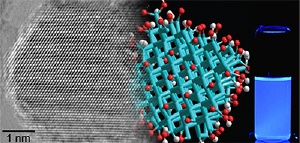
Nanodiamond powder can be produced in large quantities at a relatively low price, in a process that utilizes expired explosives, by detonating them in a closed chamber. This material has many desirable characteristics including a very narrow particle size distribution with an average of 5 nanometers (about 10,000 times smaller than the diameter of a human hair), a large accessible surface, and various surface functional groups. Nanodiamonds can be functionalized to suit a variety of applications including drug delivery, diagnostic imaging, metal/polymer composites, and protective and non-stick coatings.
Usually nanodiamond powder is chemically functionalized so that it can be dispersed in water or hydrophilic solvents, such as alcohols. However, often a hydrophobic material is required because typical polymer processing solvents, as well as many industrial polymers themselves, are hydrophobic.
The recent J. Am. Chem. Soc. paper describes a process by which strongly hydrophobic nanodiamond powder is created via the chemical reaction of carboxylic groups on the surface of purified nanodiamond particles, obtained from NanoBlox, Inc., with amino groups of octadecylamine (ODA). ODA is a well-known agent used to create hydrophobic coatings preventing corrosion of boiler equipment. The resulting nanodiamond powder is completely immiscible with water, alcohols and other hydrophilic solvents; and highly miscible with hydrophobic solvents and liquids such as oils, fuels and polymers. This will allow the use of nanodiamond additives in mineral oils, where they can improve lubrication and decrease engine wear.
Interestingly, the ODA-modified nanodiamond is highly fluorescent. The intensity is so high that a bright blue fluorescence can be easily detected with the bare eye at diamond concentrations as low as 0.004 % by weight. Though the fluorescence mechanism requires further studies, the ODA-functionalized nanodiamond can now be used in many applications where visual detection of nanoparticles is required, such as biomedical imaging and drug delivery systems.
Biologically benign nanodiamonds offer a major advantage over semiconductor quantum dots, which are currently the most widely used nanoparticles for in vitro biomedical imaging, but less in vivo, because of their intrinsic toxicity. The ODA-modified nanodiamond reported by Drs. Mochalin and Gogotsi is well-suited to fill this need.