Thermo Fisher Scientific Inc., the world leader in serving science, today announced that it has completed a custom installation of its TSQ Quantum™ triple quadrupole mass spectrometer in a mobile laboratory operating on a bus. The TSQ Quantum is the only triple quadrupole system that enables Highly Selective Reaction Monitoring (H-SRM) performance, which facilitates the quick and efficient analysis of complex samples. The Ministry of Sustainable Development, Environment and Parks in Quebec, Canada uses the system to perform real-time, mobile analysis of organic and inorganic environmental contaminants in the air, ground and water.
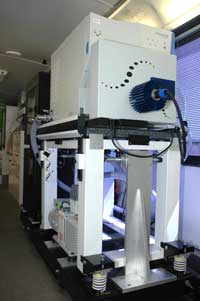 Mass spectrometer installed on a bus
Ministry personnel collaborated with Thermo Fisher and its strategic partner Phytronix Technologies, a Canada-based company, to upgrade an obsolete mobile laboratory system. The TSQ Quantum was chosen because it met the Ministry’s stringent requirements for limits of detection in the order of microgram per cubic meter, even in real time. Phytronix engineered a stabilization table to dampen motion so the TSQ Quantum can analyze samples while the bus is on the road. A dampening table was necessary because the mass spectrometer requires a stable environment during analysis.
The Thermo Scientific TSQ Quantum with ESI source was designed to analyze gaseous samples using the APCI mode. Using Phytronix’s Laser Diode Thermal Desorption technology (LDTD) it will also be possible to analyze any sample from any state (gaseous, liquid or solid). With LDTD the samples are desorbed indirectly by infrared laser diode, and gas phase molecules are introduced into the APCI region where ions are transferred into the TSQ Quantum for analysis.
A Ministry laboratory has used the mobile TSQ Quantum to identify and quantify thousands of gas contaminants in the air (including aldehydes, alcohols, acids and chlorine), as well as to map the distribution of the contamination. The map identifies the source of the contamination (e.g., the chimney or waste site) and the area over which it spreads. By combining these results with details of the wind, such as direction and force, the laboratory could provide a legal proof of source in order to enforce environmental regulations. Ministry personnel selected the Thermo Scientific TSQ Quantum because the instrument had the functionality and flexibility required for collecting this critical environmental data.