Nov 6 2009
genkur / Shutterstock
Gold bonding wire is considered the single most important application of gold in terms of tonnage of gold utilized per annum.
Wire bonding is a technique used to join very fine gold wire (usually thinner than a human hair at 10–200 µm) from one connection pad to another, thus completing the electrical connection in an electronic device. Back in 1957, the process was developed in the Bell Labs in the United States.
Today, literally billions of wires are bonded every year worldwide and most of them are utilized in the integrated circuits (ICs) that are taken for granted in all manners of electronic goods.
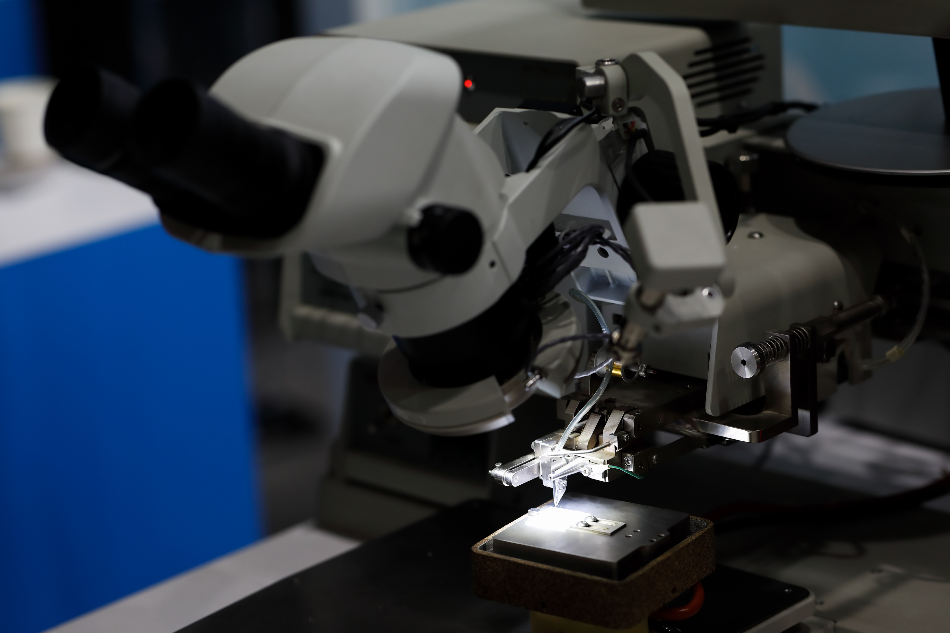
Example of Gold Bonding Wire in an Integrated Circuit
Gold has several benefits, which make it the preferred material for bonding wire. These benefits include high electrical conductivity, good corrosion resistance, and the capability to be bonded in position in an ambient environment. Gold remains the most popular metal for bonding wire and is specially refined to high purity (999.99% gold). Users can refer to the UtiliseGold Directory, for suppliers of the gold bonding wire.
How Gold Bonding Wire is Used?
Basically, there are two forms of wire bonds—ball bonds and wedge bonds. Gold wire can be bonded in the shape of a ball or a wedge, making it highly versatile. The basic process for making a gold wire bond is described below.
A small flame or spark is used to locally melt the ends of the gold wire in order to form a spherical ball that has roughly twice the diameter of the wire.
The spherical ball is thermosonically welded to a metalized pad on the semiconductor.
A wire loop is developed, as the bonding capillary moves across to the contact pad of the circuit board or the device package.
The wire is welded thermosonically to the metalized pad of the device package.
The wire is cut using the sharp edge on the tool, and its length is allowed to protrude to form the subsequent ball.
The continuous quest for cost reduction, smaller components, and increasing system functionality are all competing demands in the electronics sector. To help chip manufacturers and designers to deal with these competing demands, insulated wire bonding technology could be used in the coming days. This involves applying insulation to bare gold bonding wires, thus preventing short circuits, and enabling previously impossible chip designs to be realized.
Insulated Bonding Wire
The new and advanced form of gold bonding wire provides an opportunity to enhance the design and packaging of microchips.