Jun 21 2012
Topics Covered
Introduction
Six Metals Were used by Prehistoric Man
How Were Metals First Discovered?
Native Metals
The Start of Metallurgy?
Introduction
Throughout history and the advancement of civilization, the discovery, development and application of metals has driven the way that people live and societies have been organically shaped. Historians use the intrinsic link of industrial development and the metals discovered and prevalent at that time, to describe certain periods of significant social and technological advancements. Such as, the Stone Age, Bronze Age and Iron Age.
 |
Created from content provided by ASM International in the book "Metallurgy for the Non-Metallurgist, Second Edition
Editor(s): Arthur C. Reardon" |
Since man first discovered copper (Around 9000BC), a naturally occurring, relatively pure metal, native to many countries, the study and knowledge of metallurgy has been fundamental to the way humans have lived. Stemming from a very basic curiousity as to how this new material could be used, and it's behavior in various situations and under a variety of conditions metallurgy has developed from an art to a science.
Our fascination with metals began with Prehistoric man who began using a range of metals.
Six Metals Were used by Prehistoric Man
Prehistoric man is known to have used six metals. These were:
- Gold
- Silver
- Copper
- Tin
- Lead
- Iron.
Each with distinct properties, Prehistoric man discovered that some metals were more useful for certain jobs and they began to specify particular metals for applications. For example; Gold and silver are very soft and were therefore predominantly used for decoration and bullion for trade. Copper offered Prehistoric man more qualities and could be hardened by hammering or forging and was therefore used to make tools - albeit very primitive ones. The discovery of Bronze (an alloy of copper and tin) changed the way that Man lived, hunted, fought and prospered. It was stronger than copper, could be hardened by forging, and could be cast to a specific shape.
Lead is soft, easily worked, and Prehistoric man realised that it was perfect for making into vessels to transport liquids. Later on, Lead would be a fundamental material in the manufacture of pipes such as those used to transport water in the early Roman Empire.
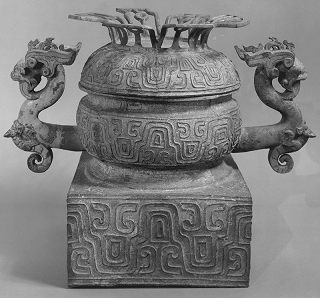
Image 1: A bronze Kuei handled vessel on a rectangular plinth (34.30 × 44.50 cm) cast in China in the 7th century B.C. Courtesy of ©The Cleveland Museum of Art, Leonard C. Hanna, Jr. Fund, 1974.73
Iron was a game changer, it was such an important material, used for all sorts of applications and the phenomenal growth of its use led to the 'Iron Age' a transition from the less developed Bronze Age.
Today, our society is completely reliant on metals, often far removed and much more exotic than the wrought Copper first discovered thousands of years ago. And, the science of metallurgy is now one of the most widely documented and researched materials sciences. So where has our fascination with metals come from to become so dependent on Mettallurgy?
How Were Metals First Discovered?
The first recorded metals used were those found, in an unreacted state referred to as 'Native Metals'. These metals could be mined and used without the need of more complicated extraction or separation from other metals or nonmetallic atoms. Most metals naturally occur as minerals or compounds, where the metal atom has reacted with other metals or nonmetallic atoms, one of the key steps of the development of Metallurgy as a science, revolves around the extraction of metals from their naturally states.
Native Metals
Gold, Silver and Copper are all examples of Native metals that naturally occur in a relatively pure state. Ancient man first found and began using Native Metals approximately 5000 years BC. Over the next 2000 years, leading up to the Bronze age, man mastered how to find, manipulate and use these native metals in better ways and in a range of applications.
Nuggets of gold were often the easiest to find and use. Naturally found mixed with sediment in river beds across the globe, Gold was easy to collect and relatively easy to shape.Silver was the same and to this day, both Gold and Silver are still prized and used as decorative metals for jewelry etc.
The use of Copper is often referred to by historians as a significant precursor to the Bronze Age, and possibly the beginning of Metallurgy as we know it today. Copper, much like Gold and Silver existed in a natural state, with 99.9% pure Ores found around the globe. Table 1 is an approximate chronological and geographical summary of some of the early dominant metals:
Table 1. Approximate chronological and geographical summary of some of the early dominant metals
| Date |
Metal |
Dominant Location |
| 9000 BC |
Earliest references of Wrought Native Copper |
Middle East |
| 5000 - 3000 BC |
Chalcolithic period: melting of copper; experimentation with smelting |
Middle East |
| 2500 BC |
Granulation of gold and silver and their alloys |
Middle East |
| 2000 BC |
Beginning of the Bronze Age |
Far East |
| 1500 BC |
Iron Age (Wrought Iron) |
Middle East |
| 700 - 600 BC |
Etruscan dust granulation |
Italy |
| 600 BC |
Cast Iron |
China |
| 200-300 AD |
Emergence of Mercury for Gilding Metals (Amalgam gilding) |
Roman Empire |
| 1200 - 1450 AD |
Introduction of Cast Iron - Start of the Iron Age |
Europe |
| 1600's AD |
Sand introduced as casting / mold material |
France |
| 1709 AD |
Cast iron produced with coke as fuel, Coalbrookdale |
England |
| 1740 AD |
Cast steel developed by Benjamin Huntsman |
England |
| 1779 AD |
First architectural use of Cast Iron |
England |
| 1838 |
Electroplating of Copper |
England / Russia |
| 1884 |
Electrolytic refining of Aluminium |
US, France |
The Start of Metallurgy?
Unbeknown to the early users of wrought (naturally occurring) copper who noticed that when they hammered this metal it got significantly harder and stronger, these were the first steps towards a Nanotechnology that dominates modern metallurgy.
By Inadvertently controlling the number and configuration of the nanocrystalline elements of the structure of copper, its hardened properties made it more useful for things like tools, knives etc. The discovery that copper could also be obtained by heating Blue Stones or minerals (primarily copper sulfide ores) occurred between 4000 - 3000 BC. The extraction of Copper from Copper Sulfide Ores provided Man with another, more abundant source of copper. Hence, Metallurgy was born.
This Article was created from Material provided by ASM International in the book "Metallurgy for the Non-Metallurgist, Second Edition" Edited by A.C. Reardon.
For More information please contact ASM International
Disclaimer: The views expressed here are those of the interviewee and do not necessarily represent the views of AZoM.com Limited (T/A) AZoNetwork, the owner and operator of this website. This disclaimer forms part of the Terms and Conditions of use of this website.