Reviewed by Lexie CornerUpdated on Feb 19 2025Revised
Aluminum is a lightweight, silvery metal with an atomic number of 13 and a low density of 2.7 g/cm3. Highly conductive and resistant to corrosion, it is one of the most widely used metals in industry.1 But what gives aluminum its unique properties? This article explores its structure, advantages, and how it compares to other metals.
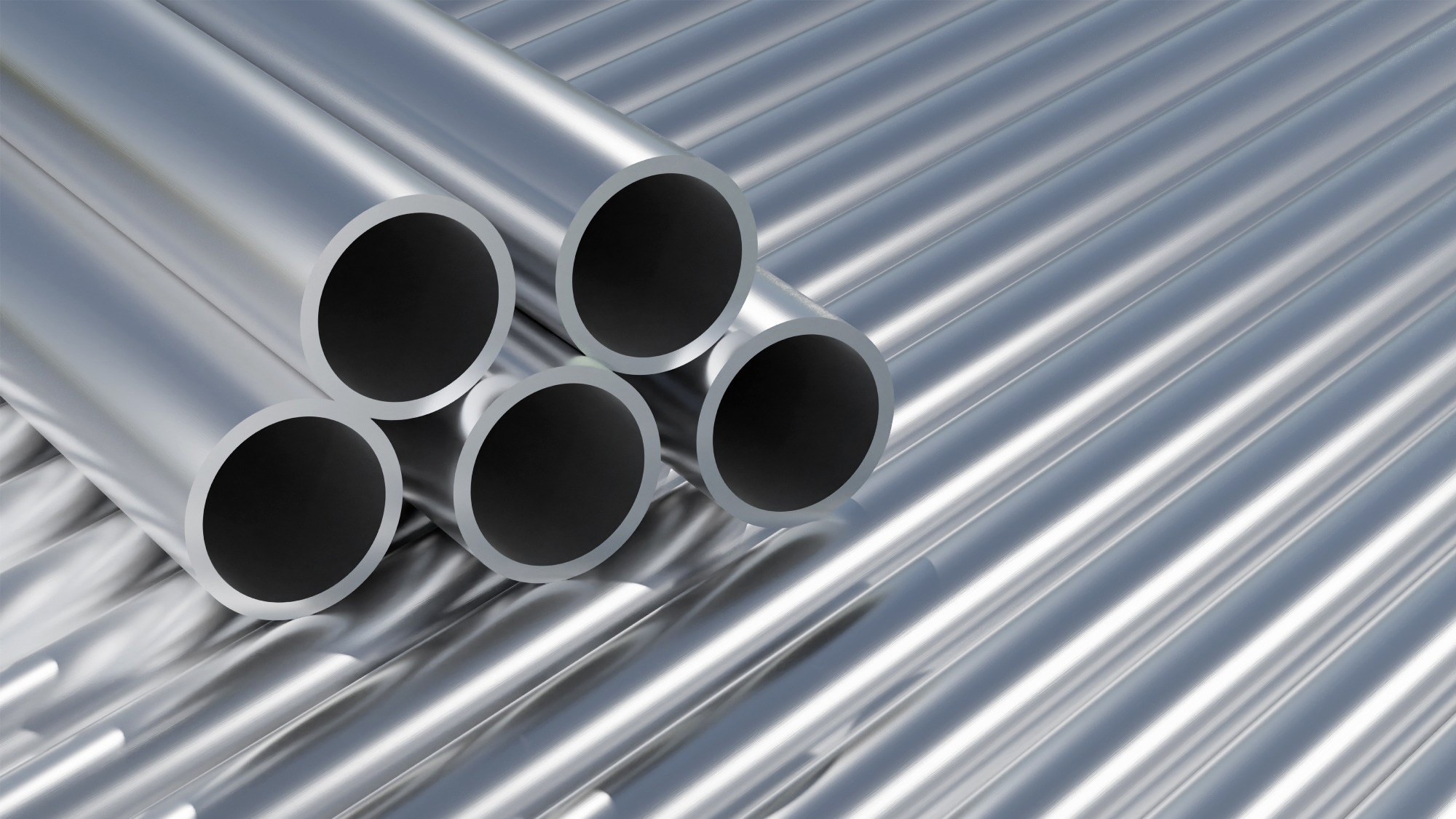
Image Credit: tomeqs/Shutterstock.com
Physical Properties of Aluminum
Density of Aluminum
Aluminum has a density of 2.7 g/cm³, approximately one-third that of steel. Its low density makes it ideal for aerospace and automotive applications, where reducing weight improves fuel efficiency and increases payload capacity.
What Is the Melting Point of Aluminum?
Pure aluminum melts at approximately 660.3 °C (1220.5 °F), which is relatively low compared to other metals. This property makes it well-suited for casting and various manufacturing processes.
Conductivity: Electrical and Thermal Properties
Aluminum is a good conductor of electricity, with a conductivity of approximately 62 % that of copper by equal cross-sectional area. This efficiency is due to its atomic structure, which allows for smooth electron flow. When compared by equal weight, aluminum's conductivity is 204 % that of copper.
Its thermal conductivity is also high (237 W/m·K), facilitating efficient heat transfer. This property is used in heat exchangers, electronic heat sinks, and cookware, where rapid and uniform heat distribution is essential for performance and temperature regulation.
What Is the Reflective Index of Aluminum?
Aluminum has a reflectivity of up to 92 % for visible light and up to 98 % for infrared radiation. This high reflectance makes it valuable in optical coatings, solar reflectors, and energy-efficient building materials. In construction, it helps reduce heat absorption, lowering cooling demands and improving energy efficiency.
Corrosion Resistance: Can Aluminum Rust?
Unlike iron, aluminum does not rust but instead forms a thin, protective layer of aluminum oxide (Al2O3), which provides excellent corrosion resistance. This oxide layer, typically 2–3 nm thick, regenerates rapidly if damaged, protecting the metal from environmental exposure, including saltwater and industrial pollutants.
Corrosion resistance can be further enhanced through treatments such as anodizing, painting, or lacquering. Anodizing, for instance, can increase the oxide layer thickness to 5–25 µm, offering additional durability in harsh environments.
Is Aluminum Magnetic?
Aluminum is paramagnetic, meaning it is non-magnetic, with a magnetic susceptibility of 16.5 x 10⁻⁶ at 20 °C. While it exhibits weak attraction to strong magnetic fields, it does not retain permanent magnetism.
This property is critical in applications where magnetic interference must be minimized, such as in MRI machines, electrical shielding, and aerospace instrumentation. Its non-magnetic nature helps prevent electromagnetic interference and ensures stability in environments where precision is essential.
Mechanical Properties of Aluminum
How Strong is Aluminum?
The term "strength" encompasses several specific properties, including tensile strength (resistance to pulling forces), yield strength (the point at which permanent deformation occurs), and compressive strength (resistance to crushing forces). Pure aluminum is relatively soft and has a low tensile strength of about 90 MPa.
However, alloying with elements such as magnesium, copper, silicon, manganese, and zinc significantly enhances its strength and hardness. For example, 7075-T6 aluminum alloy, which contains zinc and magnesium, has a tensile strength of 572 MPa, making it suitable for aerospace and structural applications. Similarly, 2024-T6 aluminum, commonly used in aerospace components, has a tensile strength of 442 MPa.
Hardness, Ductility, and Malleability
Hardness refers to a material's resistance to indentation or scratching. Pure aluminum has a relatively low hardness, but alloying and heat treatment can increase it.
Ductility refers to the ability of a material to be drawn into wires or elongated without fracturing, while malleability refers to the ability to be hammered or rolled into thin sheets. Aluminum is known for its good ductility and malleability, making it easily worked and formed using various processes, including extrusion, rolling, and forging.
Fatigue and Impact Resistance
Fatigue resistance describes a material's ability to withstand repeated stress cycles without failure. Aluminum alloys generally exhibit good fatigue resistance, but this can be further improved through specific heat treatments and surface treatments. These treatments induce compressive stresses on the surface of the material, making it more resistant to crack initiation and propagation under cyclic loading.
In terms of impact resistance, aluminum alloys can be designed to absorb significant energy upon impact, making them suitable for applications where energy absorption is critical, such as in automotive crash structures.
10 Differences Between Aluminum and Stainless Steel
Sustainability and Aluminum Recycling
Is Aluminum Recyclable?
Aluminum is 100 % recyclable without any loss of quality, meaning recycled aluminum retains the same properties as primary aluminum produced from bauxite ore. The recycling process involves melting aluminum scrap and reforming it into new products, significantly reducing the need for raw material extraction.
Recycling aluminum requires only 5 % of the energy needed to produce primary aluminum, leading to lower greenhouse gas emissions and a reduced environmental footprint. It also conserves natural resources by decreasing the demand for bauxite mining and refining.
The aluminum recycling process is well-established and efficient. Scrap aluminum is collected from various sources, sorted, cleaned, and then melted down in furnaces. The molten aluminum is then cast into various shapes, such as ingots, billets, or slabs, which can be used to manufacture new products.
The aluminum recycling process is well-established and efficient. Scrap aluminum is collected, sorted, cleaned, and melted in furnaces before being cast into new shapes such as ingots, billets, or slabs for manufacturing. Recent advancements in recycling aircraft-grade aluminum alloys have demonstrated that scrap 7075 aluminum can be efficiently processed into high-quality ingots through melting, composition adjustment, refining, and casting. The recycled material meets stringent industry standards, exhibiting excellent tensile strength and corrosion resistance after extrusion and heat treatment.
This sustainable approach maximizes aluminum recovery while reducing waste and environmental impact, reinforcing its role as a key material in sustainable manufacturing.
For more information on recycling and sustainability, explore the following resources:
Reference and Further Reading
Sverdlin, A. (2018). Properties of pure aluminum. Encyclopedia of Aluminum and Its Alloys, Two-Volume Set. CRC Press. eBook ISBN9781351045636: https://www.taylorfrancis.com/chapters/edit/10.1201/9781351045636-140000430/properties-pure-aluminum-alexey-sverdlin
UACJ. (n.d.) Aluminum's Characteristics. [Online] UACJ. Available at: https://www.uacj.co.jp/english/techno/development/feature.htm (Accessed on July 16, 2024)
Stojanovic, B., Bukvic, М., Epler, I. (2018). Application of aluminum and aluminum alloys in engineering. Applied Engineering Letters: Journal of Engineering and Applied Sciences. doi.org/10.18485/aeletters.2018.3.2.2
AALCO (2019). Introduction to Aluminium and its alloys. [Online] AALCO. Available at: https://www.aalco.co.uk/datasheets/Aluminium-Alloy_Introduction-to-Aluminium-and-its-alloys_9.ashx (Accessed on July 16, 2024)
Berlanga-Labari, C., Biezma-Moraleda, MV., Rivero, PJ. (2020). Corrosion of cast aluminum alloys: a review. Metals. doi.org/10.3390/met10101384
Wilson Power Solutions. (n.d.). Aluminium v Copper. [Online] Wilson Power Solutions. Available at: https://www.wilsonpowersolutions.co.uk/copper-vs-aluminium/#:~:text=Although%20the%20conductivity%20of%20copper,eddy%20losses%20in%20the%20windings. (Accessed on July 16, 2024)
Bayomy, AM., Saghir, Z. (2020). Thermal performance of finned aluminum heat sink filled with ERG aluminum foam: Experimental and numerical approach. International Journal of Energy Research. doi.org/10.1002/er.5217
Kolås, T., Røyset, A., Grandcolas, M., ten Cate, M., Lacau, A. (2019). Cool coatings with high near infrared transmittance for coil coated aluminium. Solar Energy Materials and Solar Cells. doi.org/10.1016/j.solmat.2019.03.021
Lin, R., Liu, B., Zhang, J., Zhang, S. (2022). Microstructure evolution and properties of 7075 aluminum alloy recycled from scrap aircraft aluminum alloys. Journal of Materials Research and Technology. doi.org/10.1016/j.jmrt.2022.05.011