| Currently the uses for auxetics are limited, and in those applications they are probably not knowingly used for the auxetic effect itself. Examples include pyrolytic graphite for thermal protection in aerospace applications, large single crystals of Ni3Al in vanes for aircraft gas turbine engines, and an expanded form of PTFE used to make Goretex. However, the development of new auxetic materials and processing routes in recent years has been accompanied by a number of patent applications and publications from organisations including Toyota, Yamaha, Mitsubishi, AlliedSignal Inc, BNFL and the US Office of Naval Research, all relating to the emerging potential of these materials. Biomedical Industry Key areas of application are seen in the biomedical field. Prosthetic materials, surgical implants, suture/muscle/ligament anchors and a dilator to open up blood vessels during heart surgery are all possible. Another area relates to the use of auxetic materials in piezoelectric sensors and actuators. Auxetic metals could be used as electrodes sandwiching a piezoelectric polymer, or piezoelectric ceramic rods could be embedded within an auxetic polymer matrix. These are expected to increase piezoelectric device sensitivity by at least a factor of two, and possibly by ten or a hundred times. The development of auxetic materials for micro- and nano-mechanical and electromechanical devices is also being investigated. Filters Auxetic foam and honeycomb filters offer enhanced potential for cleaning fouled filters, for tuning the filter effective pore size and shape, and for compensating for the effects of pressure build-up due to fouling. These benefits rely on the pores opening up both along and transverse to the direction of a tensile load applied to an auxetic filter. The pores of a non-auxetic filter open up in the stretching direction but close up in the lateral direction, leading to poorer filter performance, figure 1. However, stretching an auxetic filter improves performance by opening pores in both directions. The effect of stretching on the de-fouling of an auxetic polymeric honeycomb fouled with glass beads has been investigated. For the particular honeycomb studied the value of ν is dependent on the stretching direction. The studies clearly demonstrate that defouling is enhanced when the filter is loaded in the direction with the largest negative ν. | 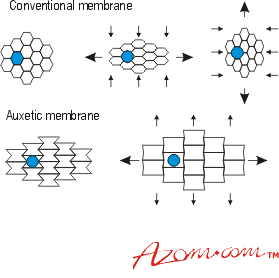
| | Figure 1. Schematic of particulate de-fouling capabilities of non-auxetic and auxetic materials | Auxetic Fibres The breakthrough development of a continuous process to produce auxetic materials in fibrous form has created the opportunity to apply their unique characteristics in a wide range of applications previously not possible. Fibres can be used in single or multiple filament structures and can be used to produce a woven structure. Typical performance characteristics expected of auxetic fibres and structures are detailed in the table of applications, (table 1), together with a list of the applications in which these characteristics could offer significant benefits. For example, by analogy with the filter de-fouling scenario of figure 4, biomedical fibrous drug-release materials could be made from auxetic fibres. Extending the fibres opens the micropores and a specific dose of drug is released. Advanced auxetic fibres will include multi-filament yarns in which an auxetic filament is wrapped with one or more other yarns, perhaps high stiffness/strength, dyeable or conductive filaments, so that the benefits of the auxetic material are combined with other beneficial properties for smart technical textiles applications. This will lead to the possibility of hierarchical composites displaying auxetic behaviour at more than one lengthscale. Current research on auxetic composites is concentrated on the use of non-auxetic constituents and so benefits due to the auxetic effect occur at a macrostructural level. Employing auxetic fibres as the reinforcement will enable benefits, such as impact energy and acoustic energy absorption, to be achieved at the microstructural level. Table 1 (Part A). Application-performance characteristic matrix for auxetic fibres and auxetic fibre based structures. | | | Composite Materials
Auxetic fibre reinforcement in composites | X | X | X | X | X | | Personal Protection Clothing
Crash helmets, body armour, sports clothing | | | X | X | X | | Fitration
Woven structures using auxetic fibres | | | | | | | Mechanical Lungs
Microporous hollow auxetic structures | | | | | | | Ropes, Cords & Fishnets
High strength, lower weight | | X | | | | | Upholstery Fabrics
Enhanced abrasion properties & entrapment of fire retardant components | | | X | X | | | Biomedical
Controlled release of drugs | | | | | | | | | | | | | | Fibrous Seals | | | X | X | X | Table 1 (Part B). Application-performance characteristic matrix for auxetic fibres and auxetic fibre based structures. | | | Composite Materials
Auxetic fibre reinforcement in composites | | | | | | Personal Protection Clothing
Crash helmets, body armour, sports clothing | | | X | X | | Fitration
Woven structures using auxetic fibres | X | | X | X | | Mechanical Lungs
Microporous hollow auxetic structures | X | | X | | | Ropes, Cords & Fishnets
High strength, lower weight | | X | | | | Upholstery Fabrics
Enhanced abrasion properties & entrapment of fire retardant components | X | X | | | | Biomedical
Controlled release of drugs | X | | X | | | | X | | X | X | Fibrous Seals | | X | | X | Auxetic Fibre Reinforced Composites Auxetic fibre reinforcements should also enhance the failure properties of composites. Fibre pull-out is a major failure mechanism in composites. A unidirectional composite loaded in tension will undergo lateral contraction of both the matrix and fibre materials, leading to failure at the fibre/matrix interface. Auxetic fibres, on the other hand, allow the possibility of maintaining the interface by careful matching of the Poisson's ratios of the matrix and fibre, figure 2. | 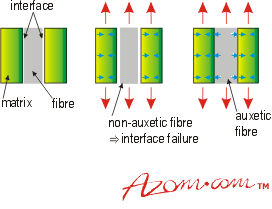
| | Figure 2. Fibre pull-out in composites | The Future So what does the future hold for auxetics? Despite the very significant developments to date we have only scratched the surface of this exciting and multi-disciplinary field. The successful synthesis and development of molecular and multi-functional auxetics represent key opportunities for the future. In addition to leading to materials with extreme properties such as high modulus and strength, these advanced materials will have potential in sensor, drug-release and separations applications. By accepting a negative Poisson's ratio as a positive property we are truly expanding the applications of these fascinating materials |