AZoM - The A to Z of Materials


Micromeritics is an Industry Leader in Particle Science and Particle Technology
CILAS state of the art laser particle size analyzers
Vesuvius - Solutions for molten metal, glass and renewable energy industries
University of Surrey-Short Courses and MSc in Materials science
World leader in design and manufacture of high-performance CCD, ICCD, sCMOS, EMCCD for scientific imaging, microscopy and spectroscopy applications
Materials testing services for aerospace to automotives, pharmaceuticals to polymers
Bruker Handheld XRF Spectrometers
X-Ray diffractometers from Shimadzu
NanoTest™, the complete nanomechanical testing center
Polyurethanes – An Introduction

Polyurethanes – An Introduction

Topics Covered

Background

What are PU’s?

What Forms can PU’s take?

Why Use PU’s

Advantages of PU’s

Disadvantages of PU’s

Background

Polyurethanes, often known as PUs, are a very large and varied family of incredibly versatile and useful engineering materials.

What are PU’s?

Well they mean different things to different people:

·         To a chemist they are polymers which contain urethane groups (-NH-CO-O-) produced by the reaction of a polyol with an isocyanate, of which will be expanded upon later in this article.

·         To an engineer they are materials which offer a combination of unique properties which allow products to meet a range of demanding applications.

·         To an accountant they are materials which are very cost effective both to process and in use.

A PU may be either thermosetting or thermoplastic. These different characteristics, and their extraordinary physical properties, are explained by the different chemical structures which can exist in PUs.

What Forms can PU’s take?

PUs can be processed into elastomers, coatings, adhesives, binders, sealants and foams for a host of applications in, amongst others, the shoe, clothing, furniture, domestic appliance, building, marine, electrical engineering and transport industries. Indeed PUs can be formulated for a bewildering array of applications for an increasing number of industries.

PUs are perhaps the most versatile polymeric materials. Whilst their major use is still in foams; utilising their strength, insulation, resilience and comfort properties, PUs also fulfil the need when a component needs to exhibit both the strength of plastics and the flexibility of rubbers. They are employed in a diverse range of industries such as furniture, transport, construction, appliances and footwear to name just a few.

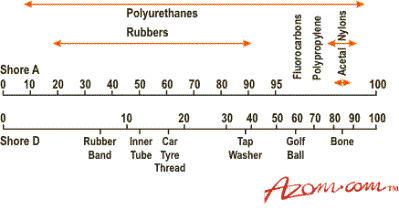
Since their discovery over 60 years ago PU chemistry has been developed and adapted to make the diverse range of products available today. The versatility of PUs means that they can be formulated into a very hard solid or a soft elastomer, or something in between, which allows the material to be custom tailored to its' end use. Figure I shows the hardness spread, i.e. from 10 Shore A (softer than an eraser) to 95 Shore D (harder than a golf ball or bone). The Shore A equates, for all practical purposes to IHRD (International Rubber Hardness Degrees), see Figure 1.

Figure 1. Hardness spread of polyurethanes.

Uniquely PUs can be tailored, by both chemistry and processing, to yield products in a wide variety of forms and which allow the processor to control the nature and the properties of the end product. For example thermoplastic polyurethanes (TPUs) are formulated for use in applications ranging through hose and cable sheathing, films and sheet, catheters, gears, bushes and bearings and such specialised areas as mining cables and optical fibres.

Why use PU’s?

PUs are used because they combine unique engineering properties with cost effectiveness.

Although PUs may initially be more expensive than other polymers, a part manufactured from PU could last two, four or even ten times longer than a part made from another material.

A further area of cost effectiveness is tooling, since moulds for PUs can be made from almost anything which does not retain moisture and can tolerate the modest heat and pressure of the moulding operation. Tool materials employed include the relatively inexpensive epoxies, glass reinforced plastics (GRP) and aluminium.

Advantages of PU’s

·         All PUs share high abrasion resistance, toughness, high impact and tear resistance, and high load bearing ability.

·         The exceptional thermal insulation and structural properties of PU rigid foams offer particular advantages for domestic appliances, homes and other buildings.

·         The strength and wear resistant properties of PU flexible foams have resulted in their dominance of the upholstery and mattress markets.

·         The outstanding properties of PU adhesives have resulted in widespread use for rigorous engineering applications, particularly in the automotive sector where high strength/weight ratios and reliability are important.

·         PUs can form tough, hard, chemical resistant coatings which have a high degree of environmental resistance to oxygen and ozone attack.

·         PU elastomers can be formulated to far outwear any other rubber or elastomer. Generally PU elastomers will retain constant properties over a wider temperature range than other elastomers.

·         The Thermoplastic Polyurethanes (TPUs) offer excellent tensile strength and elongation characteristics. TPUs are also known for their excellent abrasion resistance, high resilience, good tear resistance, flexibility at low temperatures and low compression.

Disadvantages of PU’s

PUs do have their disadvantages.

·         The polyester types are susceptible to hydrolytic attack above ambient temperatures. The susceptibility to hydrolysis is even more apparent in both acid and alkaline solutions and may ultimately result in disintegration. Solvent resistance is mixed, poor in polar organic solvents, but very good with aliphatic hydrocarbons, fuels and oils.

·         Some TPUs have a limited hardness range and have been known to stress crack in cable jacketing applications when in contact with water at ambient temperatures.


Date Added: Mar 26, 2001


Email / Share
 
 
Malvern Morphologi G3 particle characterization system
Approved Professional Development Courses from Loughborough University
Powerful MAC OS compatible scanning probe microscope SPM
Microtrac Particle Size Distribution & Characterization Analyzers
Bodycote Heat Treatments - Electron Beam Welding Services
The New D8 ADVANCE – the 1st truly all-purpose Diffraction Solution for X-ray Powder Diffraction
ADMET universal materials testing machines


version 2.0 - AZoM™ - The A to Z of Materials and AZojomo - The "AZo Journal of Materials Online"...AZoM™.com Pty.Ltd Copyright © 2000-2010