Jul 29 2001
vchal / Shutterstock
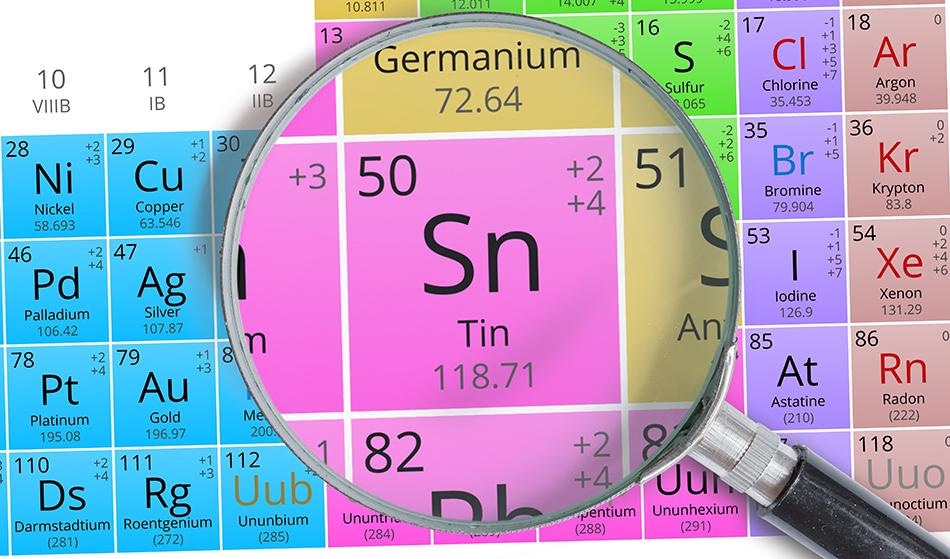
Tin (Sn) is mostly found in cassiterite (SnO2) and has been known since ancient times. It is obtained by reducing the ore with coal in a reverberatory furnace.
Tin is a silvery-white lustrous metal, with a bluish tinge. It is ductile and malleable to some extent, and has a highly crystalline structure. Tin’s electrical conductivity is about one-seventh that of silver and its hardness is slightly higher than lead.
Tin is resistant to atmospheric corrosion and has a high polished surface. It is impervious to sea, distilled, and soft tap water, but easily attacked by strong salts, strong acids, and alkalis. The presence of oxygen inside the solution expedites the attack.
Grey tin, or α tin (having a cubic crystal structure) and β tin (having a tetragonal crystal structure) are two allotropic forms of tin. At 13.2 °C, grey-tin changes into white. β-tin is considered as the usual form of the metal. The conversion from α to β is known as “tin pest.”
Ordinary tin is made up of 9 stable isotopes, while 18 unstable isotopes are known.
Applications
Metallic tin is used in the following applications:
- Pewter
- Soft solders
- Babbitt metal and Bell metal
- Bronze
- Corrosion-resistant coatings
- Electroplating
- For producing molten flat glass, in which a bath of molten tin (float glass) is implemented to create a flat surface (called the Pilkington process)
- Super conductive magnets retain the superconductivity even at very low temperatures
- Food containers and so on
Tin compounds are used in the following:
- The chloride salt (SnCl2.H
2O) is used as a mordant in calico printing, and is an extremely significant reducing agent.
- Stannic oxide (SnO2) is a white powder used in ceramic glazes for color and as an opacifier.
- Sodium stannate (Na2SnO3.3H2O) or potassium stannate (K2SnO3.3H2O) is used for immersing tinned aluminum.
- Organotin (refer to the metal’s butyl compounds) is used as a catalyst. It is also used as light and heat stabilizers in vinyl polymers, for example, Stan-Guard 100 (a liquid butyl-tin) containing sulfur is utilized as a stabilizer in rigid PVC sheet; butyl-tin maleate serves as an effective light stabilizer.
- HollicideLT-125 is a water-soluble organo-trialkyl-tin used as bactericide in textile processing and paper.