 By Taha KhanReviewed by Lexie CornerUpdated on Jul 29 2024
Bronze, a copper-tin alloy, is renowned for its durability, strength, and versatility. Also known as phosphor bronze, it includes phosphorus as a deoxidizing agent and contains 11 % zinc and up to 0.35 % phosphorus.
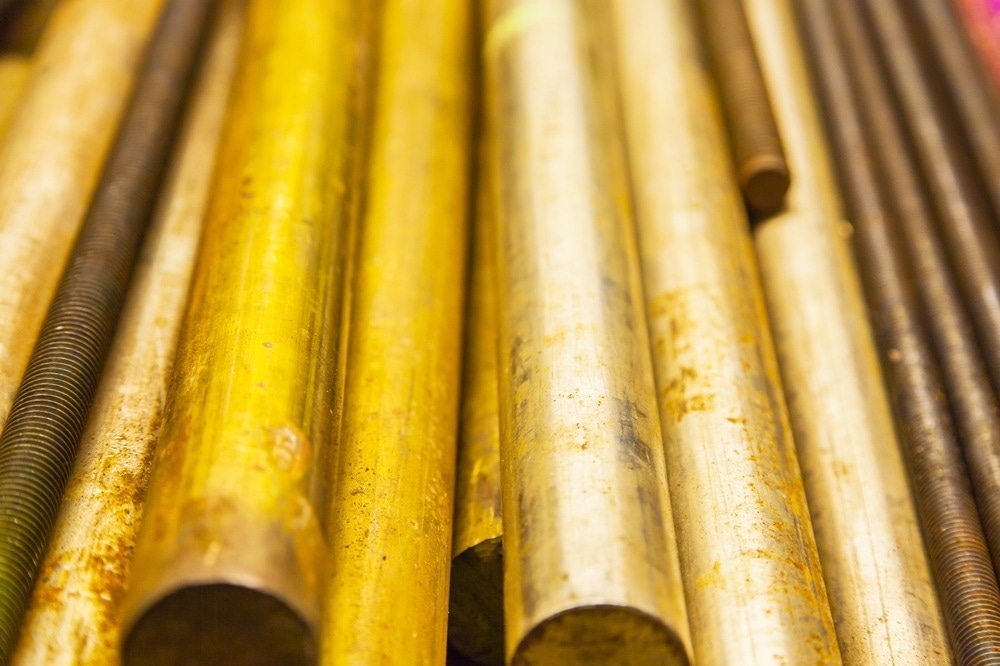
Image Credit: ZHMURCHAK/Shutterstock.com
Historically, the combination of copper and tin produced an alloy superior to pure copper in hardness and strength, allowing the creation of superior tools, weapons, and artistic masterpieces.1 Today, bronze alloys are essential in diverse engineering applications.
This article discusses the key properties of bronze alloys and their diverse applications.
Key Properties of Bronzes
Bronze alloys are known for their combination of physical and mechanical properties. The addition of tin significantly increases the material's yield and tensile strength, making it resistant to deformation and fracture. This makes bronze ideal for applications requiring strong and durable components, such as gears and tools.
Bronze alloys exhibit good ductility, allowing them to be shaped and drawn into various forms without breaking or cracking, facilitating manufacturing processes such as casting, forging, and machining.1, 2
They also resist corrosion, particularly in saltwater or freshwater environments, due to the protective oxide layer formed by the addition of tin and phosphorus. This property makes them a preferred choice for marine hardware and ship propellers.2, 3
In applications like bearings, where long-term durability is required, bronze alloys are preferred for their fatigue resistance and low friction. They can withstand repeated stress and strain without fatigue failure, making them ideal for applications experiencing cyclical loading. Additionally, their low coefficient of friction minimizes friction against other surfaces, reducing wear and tear on moving parts.1, 4
Applications of Bronzes
Bronze alloys are used in numerous mechanical parts of machines, including gears, clutch plates, bushings, bearings, springs, diaphragms, bellows, pumps, pressure vessels, and condensers. A few of these applications are discussed here in detail.
Self-Lubricating Bearings
Traditional bronze bearings often incorporate 6 to 8 % lead to enhance their self-lubricating properties. The casting process is carefully controlled to ensure even distribution of the lead particles throughout the casting, as lead is insoluble in bronze. The amounts of lead and tin in the alloy depend on the required strength and lubricity for the application.1
Another type of self-lubricating bronze has a porous microstructure that can be soaked with lubricants, offering excellent wear resistance and self-lubrication capabilities. This makes them ideal for applications demanding high performance and minimal maintenance.1, 4
Porous bronze is generally made via powder metallurgy, which involves mixing and pressing copper and tin powders together, followed by sintering. The resulting porous bronze is not as strong as cast bronze, but the pores can be impregnated with oil after sintering or with graphite before pressing to produce a self-lubricating material.
Pumps, Valves, and Fittings
One type of bronze alloy used in marine applications is phosphor bronze, which contains a small amount of phosphorus that provides wear and corrosion resistance.
These properties make it suitable for pump components, valve bodies, and fittings, particularly in harsh marine environments. Similarly, for high-pressure applications like valves and pump components, gunmetals are a preferred choice due to their high tin and zinc content, providing strength and wear resistance.1, 5
Electrical Contacts and Springs
Certain bronze alloys, like work-hardened phosphor bronzes, possess good spring properties that allow them to maintain constant pressure and ensure reliable electrical control for applications like switches and connectors. 6
Recent Innovations
Microstructure Refinement in Nickel Aluminium Bronze Alloy
In a 2023 study, researchers explored enhancing the microstructure and mechanical properties of Nickel Aluminium Bronze (NAB) alloy by adding tin (Sn). They found that incorporating various amounts of tin transformed the microstructure from columnar to equiaxed grain structures, achieving optimal results at a 1.0 wt % tin concentration. This modification significantly improved the alloy's mechanical properties, increasing hardness by up to 69 % and tensile strength by up to 28.4 %.7
The study also highlighted that adding tin altered the solidification parameters and facilitated the formation of high-temperature α and Sn-rich phases, contributing to improved properties. These findings suggest that tin addition can effectively refine the microstructure and enhance the performance of NAB alloys.7
Enhanced Medium-Entropy Bronze Alloys Performance
In another 2024 study, researchers used an induction melting technique to develop novel (CuMnNi)100-xSnx medium-entropy bronze (MEB) alloys. These alloys, containing varying amounts of tin (0, 5, 10, 15, and 20 wt%), displayed significant improvements in mechanical properties and wear resistance.
The addition of tin facilitated the formation of a body-centered cubic (BCC) phase, transitioning the microstructure from a single FCC phase to a duplex FCC-BCC structure.8
This microstructural evolution, along with solid solution strengthening from tin, led to enhanced hardness, yield strength, and compressive strength. Moreover, the wear resistance of the MEB alloys increased substantially, outperforming conventional aluminum bronze C6161 when tin content exceeded 5 wt%.8
Future Prospects
Although bronze alloys have wide applications across various industries, some challenges still require researchers' attention. For instance, self-lubricating bronze that includes lead can be harmful to the environment due to the toxic nature of lead.
However, researchers are already focusing on lead-free, self-lubricating bronze-bearing alternatives, and further advancements in this area are expected to minimize environmental impact in the near future.
More from AZoM: Aluminum: Advantages and Properties of Aluminum
References and Further Reading
- Bronze, OO. (2023). Bronze Properties. Introduction to Composite Materials. Chapter-8. Available at: https://www.booksarcade.co.in/wp-content/uploads/2023/04/Introduction-to-Composite-Materials.pdf#page=28
- Team Xometry. (2024). Bronze: Definition, Composition, Properties, and Applications. [Online] Xometry. Available at: https://www.xometry.com/resources/materials/bronze-metal/ (Accessed on July 16, 2024)
- Sankar, J., Kumar, SS., Balamurugan, P., Kumar, S., Saleem, SA., Krishna, SV. (2022). Fabrication and corrosion studies of bronze based composite prepared through powder metallurgy route. Materials Today: Proceedings. doi.org/10.1016/j.matpr.2021.07.461
- Marinković, A., Stojanović, B., Gachot, C., Lazović, T. (2024). Analysis of Lubrication Regimes for Porous Sliding Bearing. Lubricants. doi.org/10.3390/lubricants12060184
- Surbled, A., Larché, N., Thierry, D. (2024). Materials selection. In Corrosion Management of Seawater Cooling Systems (pp. 67-128). Woodhead Publishing. https://doi.org/10.1016/B978-0-443-15235-1.00007-X
- Kuwabara, T., Kumano, Y., Ziegelheim, J., & Kurosaki, I. (2009). Tension–compression asymmetry of phosphor bronze for electronic parts and its effect on bending behavior. International Journal of Plasticity. https://doi.org/10.1016/j.ijplas.2009.01.004
- Poojary, S., Marakini, V., Rao, R. N., & Vijayan, V. (2023). Enhancing microstructure and mechanical properties of nickel aluminium bronze alloy through tin addition. Scientific Reports. https://doi.org/10.1038/s41598-023-44146-y
- Bai, W., Li, Y., Zhang, A., Xin, B., Han, J., & Meng, J. (2024). A novel (CuMnNi) 100-xSnx medium entropy bronze alloys with excellent mechanical properties and wear resistance. Journal of Alloys and Compounds. https://doi.org/10.1016/j.jallcom.2024.174471
Disclaimer: The views expressed here are those of the author expressed in their private capacity and do not necessarily represent the views of AZoM.com Limited T/A AZoNetwork the owner and operator of this website. This disclaimer forms part of the Terms and conditions of use of this website.