Feb 29 2008
For the first time, researchers at North Carolina State University have demonstrated that microscopic "two-faced" spheres whose halves are physically or chemically different – so-called Janus particles – will move like stealthy submarines when an alternating electrical field is applied to liquid surrounding the particles.
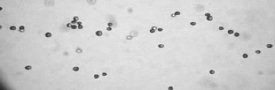 North Carolina State University research shows microscopic "two-faced" particles moving perpendicular to the direction of an electrical field, not in the direction of the field, as would be expected.
A paper describing the research, published in the Feb. 8, 2008, edition of Physical Review Letters, advances knowledge about how potential "smart" materials – think of tiny engines or sensors – can move around and respond to changes in their environment. Janus particles could be used as microscopic mixers, molecular "shuttles," self-propelling microsensors or means of targeted drug delivery.
The researchers – Dr. Orlin Velev, associate professor of chemical and biomolecular engineering at NC State and lead author of the paper; Sumit Gangwal, an NC State graduate student; Dr. Olivier Cayre, a post-doctoral researcher in Velev's lab; and Dr. Martin Bazant from Massachusetts Institute of Technology – created tiny two-faced gold and plastic particles and applied low frequency alternating current to the water containing the particles. The electric field was of voltage and frequency similar to the ones you'd get if you plugged a device into a socket in your home or office.
Velev says the micrometer-sized particles convert the electrical field into liquid motion around them and then unexpectedly propel themselves perpendicular to the direction of the powered electrodes – not in the direction of the electrical field, as would be expected. The particles always travel in the same orientation: with the plastic "face" as the front of the mini-submarine and the metallic "face" in the rear, Velev added.
The phenomenon – called "induced-charge electrophoresis," which had been predicted in a theoretical model by the MIT collaborator – had not been demonstrated previously.
The term "Janus particle" comes from the name of a Roman god with two faces. Velev says that these materials have the potential to perform a variety of applications.
"You can imagine other types of Janus particles comprising a 'smart gel' that responds to a change in its environment and then releases drugs, for example," Velev says. Fabricating these responsive materials on the microscale and nanoscale is an exciting and rapidly developing area of science, he adds.
"We are able to create tiny Janus particles of the same size and shape and are beginning to learn how to give them functionality," Velev said. "The next step is to create more complex particles that are able to perform more specialized functions in addition to propelling themselves around."