The quickening pace of business caused one of Europe's leading independent testing laboratories to seek an alternative to the standard solvent extraction/acid hydrolysis (Soxhlet) method for testing the amount of fat in a variety of foods. This contract laboratory, with numerous sites throughout the UK and Ireland, provides quality control analytical services to the food industry. By converting from the wet chemistry method to an MQC benchtop Nuclear Magnetic Resonance (NMR) analyzer for measuring fat content of foods, the lab reaped significant economic and environmental benefits. The box on the right is a brief overview of NMR's advantages over other secondary methods.
Advantages of Using NMR to Test Fat Content in Foods
Key features of NMR include:
- Can be calibrated to cover a concentration range from 0.5 to 100 percent fat
- Primary calibration can be produced using a single fat sample
- Requires infrequent recalibration
- Sample measurement time is short
- Minimal sample preparation necessary
- No solvents are required
- Excellent for bulk measurements
- Insensitive to sample granularity and
- product additives
- Non-destructive, facilitating repeatability measurements
Standard Wet Chemistry Methods Result in Bottlenecks
Customers send foodstuff samples to this contract quality control laboratory, which has a specialty in fast turnaround service. A typical request includes five or six measurements, including fat (oil) content. The Soxhlet method used for the oil measurement is slow, with measurements taking as long as 6 hours. This situation led to serious bottlenecks that were reducing throughput and affecting the lab's ability to deliver its promised rapid analysis service. The process is also rather cumbersome, can be inaccurate, and requires highly skilled personnel. In addition, many of the hazardous chemicals used are becoming increasingly unacceptable according to international environmental standards.
NMR and Its Advantages over Other Techniques
The lab began seeking a rapid technique that would improve turnaround time without increasing operating costs, but would also be comparable to the industry standard Soxhlet technique.
There are a number of analytical methods that can be used to conduct the testing. Such methods are often referred to as secondary techniques, since they are usually set-up to match the results produced by solvent extraction. To provide a result equivalent to the traditional extraction techniques, secondary techniques must be correlated against the reference technique used. Although they may be fast in use, many secondary techniques need to be calibrated and maintained regularly. Maintenance and consumables add significantly to the cost of ownership.
For example, Supercritical Fluid Extraction (SFE) is reasonably fast, but it requires high maintenance and the cost of compressed CO2 that is used to extract oil is also significant. Near Infra-Red (NIR) is sometimes used, but it is generally sensitive to the surface rather than the bulk of the sample, and has substantial calibration and calibration maintenance issues. NIR calibration is complex because measurements are sensitive to product granularity and other physical characteristics and can be affected by additives such as seasoning, making it difficult to maintain accurate calibrations on a large variety of product types. This gives NIR limited applicability for the quality control of fat content in foodstuffs.
In contrast to the standard wet chemistry methods and various secondary techniques, low field nuclear magnetic resonance (NMR) provides a fast, direct and user friendly method for determination of the fat and oil content in foodstuffs. The technique is based on measurement of the NMR response obtained from fat in the product, and quantification of the fat content by simple and direct calibration without the use of chemometrics. The instrument is extremely easy to operate and does not require the use of skilled chemists or NMR specialists.
NMR can be calibrated to cover a concentration range from 0.5 to 100 percent fat. The user can produce a primary calibration using a single sample of fat. NMR is very stable over the long-term, and therefore requires infrequent recalibration. Sample measurement time is short, typically about 20 seconds, allowing a high throughput of samples and efficient laboratory operation. Minimal sample preparation is required because the entire sample is normally loaded into a tube and measured directly, and there are several different size tubes available.
With NMR, no solvents are required since the sample is analyzed in its natural state. The instrument facilitates bulk measurement; the signal is generated from the whole sample, ensuring that the result embodies everything inside the sample, not just on the surface. NMR is virtually insensitive to sample granularity and such additives as spices, flavors, colours and salt. Finally, unlike Soxhlet, the NMR technique is non-destructive, so any required repeatability measurements can be made easily.
NMR Selected to Solve Throughput Challenges
After reviewing the potential alternative solutions to bottlenecks associated with fat measurements, the laboratory contacted Oxford Instruments Magnetic Resonance, which offers a benchtop NMR instrument widely used in industry to measure the oil content in foodstuffs and oil seeds. Oxford Instruments Magnetic Resonance recommended its powerful but compact MQC benchtop NMR analyzer for this application because it offers the analyst the benefits of accurate quantitative results, combined with sampling ease and convenience.
Verifying if the Oxford Instruments Magnetic Resonance MQC Benchtop NMR is up to the Task
To verify whether the MQC NMR instrument would meet the laboratory's needs, applications specialists from Oxford Instruments Magnetic Resonance collected and tested samples of some of the foods the lab typically analyzes and compared NMR measurements on dried samples with fat measurement values obtained with the Soxhlet method also after oven drying. The goals of the testing process were to analyze 80 percent of samples using the MQC NMR instrument, achieve correlation to within 5 percent of the wet chemistry method, and achieve a repeatability of within 5 percent.
Applications specialists sampled a range of foods, with fat contents ranging from 2.1 to 40.2 percent by mass, including baked cheese, muesli, milk powder, chicken powder, trifle, garlic bread, macaroni and cheese, meat, and chicken sandwich filler. Sampling was conducted using an Oxford Instruments Magnetic Resonance MQC-23 benchtop NMR analyzer equipped with a 26 mm diameter probe.
As shown on Table 1, the NMR results compared very closely to wet chemistry.
Table 1. Comparison of wet chemistry and NMR-MQC instrument
| Sample |
Given fat content % (wet chemistry)
|
Measured fat content % (NMR – MQC instrument)
|
| Baked cheese |
6.1
|
5.8
|
| Muesli |
2.3
|
2.2
|
| Milk Powder |
25
|
24.2
|
| Chicken powder |
40.2
|
40.1
|
| Garlic Bread |
16.1
|
16.0
|
| Macaroni cheese |
2.8-3.4
|
3.4
|
| Meat |
9.9
|
9.2
|
| Sandwich filler |
21.7
|
21.6
|
Figure 1 shows a calibration for the samples, indicating an excellent linear correlation between the NMR response and the concentration of fats in the products. Instrument repeatability was tested by measuring one sample ten times. Each sample was conditioned by placing it in a controlled-temperature heating block at 40 °C for 20 minutes prior to measurement. NMR is temperature sensitive, and with a stabilised magnet temperature of 40 °C, repeatability and precision are optimised by pre-conditioning the sample at that temperature.
In addition, some samples must be heated to melt the fat so it becomes visible to the NMR.
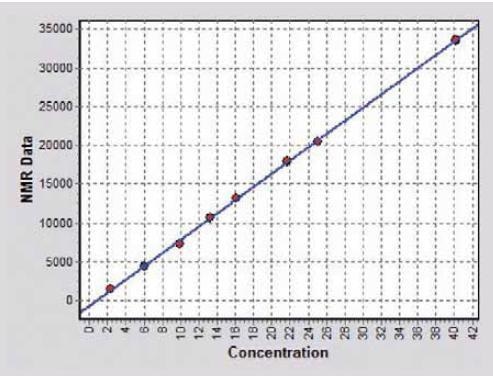
Figure 1. Fat (Oil) Content in Foodstuffs. Calibration obtained for fat content in foodstuffs; standard deviation of the linear fit is 0.20 % by mass, correlation coefficient R2 = 1.00. Measurements were made using an Oxford Instruments Magnetic Resonance MQC-23 benchtop NMR analyzer equipped with a 26 mm diameter probe.
Table 2 illustrates the repeatability test results, which were well within the anticipated range.
Table 2. Results of instrument repeatability test
|
Given fat content % (wet chemistry)
|
Results (%) of Repeat NMR Measurements
|
Mean Value %
|
Standard Deviation %
|
|
16.1
|
15.79
|
15.80
|
15.80
|
15.81
|
15.82
|
15.81
|
15.82
|
15.82
|
15.83
|
15.81
|
15.81
|
0.01
|
Throughput Results Achieved
Laboratory managers reported that the testing results exceeded their expectations, and the group purchased an MQC low-field, benchtop NMR analyzer. Currently, about 90-95 percent of the laboratory's samples are run on the MQC instrument and the lab has increased its efficiency because of the rapid measurement capability.
Table 3 compares the number of analyses per hour and the skills required for the NMR technique versus that of Soxhlet. According to Kulsum Jassat, sales manager for the UK and Europe, "Throughput has increased from 80 to 200 samples per day. With solvent extraction, each sample took approximately six hours from set-up to completion, or a rate of about one sample per hour. With NMR, it is usually less than one minute per sample after sample set-up." She adds, "The company achieved a return on investment (ROI) within 5 months of purchasing the instrument."
Table 3. Measurement comparison
|
Technique
|
Analyses per hour at room temperature
|
Skills required
|
|
Solvent extraction
|
1
|
Highly skilled operator, usually a chemist
|
|
MQC/NMR
|
60 (1 per minute)
|
Non-skilled operator
|
Replacing Soxhlet Units with MQC Benchtop NMR Instruments
The purchase of the NMR MQC instrument allowed the laboratory to replace four of its Soxhlet units. This significantly reduced the cost of purchase and disposal of solvents, increased available laboratory space, reduced running costs, achieved environmental benefits associated with reduced solvent usage, and facilitated better deployment of laboratory staff.
Calibrating the Oxford Instruments Magnetic Resonance MQC Benchtop NMR Instruments
Since there is a slight calibration drift over about six months to a year, the laboratory will still need to recalibrate periodically against the primary technique or with set-up samples supplied by Oxford Instruments Magnetic Resonance. During installation, set-up samples can be made to physically capture and maintain the original calibration, saving time during instrument recalibration. They also save time by allowing calibrations to be transferred to other similarly configured Oxford Instruments Magnetic Resonance MQC NMR instruments.
Getting the NMR Test Method Accredited
While not required by most potential users of NMR instruments, this particular contract lab chose to get its new fat measurement method accredited by the United Kingdom Accreditation Service (UKAS); the national accreditation body that uses a set of internationally agreed standards to assess organizations that provide certification, testing, inspection, and calibration services.
The lab developed a universal method using a sample blending process, sample conditioning to ensure the optimal temperature for reading the NMR signal, followed by analysis using the MQC instrument. They used hundreds of data samples from Soxhlet and NMR-MQC to prove that the results obtained from the MQC reproducibly fell within acceptable tolerance. This method has been UKAS-validated and fully accredited since 2009.
NMR Eliminating Quality Control Bottlenecks
NMR provides a fast and reliable method to increase throughput for quality control testing of fat content in foodstuffs. Although past history may have placed the venerable Soxhlet solvent extraction technique in the role of industry standard, for those seeking to eliminate quality control bottlenecks, the MQC NMR analyzer is poised to take over the lead.

This information has been sourced, reviewed and adapted from materials provided by Oxford Instruments Magnetic Resonance.
For more information on this source, please visit Oxford Instruments Magnetic Resonance.