Dec 18 2001
LuYago / Shutterstock
Marignac first isolated gadolinia, an oxide of gadolinium (Gd), in 1880. Then, in 1886, Lecoq de Boisbaudran successfully separated the element from Mosander’s “yttria.” Gadolinium is present in various minerals.
Bastnasite and monazite are two commercially important minerals that contain gadolinium. Currently, 17 isotopes of gadolinium have been identified, and among these, seven isotopes occur naturally.
Appearance and Properties
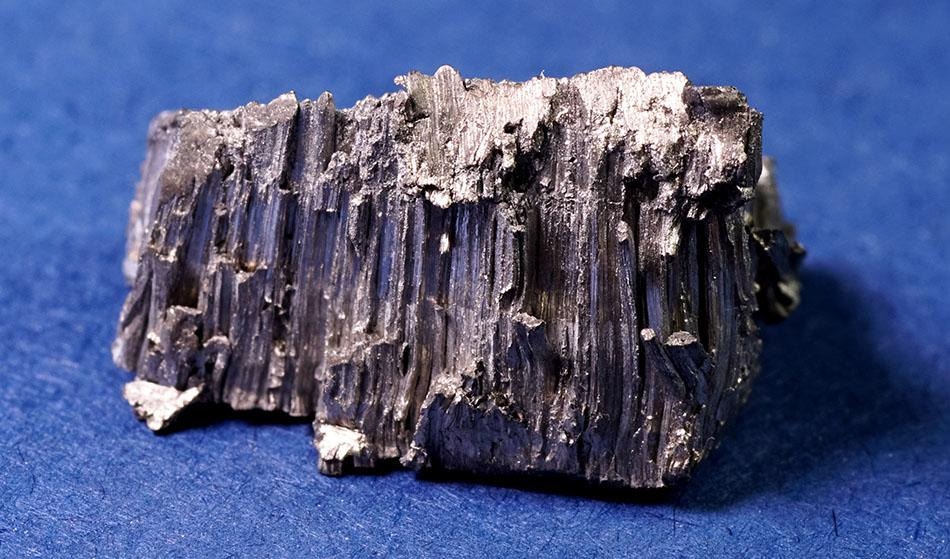
Gadolinium can be prepared by reducing anhydrous fluoride of the metal using metallic calcium. It has a metallic sheen with a silvery-white appearance. It is both malleable and ductile. Gadolinium metal is also ferromagnetic in nature.
Gadolinium has two crystal structures that are dependent on temperature. At room temperature, gadolinium crystallizes in a hexagonal, close-packed α form. When α gadolinium is heated to 1235 °C, it changes into the β form that exhibits a body-centered cubic structure.
Although gadolinium metal is comparatively stable in dry air, it corrodes in moist air and produces a loose oxide film. This film spalls off, resulting in the oxidation of the fresh metal. Gadolinium reacts slowly in water and is soluble in dilute acid.
Among all known elements, gadolinium has the highest thermal neutron capture cross-section (49,000 barns). But this element has a very fast burnout rate, and hence it is not used much as a nuclear control rod material.
Applications
Gadolinium has been used for making gadolinium yttrium garnets, which are useful in superconducting and microwave applications.
Compounds of gadolinium are used for producing phosphors for color TV tubes. It is used as an alloying element for better workability and improved resistance to high-temperature oxidation in chromium, iron, and their associated alloys.
Gadolinium ethyl sulfate has very low noise properties and can be used to mimic the performance of high-frequency amplifiers, like the maser.
Since gadolinium is ferromagnetic in nature, it has a very high magnetic moment combined with its unique Curie temperature, which lies at room temperature. The ferromagnetism of the metal ceases above the Curie temperature.
Gadolinium can also be used as a magnetic component for sensing both hot and cold variations.