Nov 24 2009
Zircon is a mineral that exists in nature from colourless to reddish-brown, yellow, green or blue. Zircon may also be transparent making its visual appearance similar to diamond. Zircon is a common accessory mineral in many rocks of the continental crust. Their chemical and physical durability allow this mineral to survive even under the pressure and temperature conditions of the Earth's upper mantle. These characteristics challenged a group of scientists from Tübingen (Germany), Los Angeles (USA), Perth (Australia) and Hefei (China) to take a closer look on zircons from basaltic fields in north-eastern Bavaria.
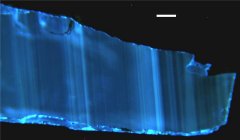 Kathodoluminescence (CL) of a polished fragment of a zircon.
Their results show that these zircons were formed in the Earth mantle and were stored in this environment many million of years before they were delivered to the surface by basalt lava flows with which they are associated. Their study appears online in Nature geoscience.
The scientists have chosen exceptional large crystals (1 to 3 mm in diameter) of gem quality which were recently discovered in placer deposits within the western segment of the central European Eger rift system. A number of experiments were carried out the crystals including in situ trace element analyses, oxygen isotope composition and isotope analyses of the decay products of the radioactive elements Lutetium, Samarium und Uranium.
Uranium-thorium-helium-dating revealed that the zircons were transported to the surface environment by basalt eruptions 29 to 24 million years ago. Their trace element composition points to formation depths of 60-80 km under relatively low temperature conditions (850-950°C). The zircons reveal uranium-lead ages from 80 to 50 million years considerably older than their eruption age. There is no evidence that the zircons were stored in the crust prior to eruption. Obviously the zircon fragments resisted dissolution and diffusive element loss to various extents and survived partly unscathed in the upper mantle.
This is a remarkable finding given that the temperature increased within the shallow mantle below the Eger rift in the geological past as known from other studies. Zircons like these, apart from their aesthetic beauty, carry a wealth of information and offer an interesting glimpse in the mantle.