Automation is transforming density measurement workflows by streamlining both sample handling and data management. This article explores how integrated automated solutions enhance throughput, improve repeatability, and minimize human error - ultimately delivering more reliable results while cutting manual labor time by up to 70%.
Automating density workflows can improve analytical efficiency and throughput. Data management can be automated to increase processing speed while reducing transcription errors and other data-capture issues, such as data loss.
The use of a system that combines automated workflows with automated data management will yield the largest benefit by significantly boosting efficiency and accuracy in both measurement and results management.
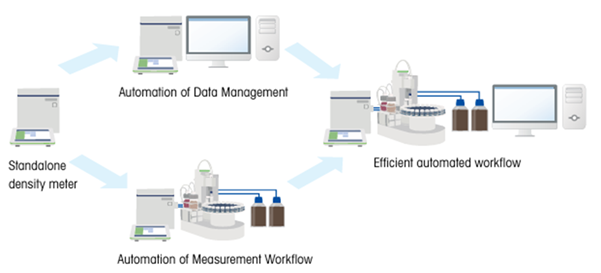
Figure 1. The evolution from a standalone instrument to an automated solution yields significant benefits in terms of throughput, accuracy, and ease of use. Image Credit: Mettler-Toledo International Inc.
Automation not only increases throughput, saves operator time, and reduces errors, but it also improves measurement repeatability because the workflow is always the same: sampling, measuring, draining, rinsing, and drying.
As previously stated, METTLER TOLEDO’s experience has shown that insufficient cell cleaning and/or drying is the most prevalent cause of data error, particularly for density meters. Automation removes this potential error cause.
The best strategy to acquire high-quality density measurement findings is to automate your procedure and reduce operator influence. The new METTLER TOLEDO InMotion PX autosamplers enable a one-click start to the whole automated workflow:
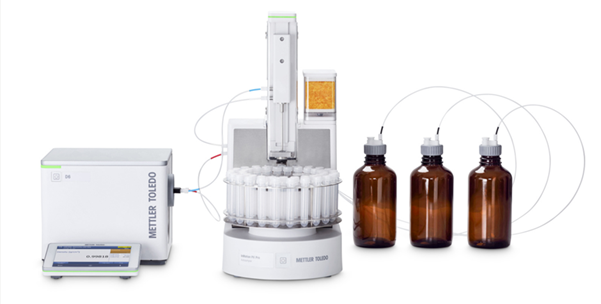
D6 Excellence Density Meter with InMotion PX Pro autosampler. Image Credit: Mettler-Toledo International Inc.
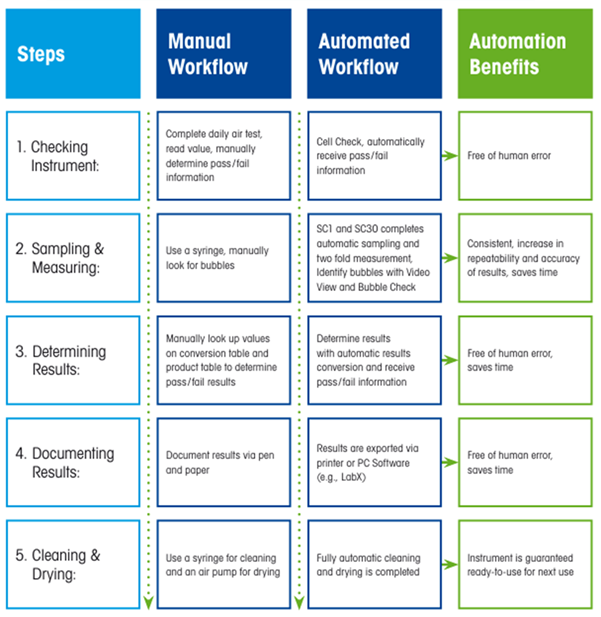
Image Credit: Mettler-Toledo International Inc.
The figure above compares manual and automated workflows across key steps in density measurement, including instrument checking, sampling, result determination, documentation, and cleaning. In manual processes, each stage requires hands-on input, from visually checking bubbles to manually calculating and recording results, increasing the risk of human error and time consumption. In contrast, automated workflows streamline these steps through integrated systems that perform checks, measurements, result calculations, and data export automatically. The result is a more efficient process with improved accuracy, repeatability, and consistency, while significantly reducing operator involvement and ensuring the instrument is ready for immediate reuse.

This information has been sourced, reviewed, and adapted from materials provided by Mettler-Toledo International Inc.
For more information on this source, please visit Mettler-Toledo International Inc.