Many aerospace testing programs depend on charge-output piezoelectric accelerometers, dynamic pressure transducers, and force sensors due to their wide frequency response, durable design, and ability to capture rapidly changing events.
These sensors produce extremely small electrical charge signals, often expressed in picocoulombs (pC), which are susceptible to cable capacitance, electrical noise, leakage currents, and environmental factors that can impair measurement accuracy.
Charge amplifiers alleviate these issues by transforming the sensor's high-impedance charge output to a steady, low-impedance voltage signal that can be transmitted, recorded, and analyzed.
They help maintain signal integrity, enhance measurement confidence, and provide accurate data for aerospace qualification, certification, and validation tests by performing measurements that are mostly independent of cable capacitance while preserving low noise, stable gain, and high linearity.
Challenge #1: Long Cable Runs
Sensors are often located away from instrumentation racks in aircraft structures, engine test cells, environmental chambers, and ground test facilities. Without sufficient signal conditioning, cable capacitance can drastically affect measured amplitudes and inject uncertainty into test results.
How Charge Amplifiers Solve the Problem
A precision feedback capacitor determines the output of a charge amplifier rather than the capacitance of the cable connecting the sensor and the instrument. It helps to:
- Increase confidence during large-scale structural testing
- Ensure consistent sensitivity independent of cable length
- Improve measurement reproducibility
- Reduce installation unpredictability
Stability is important for modal analysis, wing testing, fuselage validation, and propulsion development since it ensures consistent measurements across channels and test configurations.
In many test facilities, moving the charge amplifier closer to the sensor can enhance measurement quality by shortening the high-impedance charge cable and limiting opportunities for signal degradation before amplification happens.
Rugged Signal Conditioning in Harsh Aerospace Environments
In many aerospace test programs, the optimal position for signal conditioning is often the most difficult setting in the test setup. Often, sensors must be located far away from data acquisition equipment during engine development, propulsion testing, structural qualification, and flying hardware validation.
While traditional instrumentation is often located in secure control rooms or equipment racks, moving the charge amplifier closer to the sensor can considerably enhance measurement accuracy.
This method shortens the cable length between the piezoelectric sensor and charge amplifier, reducing the possibility of noise pickup, leakage effects, and signal loss before charge conversion happens. As a result, engineers may maximize signal reliability at the source while also increasing measurement confidence.
To support these demanding applications, aerospace test organizations often require charge amplifiers that can withstand vibration, temperature extremes, moisture, and exposure to industrial test cell environments.
Rugged charge amplifier designs facilitate direct installation on engine test stands, thrust frames, and other locations near the sensor, preserving measurement quality while ensuring reliable performance in difficult test situations.
Challenge #2: Detecting Small Signals in Noisy Environments
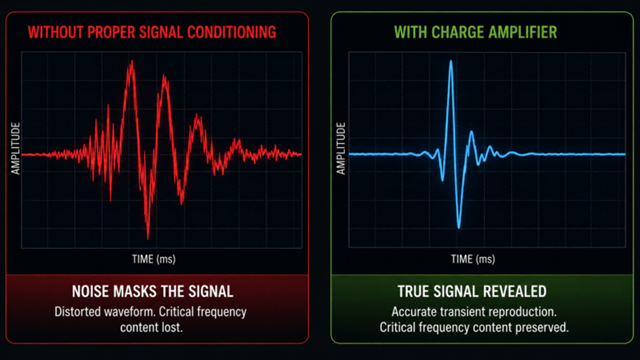
Image Credit: Vitrek, LLC
Variable frequency drives, high-current motors, power conversion equipment, hydraulic power units, RF systems, and environmental chambers are just a few of the electromagnetic interference sources found in aerospace and defense testing environments.
These noise sources can disrupt sensor readings, concealing low-level vibration signatures and dynamic pressure events required for qualification, performance validation, and reliability testing.
How Charge Amplifiers Help
Modern charge amplifiers are designed to sustain weak sensor signals while reducing the impacts of electrical noise, leakage currents, and environmental factors. They help maximize signal integrity through the measurement chain by carefully conditioning signals and ensuring consistent charge-to-voltage conversion.
Challenge #3: Capturing High-Frequency Dynamic Events
Many defense and aerospace measurements include transient events that last milliseconds or even microseconds.
Applications such as pyroshock testing, missile launch analysis, turbine blade vibration monitoring, combustion instability research, structural impact testing, and flight control validation generate high-frequency signals that must be reliably captured to support engineering decisions.
If the signal conditioning system does not have enough bandwidth, these occurrences can become twisted, muted, or lost entirely, concealing crucial frequency content and lowering confidence in test results.
High-performance charge amplifiers contribute to the integrity of these tests by offering wide bandwidth operation, flat amplitude response, low phase distortion, and precise transient reproduction.
Charge amplifiers allow engineers to capture fast-changing events with more accuracy and confidence because they correctly convert weak sensor outputs into steady voltage signals, guaranteeing that recorded waveforms perfectly mirror real-world system behavior.
How Charge Amplifiers Solve the Problem
High-quality charge amplifiers are designed to provide consistent gain, great linearity, low drift, and stable phase over numerous channels. The result is better correlation between channels and more trust in system-level observations.
Challenge #4: Maintaining Channel-to-Channel Consistency
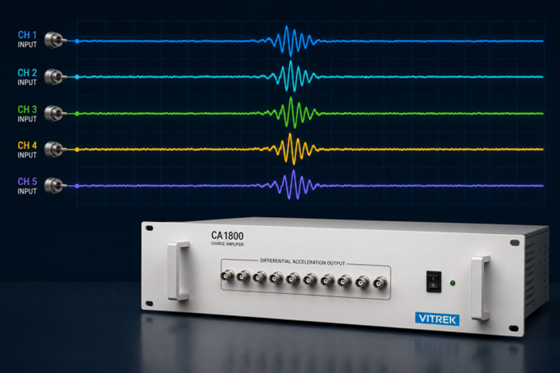
Image Credit: Vitrek, LLC
Many defense and aerospace test programs rely on large-scale data collection systems that support dozens, if not hundreds, of measurement channels at the same time.
These channels are frequently spread throughout aircraft constructions, propulsion systems, environmental test articles, or complicated assemblies, where correct comparison of sensors is crucial to understanding overall system performance.
Even modest changes in amplifier strength, phase response, or signal-conditioning features might generate measurement errors that degrade analysis quality. Such differences can have a major impact on applications such as modal analysis, structural correlation investigations, vibration mapping, and digital twin validation.
When channels do not respond in the same way, engineers may notice obvious changes in amplitude or timing that are measuring system artifacts rather than true physical activity.
This can impede efforts to find resonant frequencies, validate simulation models, correlate test results with projected performance, and accurately define structural reactions.
Ensuring consistent signal conditioning across all channels is thus critical for delivering reliable, reproducible, and defensible test results in aerospace qualification and development projects.
The Value of Multi-Channel Signal Conditioning
Modern aerospace test programs often require the use of dozens or hundreds of sensors placed throughout aircraft structures, engines, environmental test articles, and propulsion systems.
Multi-channel charge amplifiers, such as the Vitrek CA1800, contribute to uniform signal conditioning across all measurement locations, enhancing channel-to-channel correlation, simplifying system setup, and eliminating sources of measurement variability.
For large-scale certification and validation processes, ensuring consistent signal integrity across all channels is critical to providing accurate and defensible test results.
Why Charge Amplifier Selection Matters
Not all charge amplifiers are built to withstand the rigorous demands of aerospace and defense testing.
Applications ranging from structural qualifying and propulsion development to environmental testing and flight hardware validation necessitate measuring systems that can produce accurate, reproducible, and traceable findings across a wide variety of operating circumstances.
Choosing the correct charge amplifier can have a major impact on the quality of the data obtained and the engineers' confidence in their analysis.
Noise Performance
Aerospace measurements sometimes include extremely low-level vibration, force, and dynamic pressure signals, which are easily masked by electrical noise.
To keep crucial signal information visible and quantifiable, the amplifier must function at a low noise level. Poor noise characteristics can obscure delicate events, impair measurement resolution, and make it difficult to identify true system action from background interference.
Gain Stability
Many qualification and development processes include extended testing under varied environmental conditions.
Changes in amplifier gain due to temperature fluctuations, component drift, or aging can create measurement uncertainty and diminish reproducibility. A high-quality charge amplifier should maintain stable gain characteristics throughout the test, enabling precise, reliable measurements over time.
Dynamic Range
Aerospace systems frequently generate both low-level signals and massive transient events during a single test. Engineers may need to monitor minor structural vibrations while recording large shock or impact loads.
The amplifier must have enough dynamic range to measure both extremes without causing distortion, clipping, or saturation, which could jeopardize vital data.
Frequency Response
Many aerospace events contain essential information over a wide frequency range.
Turbine blade vibration, combustion instability, structural resonance, pyroshocks, and flight control transients necessitate precise amplitude and phase reproduction. Amplifiers with insufficient bandwidth may reduce high-frequency content or produce phase errors, affecting analysis, correlation, and system modeling.
Calibration Traceability
Aerospace qualification and certification programs frequently demand documented measurement traceability and validation.
Engineers should assess whether amplifier performance can be calibrated, validated, and recorded to meet internal quality criteria, as well as industry and military standards. Traceable calibration ensures that acquired data is accurate, repeatable, and defensible throughout the duration of the test program.
Engineers may choose charge amplifiers that not only maintain signal integrity but also provide the measurement reliability necessary for aerospace qualification, certification, and mission-critical system validation by carefully analyzing these parameters.
Conclusion
As aerospace systems get more advanced, measurement uncertainty grows in cost. Charge amplifiers are a critical component of the signal chain, ensuring that data used for structural validation, propulsion development, environmental qualification, and flight hardware certification accurately reflects real-world performance.
Modern charge amplifiers transform weak sensor outputs into trusted engineering data that can support critical qualification and mission-readiness decisions by combining low-noise operation, wide bandwidth, stable gain characteristics, cable capacitance immunity, and repeatable measurement performance.

This information has been sourced, reviewed, and adapted from materials provided by MTI Instruments Inc.
For more information on this source, please visit MTI Instruments Inc.