The Battery Cycler Microcalorimeter solution combines TA Instruments' TAM IV isothermal microcalorimeter and BioLogics' VSP-300 Potentiostat. This technique streamlines the most complex and labor-intensive portions of battery calorimetry, increasing the technology's performance and practical usability.
The integrated TAM Assistant software controls the potentiostat and calorimeters, imports and correlates both data sets, and provides automatic analysis features. The pre-wired battery lifters are calorimeter inserts that hold the batteries and provide electrical contact with the potentiostat.
They are designed to fit three common lithium-ion battery types: 18650 cylindrical cells, pouch cells, and coin cells. This solution is a highly appreciated tool for R&D labs, providing more insights than other existing solutions on the market.
Introduction
Traditional battery chemistry research approaches separated materials characterization and temperature analysis from electrochemical testing. Materials characterization was performed to quantify new battery components and how they altered following cell failure.
Thermal analysis was employed to create more effective thermal management systems for end-use applications. The electrochemical data provided most of the information on how the battery functions, what chemistry occurs within the cell, and how it develops over time.
The information generated by this standard research procedure left significant gaps in the chemistry.1
Batteries are highly dynamic systems that undergo a variety of electrochemical and chemical reactions, as well as structural changes, during each cycle.
Electrochemical analysis will only reveal information on processes that influence electrochemical reactions, leaving all other activities (chemical, phase, and structural) uncharacterized.
However, there are numerous phases of change between a new and a failing battery cell, and understanding the deterioration process requires more information than current approaches can provide.1,2
New approaches focus on integrating a secondary analytical methodology with electrochemistry to quantify battery processes during operation. One of the primary approaches to this effort is to combine high-resolution isothermal microcalorimetry with electrochemistry.3–6
Understanding the thermal activity of lithium-ion batteries as a function of electrochemical stimulation will provide significantly more information than electrochemistry alone.
Calorimetry may assess parasitic processes (non-reversible events that lead to degradation), structural changes, lithium plating, self-discharge rates, and reactions related to SEI layer growth/decay.3–8
This data can be used in research to better understand and enhance battery formulation chemistry. Battery calorimetry can also be used in quality control to more effectively screen out badly constructed cells due to its inherent compatibility with commercial cell designs.
While electrochemical calorimetry is a powerful tool, many researchers find it challenging to approach due to the experiment's complexity and nuance. Hyphenated or hybrid instrument techniques are sometimes plagued by extensive data processing after the experiment has been completed, when correlating signals from various instruments.
They also require several software interfaces, forcing the user to coordinate start timings and experiment settings. The Battery Cycler Microcalorimeter solution addresses these challenges and simplifies battery calorimetry by integrating the calorimeter and potentiostat at both the hardware and software levels.
Battery Cycler Microcalorimeter Solution
The Battery Cycler Microcalorimeter solution combines the BioLogic VSP-300 Potentiostat and the TA Instruments TAM IV Isothermal Microcalorimeter (Figure 1).
Integrated TAM Assistant software manages both devices, including experiment preparation and the real-time assimilation of heat-flow and electrochemical data. The pre-wired lifters are calorimeter inserts that hold the batteries and provide electrical contact with the potentiostat.
These lifters are designed to transfer heat generated by the battery into the calorimeter while reducing noise from ambient temperature fluctuations and wire heating. A conductive spring clip is used to connect to the battery, eliminating the need for soldering or additional insulation.
Three different lifters fit standard lithium-ion battery dimensions. The coin cell lifter can accommodate coins (button cells) up to 23 mm in diameter, working with all 20 mL calorimeters on the TAM IV, including the microcalorimeter and multicalorimeter (three-pack) configurations.
The macrocalorimeter lifter is designed to suit standard 18650 cylindrical cells, the most popular type used in electric vehicles. The Micro-XL lifter can accommodate pouch cells with maximum dimensions of 50 mm width, 94 mm length, and 12 mm thickness. An adjustable clamp (with conductive connections) holds the tabs in place, allowing for a wide range of tab spacing.
Depending on the testing requirements, TAM IV calorimeters can be set in a variety of ways to maximize throughput. If the TAM IV is equipped with four multicalorimeters and two VSP-300 potentiostats (each with six channels), a user can test 12 coin cells at the same time in discrete studies.
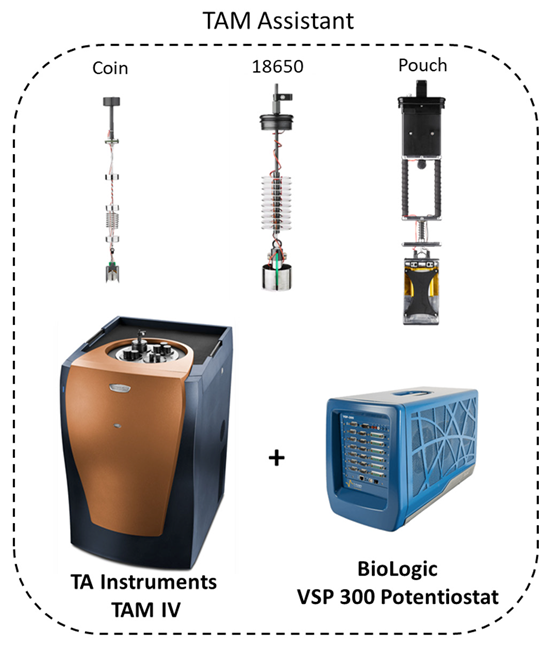
Figure 1. The Battery Cycler Microcalorimetry Solution integrates TA Instruments’ TAM IV Isothermal Microcalorimeter with BioLogic’s VSP-300 Potentiostat. The Pre-wired lifters house the batteries and make electrical contact with the potentiostat. Both instruments are controlled through an integrated TAM Assistant software. Image Credit: TA Instruments
Integrated Software
From a workflow standpoint, the most important feature of the battery cycler microcalorimeter is the software connection between the TAM IV and the VSP-300. TAM Assistant facilitates control of both the TAM IV and the VSP-300 Potentiostat from a single software interface, making battery calorimetry research more convenient.
Figure 2 shows the new experiment wizards for battery experiments. The experiment wizard will walk the user through selecting a technique, adjusting parameters, loading the sample, and assuring baseline stability.
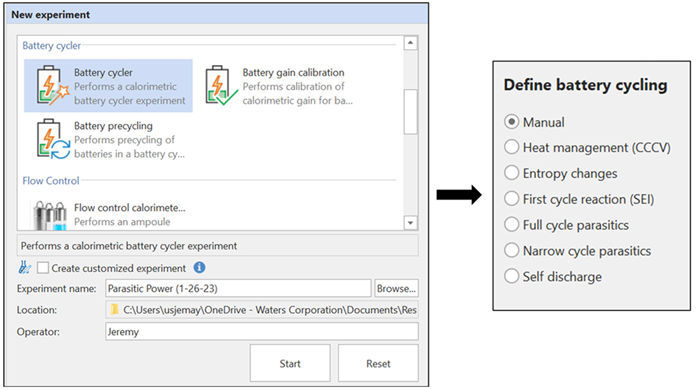
Figure 2. New experiment wizard in TAM Assistant. The user can choose from a variety of preset experiments and program custom run sequences for maximum flexibility. Image Credit: TA Instruments
The battery cycler microcalorimeter can be configured in multiple ways.
- Manual: Create custom experiments by selecting actions, wait intervals, and event markers from the run sequence menu.
- Heat management (CCCV): Measure heat flow during cycling for thermal management. This approach uses constant current, constant voltage (CCCV) parameters to program various charging profiles (i.e., changing charge/discharge rates).
- Entropy changes: The entropy changes approach involves a slow cycle (C/20) followed by a very slow cycle (C/100) to better understand structural and phase changes during lithiation/delithiation.
- First-cycle reaction (SEI): The first-cycle reaction (SEI) is a method for studying SEI formation. This approach uses a low charging current in the low-voltage region where SEI formation occurs (typically less than 3 V), followed by a higher charging current until the conventional upper voltage limit is reached (typically 4.2 V).
- Full-cycle parasitics: This method measures parasitic power throughout the entire voltage range. Parasitics refers to any non-reversible side reaction that contributes to battery degradation.
- Narrow-cycle parasitics: This method measures parasitic power within a restricted voltage range. It is faster than other methods if only one (or more) narrow voltage windows are of interest.
- Self-discharge: This experiment is designed to measure the self-discharge rate, combining the usual technique (monitoring open-circuit voltage over time, then discharging to determine remaining capacity) with the thermal method of integrating the total heat produced throughout the open-circuit duration.
During the experiment, the thermal and electrochemical values are displayed in the same window (Figure 3). To be relevant, the data must be correlated with unparalleled precision.
During the import, the software timestamps both data sets and automatically correlates them. This is a considerable improvement over manual data processing, which takes significantly longer and frequently produces transcription errors.
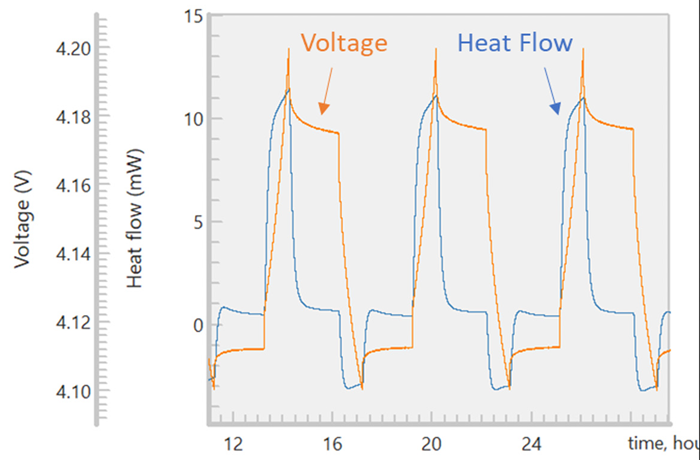
Figure 3. Real-time data integration of the potentiostat and calorimeter signals. Voltage and heat-flow labels were added for clarity. Image Credit: TA Instruments
Analysis Tools
Following the conclusion of the experiment, the results file has many analysis choices. The included TAM Assistant program will automatically calculate important values and display them in a table or figure.
There are many x- and y-axis possibilities, as well as the ability to overlay multiple cycles and separate charge and discharge (Figure 4). These tools were created to enhance flexibility, speed, and convenience, allowing the user to more efficiently identify trends or features in the data.
The summary table displays the averaged or aggregated signals, which include coulombic efficiency and average parasitic power.
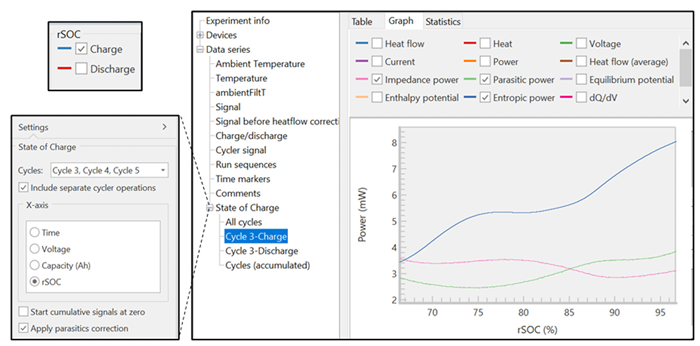
Figure 4. Automated plotting of raw signals and calculated values. Image Credit: TA Instruments
Conclusions
Calorimetry of full-battery cells is a useful tool for temperature management, electrolyte additive research, active material development, and quality control.
The complexity of the tests and the labor-intensive data processing posed a barrier to this technology. The Battery Cycler Microcalorimeter solution integrates the TAM IV with the VSP-300 at both the hardware and software levels, improving the accessibility, dependability, and overall utility of battery calorimetry.
References and Further Reading
- Liu, D., et al. (2019). Review of Recent Development of In Situ/Operando Characterization Techniques for Lithium Battery Research. Advanced Materials, 31(28). DOI:10.1002/adma.201806620. https://advanced.onlinelibrary.wiley.com/doi/abs/10.1002/adma.201806620
- Boebinger, M.G., et al. (2020). Understanding Transformations in Battery Materials Using in Situ and Operando Experiments: Progress and Outlook. ACS Energy Letters, 5(1), pp.335–345. DOI:10.1021/acsenergylett.9b02514. https://pubs.acs.org/aelccp/article-abstract/5/1/335/1675750/Understanding-Transformations-in-Battery-Materials?redirectedFrom=fulltext
- Krause, L.J., Jensen, L.D. and Dahn, J.R. (2012). Measurement of Parasitic Reactions in Li Ion Cells by Electrochemical Calorimetry. Journal of The Electrochemical Society, 159(7), pp.A937-A943. DOI:10.1149/2.021207jes. https://iopscience.iop.org/article/10.1149/2.021207jes/meta
- Downie, L.E., Hyatt, S.R. and Dahn, J.R. (2015). The Impact of Electrolyte Composition on Parasitic Reactions in Lithium Ion Cells Charged to 4.7 V Determined Using Isothermal Microcalorimetry. Journal of The Electrochemical Society, 163(2), pp.A35-A42. DOI:10.1149/2.0081602jes. https://iopscience.iop.org/article/10.1149/2.0081602jes/meta
- Krause, L.J., Jensen, L.D. and Chevrier, V.L. (2017). Measurement of Li-Ion Battery Electrolyte Stability by Electrochemical Calorimetry. Journal of The Electrochemical Society, 164(4), pp.A889-A896. DOI:10.1149/2.1651704jes. https://iopscience.iop.org/article/10.1149/2.1651704jes/meta
- Kunz, A., et al. (2022). Time-Resolved Electrochemical Heat Flow Calorimetry for the Analysis of Highly Dynamic Processes in Lithium-Ion Batteries. Journal of The Electrochemical Society, 169(8), p.080513. DOI:10.1149/1945-7111/ac8625. https://iopscience.iop.org/article/10.1149/1945-7111/ac8625/meta
- Burns, J.C., et al. (2013). Predicting and Extending the Lifetime of Li-Ion Batteries. Journal of The Electrochemical Society, 160(9), pp.A1451-A1456. DOI:10.1149/2.060309jes. https://iopscience.iop.org/article/10.1149/2.060309jes/meta
- Downie, L.E., et al. (2013). In Situ Detection of Lithium Plating on Graphite Electrodes by Electrochemical Calorimetry. Journal of The Electrochemical Society, 160(4), pp.A588-A594. DOI:10.1149/2.049304jes. https://iopscience.iop.org/article/10.1149/2.049304jes/meta
Acknowledgements
Produced using materials originally authored by Jeremy May, PhD, at TA Instruments.

This information has been sourced, reviewed and adapted from materials provided by TA Instruments.
For more information on this source, please visit TA Instruments.