Electrical energy powers modern life because it can be converted when needed into heat, light, chemical bonds, or mechanical work. The number of applications requiring electricity acquired off-grid–including mobile phones, vehicles, and household appliances–is increasing.
Many such devices must store substantial energy in a compact form. Accordingly, battery technology has continued to advance, with particular attention given to extending the charging-cycle life, service life, and safety of rechargeable batteries.
Li-ion batteries, which are available in many chemical configurations and physical forms, are central to the development of battery-powered vehicles and portable electronics. Indeed, the inventors of Li-ion batteries received the 2019 Nobel Prize in Chemistry because “they created a rechargeable world”.
Although numerous battery chemistries are under investigation, Li-ion batteries currently dominate rechargeable-battery research, development, and commercial markets.
Whether a battery is under load or being charged, its electrochemical processes exchange heat with the surrounding environment. As charged species move through the battery, several parasitic processes can occur. These processes may cause redox reactions at the anode and cathode, generate heat, and reduce the battery’s usable lifetime.
In general, changes in the composition or physical state of a material are accompanied by heat exchange with the surrounding environment. The faster the chemical or physical transformation, the greater the rate of heat generation.
Isothermal microcalorimetry is a well-established approach for investigating a broad range of physical, chemical, and biological processes. Within an isothermal microcalorimeter, heat production is continuously monitored in real time while the temperature of the specimen remains constant.
Isothermal microcalorimetry has been used for decades to monitor self-discharge in primary batteries, including batteries used in pacemakers.4 Over the past 10 years, industrial and academic battery research has generated substantially greater interest in isothermal microcalorimetry. Most of this work has focused on secondary batteries, particularly Li-ion batteries.
The most commonly used microcalorimeter designs are thermally conductive or heat-flow instruments equipped with a removable sample vessel for holding battery specimens.
Suurkuusk et al. provide a detailed description of a modern microcalorimetry system.7 The calorimeter is installed in a highly controlled environment that provides temperature stability on the μK scale.
When the sample releases or absorbs heat, energy flows between the specimen and the thermostated surroundings, maintaining a constant sample temperature. This heat flow is measured by a thermoelectric sensor positioned between the sample and the temperature-controlled environment.
This article describes the methodology of isothermal microcalorimetry in battery research, development, and quality control. It also illustrates the versatility of the technique and demonstrates its potential applications.
Heat Production and Battery Processes
During battery charging and discharging, heat is produced through several events involving either heat generation or heat absorption. Dahn et al. (1985) investigated Li intercalation into LixMo6Se8 in electrochemical batteries using isothermal microcalorimetry.
Their work proposed a model that accounts for different contributions to the total heat generated by rechargeable Li-ion batteries. These contributions are summarized below.
| PTotal = PPolarization + PEntropic + PParasitic |
(1) |
Dahn et al. aimed to clarify the reversible entropy contribution and experimentally assess changes in the entropy of the intercalation compound as a function of lithium loading, x. The research also experimentally tested the theoretical gas-lattice model of intercalation.
The polarization contribution represents heat generated by processes that cause the battery voltage to differ from the thermodynamic voltage. These processes include the movement of charged species, such as electrons and ions, within the battery.
The reversible contribution represents the enthalpy change of the battery during charging and discharging. For example, the thermodynamic state of the electrode material varies with the number of Li ions undergoing intercalation.
Parasitic reactions generally involve irreversible changes in the battery’s chemical properties and therefore limit its useful lifetime. The heat produced by these reactions directly indicates the extent to which they reduce the battery’s effective life.
Using this model, Krause et al. later streamlined the quantification of parasitic reactions in Li-ion batteries through isothermal microcalorimetry.5
Self-Discharge
Batteries maintained under open-circuit conditions often produce small heat flows associated with self-discharge, which can be defined as an energy loss that decreases the usable lifetime of a battery. Although this phenomenon is well-known in primary batteries, it also occurs in secondary batteries.
Self-discharge in secondary batteries is irreversible, whereas some other processes can be reversed upon recharging. The mechanism responsible for self-discharge is not fully understood for many battery types. However, it is generally hypothesized that, within a similar battery class, greater thermal activity corresponds to shorter battery life or fewer available recharge cycles.
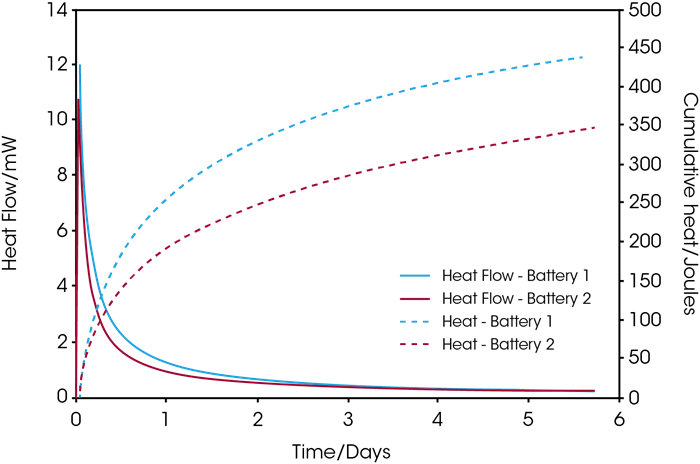
Figure 1. Open-circuit heat flow of commercial NiMH batteries from two different manufacturers initially charged to 100%. Image Credit: TA Instruments
Figure 1 shows the self-discharge heat flows and cumulative thermal curves for commercial AAA NiMH batteries from two manufacturers. Before placement in the calorimeter, both batteries were fully charged at 25 °C.
During the first three days, the heat flow from both batteries stabilized at nearly the same level, although the first battery displayed a higher discharge rate. The cumulative thermal curve indicates that, after 5.7 days, the difference in released energy between the two batteries was below 100 joules.
Roth investigated Li-ion battery self-discharge as a function of temperature and state of charge (SOC) using two cathode intercalation metal-oxide compounds. A strong dependence on the self-discharge process was observed across an SOC range of 0–100% and a temperature range of 40–70 °C.
Microcalorimetric measurements revealed that batteries containing LixNi0.8Co0.2O2 were more reactive than those containing LixCoO2 cathodes. Furthermore, within the temperature range examined, a relationship was identified between the heat-release trend and the measured heat flow.
Hansen and Hart (1978) characterized internal power losses in pacemaker batteries to develop a rapid and reliable quality-assurance method for excluding batteries with unusually high self-discharge rates.4
By testing magnesium/zinc oxide and lithium iodine batteries, they successfully identified both high- and low-self-discharge batteries. They also reported that battery age affects self-discharge heat flows, an issue that should be considered when interpreting calorimetry data.
An isothermal microcalorimeter can now be used to perform quality testing of pacemakers, a type of medical device commonly evaluated using this approach. Naturally, the heat flow from passive equipment is very small, generally below 20 μW and often below 10 μW.
Closed-Circuit Measurement
Modern microcalorimetry systems, such as TAM IV and TAM XL, allow battery processes to be measured under closed-circuit conditions and across many experimental configurations. A specially designed insertion ampoule holds the battery and other electronic components and provides a connection to lead wires.
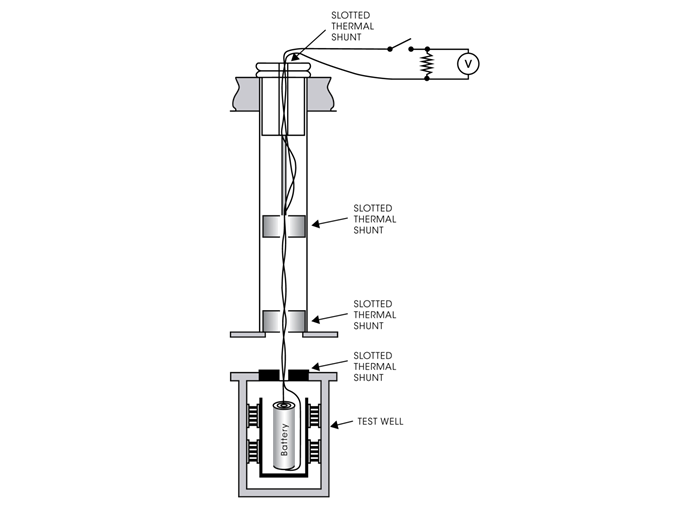
Figure 2. Illustration of an insertion ampoule equipped with electrical wires connected to a battery inside the measuring position of a calorimeter. Externally, the wires are connected to an electronic device, a resistor, and a voltmeter. Image Credit: TA Instruments
These wires extend outside the calorimeter so that the cell can be connected to external electronic devices, such as resistors, power supplies, and voltmeters. This arrangement enables heat generated by the battery to be measured during charging and discharging.
Multichannel calorimetry platforms such as TAM IV allow several calorimeters to operate independently at the same time. Heat flow from the battery can therefore be measured separately from heat generated by electronic components, such as resistors. Such measurements provide a more complete energy balance for heat generation.
Figure 3 presents the heat flow and cumulative heat measured from a commercially available silver oxide coin battery connected to a 380 Ω resistor housed in a second calorimeter.
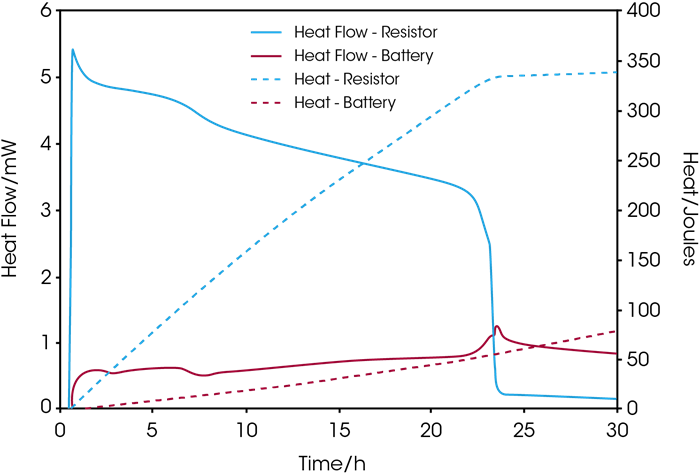
Figure 3. Heat flow and cumulative heat from a closed-circuit measurement of a commercial silver oxide coin cell (orange traces) connected to a 380 Ω resistor placed in a second calorimeter (blue traces). Image Credit: TA Instruments
The graph indicates that as the voltage declines, the current passing through the resistor decreases, while the heat generated by the battery increases. When the resistor’s heat flow approached zero approximately 23 hours after measurement began, the total heat released was about 330 joules. This value corresponded to the remaining energy content of 75 mAh.
The term “electrochemical calorimetry” was introduced to describe the combination of isothermal microcalorimetry with high-resolution voltmeters and precision current sources for studying charge-discharge cycles under different charging conditions.5
This experimental arrangement enables calorimetry data to be related to coulomb efficiency and to the different contributions to total heat flow, which can then be quantified according to Equation 1.
Parasitic Reactions
Krause et al. described a method for quantifying parasitic reactions by separating parasitic events from total heat generation.5 The approach required measurement over an entire charge-discharge cycle. Based on the polarization contribution calculated from integrated voltage hysteresis, Krause and colleagues subtracted this contribution from the thermal-flow measurements collected across the cycle.
Because reversible heat flow is canceled when integrated over a complete cycle, the remaining heat represents the irreversible parasitic reaction after the polarization contribution has been removed.
The researchers identified a linear relationship between parasitic heat loss and active Li, allowing enthalpy changes associated with the parasitic reaction to be calculated. In this case, the enthalpy change was estimated to be 212 kJ mol-1. A comparison involving graphite electrodes with a large surface area showed that the former configuration produced greater parasitic energy.
Downie et al. (2013) quantitatively studied how electrolyte additives affect the stability of LiCoO2/graphite pouch batteries by combining a TAM microcalorimeter with a battery cycler across the specified voltage range.2,3
Under other conditions, low-current charge-discharge cycles were measured using multiple batteries containing different concentrations of vinyl carbonate. Any difference in heat flow betweenadditive-containing batteries and comparison batteries without it could therefore be attributed to the additive.
The results showed a clear influence on heat flow: greater additive concentrations produced lower heat flow and improved stability. The researchers also concluded that once the concentration exceeded 2%, the additional stabilizing effect was small, allowing the optimal concentration of binilene carbonate in the electrolyte to be evaluated.
Structural Changes
During charging, lithium ions move from the positive electrode and intercalate into the anode. This movement produces changes in crystal structure. The resulting effect on configurational entropy can be detected in the heat-flow signal corresponding to the second term of Equation 1.
If the process is reversible, the charge and discharge signals cancel each other. In some cases, however, configurational entropy produces more pronounced features in the heat-flow signal. These features may be associated with lithium plating, an event that is difficult to identify using electrochemical methods.2,3
Isothermal microcalorimetry data enabled unexpected material behavior, such as crystallization, to be identified. Crystallization generates heat rapidly, but this event is nearly impossible to recognize through electrochemical methods.1
Safety Assessment
In general, storing chemical energy at high density creates a safety risk because exothermic decomposition may occur. Thermal decomposition can initiate runaway reactions and potentially result in fires or explosions. As with other high-energy materials, including gunpowder, this concern also applies to batteries.
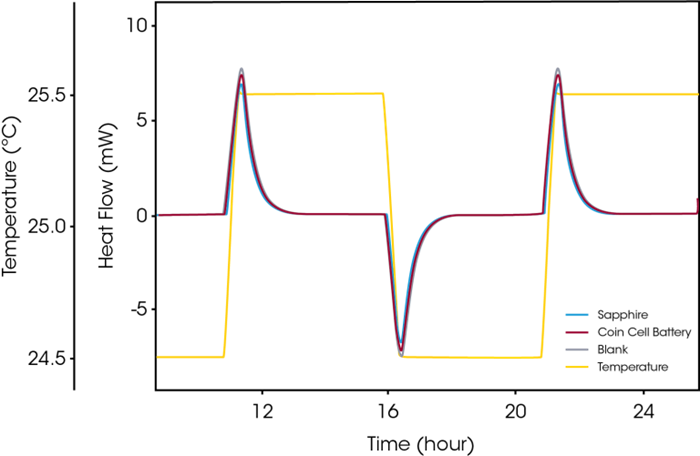
Figure 4. Heat flow curves illustrating a heat capacity measurement of a whole battery. Image Credit: TA Instruments
Efforts to increase the energy density of Li-ion batteries have continued, but the reactivity of reduced lithium species is very high in such systems. Consequently, the heat factor of these materials is an important parameter when evaluating possible thermal-runaway scenarios.
Microcalorimetry is an established method for evaluating various high-energy substances. To estimate temperature increases at different states of charge and during charging or recharging, it is necessary to reliably determine not only the thermal activity but also the thermal characteristics of the entire battery.
Battery heat capacity is one of these characteristics and can be measured accurately by microcalorimetry. Figure 4 shows a typical “step isothermal” measurement of a complete battery.
Conclusion
As microcalorimetry instruments have become more flexible and achieved detection limits approaching nanowatts, interest in calorimetric measurements for battery research, development, and quality control has increased.
Using insertion vessels in different shapes and sizes, batteries of many formats–including coin, AA, AAA, 18650-size cylindrical, and pouch cells–can be measured rapidly under either open- or closed-circuit conditions.
The detection limit of the most sensitive TAM IV calorimeters can also support measurement of low self-discharge rates in small coin cells and heat flow from charge-discharge cycles performed at very low currents.
When combined with current sources, voltmeters, and commercial battery cyclers, parasitic reactions can be quantified rapidly as functions of voltage, temperature, and changing battery chemistry.
The flexibility of the TAM system permits the design of many experimental configurations, with the researcher’s experimental design serving as the primary factor determining the practical detection limit.
References and Further Reading
- Chevrier, V.L., et al. (2021). Isothermal Calorimetry Evaluation of Metallurgical Silicon as a Negative Electrode Material for Li-Ion Batteries. Journal of The Electrochemical Society, 168(3), p.030504. DOI:10.1149/1945-7111/abe16a. https://iopscience.iop.org/article/10.1149/1945-7111/abe16a/meta.
- Downie, L.E., et al. (2013). The Impact of Electrolyte Additives Determined Using Isothermal Microcalorimetry. ECS Electrochemistry Letters, 2(10), pp.A106-A109. DOI:10.1149/2.010310eel. https://iopscience.iop.org/article/10.1149/2.010310eel/meta.
- Downie, L.E., et al. (2013). In Situ Detection of Lithium Plating on Graphite Electrodes by Electrochemical Calorimetry. Journal of The Electrochemical Society, 160(4), pp.A588-A594. DOI:10.1149/2.049304jes. https://iopscience.iop.org/article/10.1149/2.049304jes/meta.
- Hansen, L.D. and Hart, R.M. (1978). The Characterization of Internal Power Losses in Pacemaker Batteries by Calorimetry. Journal of The Electrochemical Society, 125(6), pp.842–845. DOI:10.1149/1.2131565. https://iopscience.iop.org/article/10.1149/1.2131565/meta.
- Krause, L.J., Jensen, L.D. and Dahn, J.R. (2012). Measurement of parasitic reactions in Li-ion cells by electrochemical calorimetry. Journal of The Electrochemical Society, 159(7), pp.A937–A943. DOI:10.1149/2.021207jes. Available at: https://iopscience.iop.org/article/10.1149/2.021207jes/meta.
- Roth, E.P. (1999). Thermal stability of Li-ion cells. Sandia National Labs., Albuquerque, NM (US). Available at: https://www.osti.gov/servlets/purl/14010.
- Suurkuusk, J., Suurkuusk, M. and Vikegard, P. (2017). A multichannel microcalorimetric system. Journal of Thermal Analysis and Calorimetry, 131(2), pp.1949–1966. DOI:10.1007/s10973-017-6684-7. https://link.springer.com/article/10.1007/s10973-017-6684-7.

This information has been sourced, reviewed, and adapted from materials provided by TA Instruments.
For more information on this source, please visit TA Instruments.