Electron microscopy is an essential technique for understanding battery materials; however, mere surface observation is insufficient for comprehensive analysis.
The production of high-quality cross-sections is crucial, as it reveals the true structure and distribution of particles, pores, and various components.
Image Credit: Black_Kira/Shutterstock.com
Techniques for Cross-Sectioning
Mechanical techniques, such as resin embedding, mechanical polishing, precision saw cutting and cleaving, are commonly employed but can be challenging for porous composite materials.
These methods may result in pores being filled with polishing debris, hard particles being removed, soft materials being smeared, and layers being delaminated.
Focused Ion Beam (FIB) instruments utilizing a liquid metal ion gun (Ga+) or plasma source (typically Xe+) offer a solution for high-precision, site-specific cross-sectioning; however, they are generally not well-suited for milling larger areas due to limitations in speed and field of view.
Broad Ion Beam Milling (BIB) employs a low-energy Ar+ ion beam to expediently cross-section large areas with minimal sample damage. This technique provides high-quality sectioning over length scales that are particularly relevant for battery materials.
Anodes
Cross-sectional studies yield insights into cluster sizes, binder distribution, compaction ratios, film uniformity, film thickness and adhesion to the electrode.
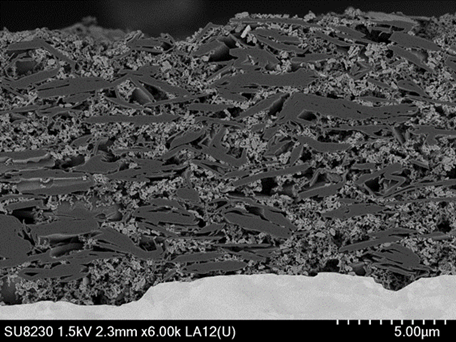
Anode cross-section. Image Credit: Hitachi High-Tech Europe
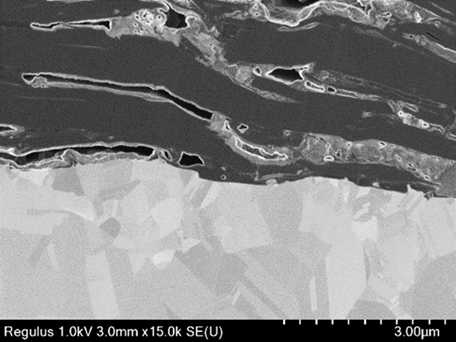
Detail of anode cross section showing adhesion to the Cu foil. Image Credit: Hitachi High-Tech Europe
Cathodes
Cross-sectional analysis of typical sintered metal powder clusters for cathodes is necessary to elucidate the internal grain or pore structure, which is critical for performance.
Properties such as particle size distribution, pore size, binder distribution, and particle cracking can be systematically studied and quantified.
Following the formation and aging processes or after battery cycling, electrode properties such as swelling, cracking, degradation, and SEI layer formation can be examined and correlated with practical battery performance.
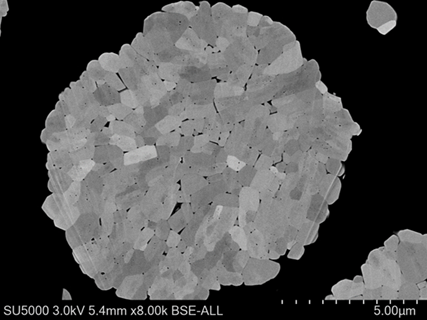
NMC cathode active material particle. Image Credit: Hitachi High-Tech Europe
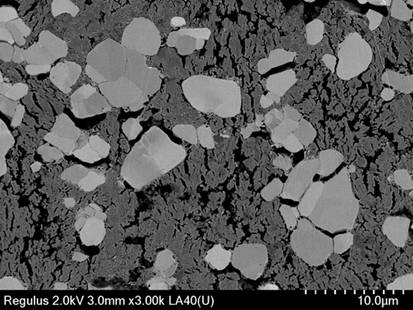
Electrode of Lithium Sulphur battery. Image Credit: Hitachi High-Tech Europe
Separator Foils
Although the separator foil is not an active component of the cell, it plays a vital role in ion transport and significantly influences cell performance, longevity, and safety.
Cross-sectioning can facilitate the understanding of pore size, the structure of the ceramic coating layer, and potential residues after cycling that may impact long-term performance.
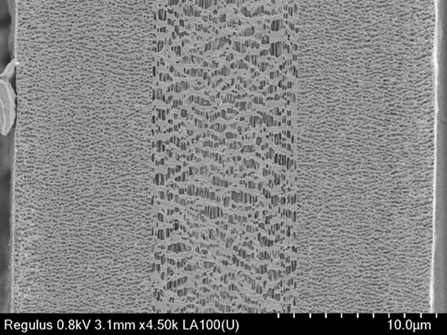
Cross section of separator membrane. Image Credit: Hitachi High-Tech Europe
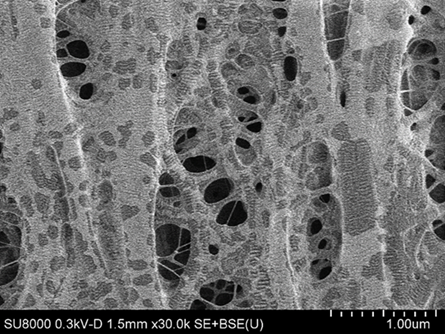
Separator imaged at 300 V showing residues after cycling. Image Credit: Hitachi High-Tech Europe
Conclusion
Electron microscopy and high-quality cross-sections derived from broad beam ion milling are invaluable for understanding and developing solutions for energy storage.
Revealing and analyzing the actual structure visually provides significantly deeper insights than alternative numerical techniques, such as particle size distribution charts from laser diffraction or gas adsorption measurements using BET.

This information has been sourced, reviewed and adapted from materials provided by Hitachi High-Tech Europe.
For more information on this source, please visit Hitachi High-Tech Europe.