Particle size often monopolizes the starch powder conversation, but missing out on aspect ratio, convexity, or circularity risks often means only seeing half the picture.
Particle shape can significantly influence functionality in industries ranging from food processing to pharmaceuticals. This impacts product characteristics from compressibility and flowability to appearance and reactivity.
Dynamic Image Analysis with the Raptor Dry Powder Module solves this issue, making explorations into particle shape as simple as pressing “start.”
The Issue with Size-Only Analysis
Sieving and laser diffraction remain popular techniques for starch particle size analysis. These methods are useful - and fast - but they rely on the assumption that the particles being investigated are all spherical, when this is often not the case.
Starch particles are especially variable in shape depending on their intended application, processing method, and source (for example, corn, wheat, or potato). For instance, two starches may behave very differently in a product despite having identical D50 values.
Failing to consider particle shape can lead to incorrect predictions of how a starch will perform in a particular process.
The Raptor Difference
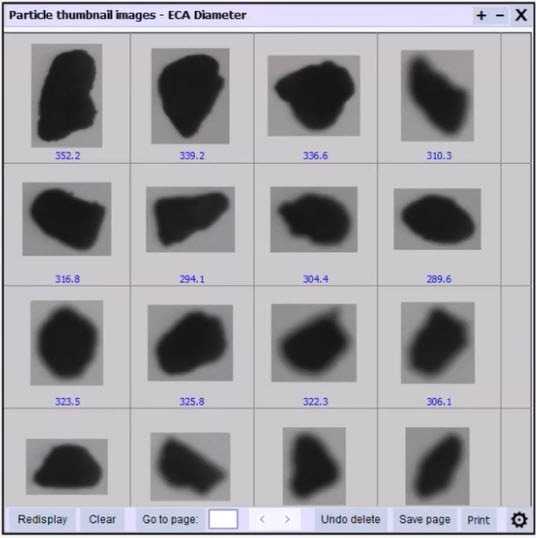
Starch Thumbnails. Very irregular particles will have poor flowability and compaction but have higher surface area. Image Credit: Vision Analytical Inc.
The Raptor Dry Powder Module provides more than just size metrics: It offers users high-resolution thumbnail images and useful shape descriptors, including aspect ratio, convexity, circularity, and elongation.
These insights allow users to understand the impact of drying or milling conditions, detect unexpected particle types or contaminants, and tune particle morphology to achieve desired product performance.
The Raptor is also incredibly user-friendly, with starch powder sample analysis taking just minutes.
Starch in Food Applications
Particle shape affects how starch hydrates, swells, and interacts with other ingredients throughout the food industry, with irregular shapes potentially causing uneven texture or clumping. More uniform shapes ensure more consistent processing and improved mouthfeel.
The Raptor allows QA teams to routinely monitor these parameters, rather than relying on occasional SEM snapshots or guesswork.
Raptor Portable Analyzer: Dry Powder Module Demonstration for Particle Analysis
Watch the video: How Easy It Is to Analyze Starch With the Raptor. Video Credit: Vision Analytical Inc.
Conclusion
Starch powder characterization requires more than measuring particle size. The Raptor Dry Powder Module provides a complete view of a powder’s morphology, delivering this automatically, efficiently, and completely, with visual proof.
This level of detail is key to making better decisions and ensuring ongoing improvements in process control, product consistency, and ultimately, customer satisfaction.
Acknowledgments
Produced from materials originally authored by Vision Analytical Incorporated.

This information has been sourced, reviewed, and adapted from materials provided by Vision Analytical Inc.
For more information on this source, please visit Vision Analytical Inc.