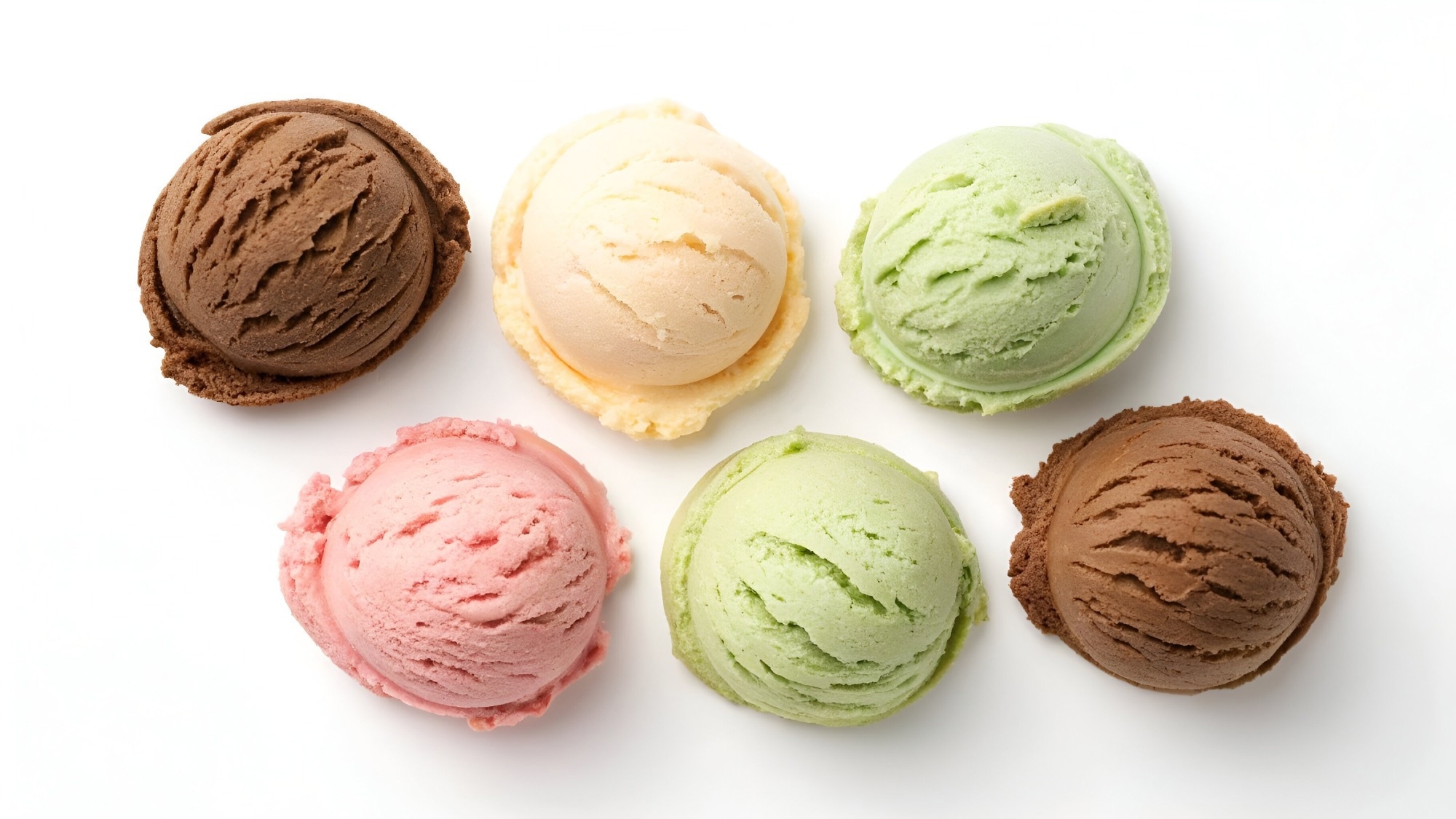
A complex emulsion of dairy products, water, proteins, fat, sugars, and air forms ice cream. Each individual component plays a unique and critical role in creating its creamy and smooth consistency. During the manufacturing process of ice cream, quality testing ensures consistency between batches to meet customer expectations. The quality analysis of ice cream involves analyzing its protein percentage, fat content, and total solids as well as calories, and sucrose and lactose content.

Image Credit: Jokhia/Shutterstock.com
These factors impact flavor, texture, consumer satisfaction, and shelf life. Traditional laboratory ice cream analysis requires sample preparation and can be time-consuming. Near-infrared spectroscopy (NIRS) is an alternative technique that is simpler, chemical-free, and simultaneously measures all these parameters in just a few seconds.
Experimental Equipment
Forty samples of different ice creams were analyzed using a Metrohm NIR Analyzer. All the measurements were performed in reflection mode (1000–2250 nm) using the small cup accessory and single-point measurement.
Reference values were acquired using official methods, such as AOAC 932.06 (fat), AOAC 941.08 (total solids), AOAC 930.33 (protein). Reference values for lactose and sucrose were obtained using HPLC (high-performance liquid chromatography), while caloric content was measured using a bomb calorimeter. Metrohm software was used to acquire all data and develop prediction models.
Results
The acquired NIR spectra (Figure 1) were used to develop prediction models for the aforementioned reference parameters. A ‘leave one out’ validation procedure was applied. Figures 2–7 show correlation diagrams that display the relation between the NIR prediction and the reference values, alongside the respective figures of merit (FOM).

Figure 1. NIR spectra of several ice cream samples. Image Credit: Metrohm Middle East FZC
Results of Fat Content in Ice Cream Mix

Figure 2. Correlation diagram and the respective figures of merit for the prediction of fat in ice cream mix. Reference values were obtained according to AOAC 932.06. Image Credit: Metrohm Middle East FZC
Source: Metrohm Middle East FZC
| R2 |
SEC (%) |
SECV (%) |
| 0.979 |
0.24 |
0.30 |
Results of Total Solids Content in Ice Cream Mix

Figure 3. Correlation diagram and the respective figures of merit for the prediction of total solids in ice cream mix. Reference values were obtained according to AOAC 941.08. Image Credit: Metrohm Middle East FZC
Source: Metrohm Middle East FZC
| R2 |
SEC (%) |
SECV (%) |
| 0.979 |
0.52 |
0.58 |
Results of Lactose Content in Ice Cream Mix

Figure 4. Correlation diagram and the respective FOMs for the prediction of lactose in ice cream mix. Reference values were obtained with high-performance liquid chromatography (HPLC). Image Credit: Metrohm Middle East FZC
Source: Metrohm Middle East FZC
| R2 |
SEC (%) |
SECV (%) |
| 0.921 |
0.06 |
0.10 |
Results of Sucrose Content in Ice Cream Mix

Figure 5. Correlation diagram and the respective FOMs for the prediction of sucrose in ice cream mix. Reference values were obtained with high-performance liquid chromatography (HPLC). Image Credit: Metrohm Middle East FZC
Source: Metrohm Middle East FZC
| R2 |
SEC (%) |
SECV (%) |
| 0.952 |
0.33 |
0.37 |
Results of Protein in Ice Cream Mix

Figure 6. Correlation diagram and the respective FOMs for the prediction of protein content in ice cream mix. Reference values were obtained according to AOAC 930.33. Image Credit: Metrohm Middle East FZC
Source: Metrohm Middle East FZC
| R2 |
SEC (%) |
SECV (%) |
| 0.974 |
0.11 |
0.14 |
Results of Calories in Ice Cream Mix

Figure 7. Correlation diagram and the respective FOMs for the prediction of calories in ice cream. Reference values were obtained by using a bomb calorimeter. Image Credit: Metrohm Middle East FZC
Source: Metrohm Middle East FZC
| R2 |
SEC (%) |
SECV (%) |
| 0.981 |
2.83 |
2.89 |
Conclusion
Total solids and fat determination in ice cream, among other parameters, are critical for quality control purposes. This article has shown how NIR spectroscopy can be employed to analyze protein content, total solids, calories, fat, sucrose, and lactose in ice cream. These parameters can be simultaneously determined when using NIRS.
The analysis is user-friendly and can be conducted in just a few seconds without the use of any chemicals. The NIRS solution can be employed for quality assurance in ice cream production, both during the production process and for determining quality of the final product.

This information has been sourced, reviewed and adapted from materials provided by Metrohm Middle East FZC.
For more information on this source, please visit Metrohm Middle East FZC.