Food production processes require stringent quality control measures to maintain quality standards and protect consumers. Products like chocolate, sweets, and other confectionery are no different – they must all meet the highest food industry standards.
To meet strict regulations, final product control is essential in delivering consistent quality, especially when producing indulgent food products.
Near-infrared spectroscopy (NIRS) is a chemical-free analytical method that can quickly identify key quality-control constituents of chocolate bars without complex sample preparation. The fast, easy-to-use NIRS solution can be deployed at the production line or in a quality control laboratory.
Experimental Equipment
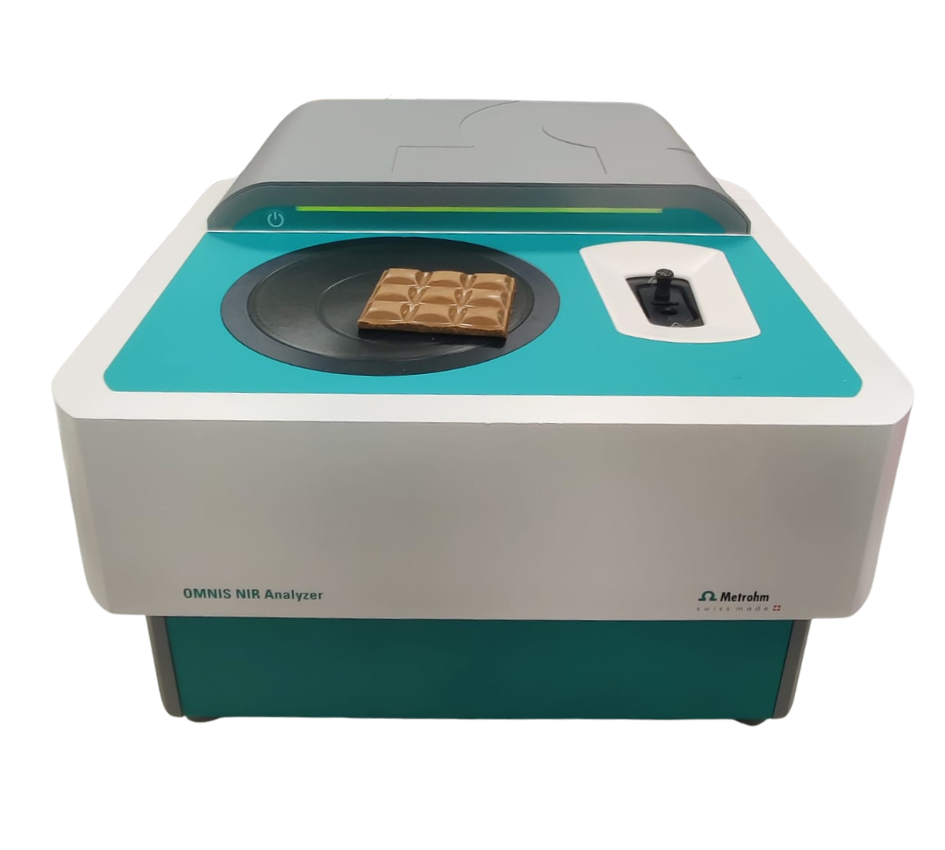
The Metrohm DS2500 Solid Analyzer (Figure 1) was used to analyze 18 chocolate bars from various suppliers. The chocolate bars were placed directly on the sample window, with diffuse reflection mode used for measurements.
For sample variety, each bar of chocolate was analyzed at three distinct points of reference. A model was developed using spectra averaged across these points. The software package Vision Air Complete was used for accurate data acquisition and prediction model development (Table 1).
Table 1. Hardware and software equipment overview. Source: Metrohm Middle East FZC
| Equipment |
Article number |
| DS2500 Solid Analyzer |
2.922.0010 |
| Vision Air 2.0 Complete |
6.6072.208 |

Figure 1. Metrohm NIRS DS2500 Solid Analyzer with a chocolate bar covering the sample window. Image Credit: Metrohm Middle East FZC
Result
The acquired Vis-NIR spectra (Figure 2) enabled users to generate reliable prediction models for various reference parameters, with a ‘leave one out’ validation procedure. Correlation diagrams displaying the relation between the Vis-NIR prediction and the reference values are shown in Figures 3-8 together with the respective figures of merit (FOM).

Figure 2. Selection of Vis-NIR spectra of chocolate bar samples. Data was obtained with a DS2500 Solid Analyzer. A spectra offset was applied for visualization purposes. Image Credit: Metrohm Middle East FZC
Result: Calories in Chocolate Bars

Figure 3. Correlation diagram and the respective FOMs for the prediction of calories in chocolate bars using a DS2500 Solid Analyzer. Image Credit: Metrohm Middle East FZC
Result: Fat in Chocolate Bars

Figure 4. Correlation diagram and the respective FOMs for the prediction of fat in chocolate bars using a DS2500 Solid Analyzer. Image Credit: Metrohm Middle East FZC
Result: Saturated Fat in Chocolate Bars

Figure 5. Correlation diagram and the respective FOMs for the prediction of saturated fat in chocolate bars using a DS2500 Solid Analyzer. Image Credit: Metrohm Middle East FZC
Result: Carbohydrates in Chocolate Bars

Figure 6. Correlation diagram and the respective FOMs for the prediction of carbohydrates in chocolate bars using a DS2500 Solid Analyzer. Image Credit: Metrohm Middle East FZC
Result: Sugar in Chocolate Bars

Figure 7. Correlation diagram and the respective FOMs for the prediction of sugar in chocolate bars using a DS2500 Solid Analyzer. Image Credit: Metrohm Middle East FZC
Result: Protein in Chocolate Bars

Figure 8. Correlation diagram and the respective FOMs for the prediction of protein in chocolate bars using a DS2500 Solid Analyzer. Image Credit: Metrohm Middle East FZC
Conclusion
Near-infrared spectroscopy (NIRS) is an exceptional analysis method that can reliably determine the content of calories, fat, saturated fat, carbohydrates, sugar, and protein found in chocolate bars.
Analyses of these quality control parameters can be performed without complex setup or chemical reagents. NIRS wastes no time delivering accurate results and, compared with the more traditional methods used to determine these parameters, generates significant time and cost savings, delivering results in seconds.

This information has been sourced, reviewed, and adapted from materials provided by Metrohm Middle East FZC.
For more information on this source, please visit Metrohm Middle East FZC.