Fast, Chemical-Free Monitoring of Roasted Coffee Using Near-Infrared Spectroscopy (NIRS)

For coffee roasters, consistent analysis of roasted coffee beans can have substantial monetary effects. Continuous analysis enables the roasting settings to be improved for highly consistent final products and more energy-efficient procedures. When determining caffeine concentration, methods such as high-performance liquid chromatography (HPLC) involve chemicals, require extensive knowledge to operate the instrument, and can take a long time to perform the analysis.

Near-infrared spectroscopy (NIRS) is a chemical-free, rapid alternative for analyzing caffeine and moisture in roasted coffee beans. The NIRS solution is simple to use, requires no sample preparation, and can be operated either near the roaster or in a quality control laboratory.

OMNIS NIR Analyzer Solid

Near-infrared Spectrometer for Solid and Viscous Samples.

Developed and created following Swiss quality standards, the OMNIS NIR Analyzer is the NIRS solution for routine analysis across the entire production chain. Its integration in the modern OMNIS Software and its application of the latest technologies are proven in its operability, speed, and flexible utilization of this NIR spectrometer.

Fast, Chemical-Free Monitoring of Roasted Coffee Using Near-Infrared Spectroscopy (NIRS)

Image Credit: Metrohm Middle East FZC

Experimental Equipment

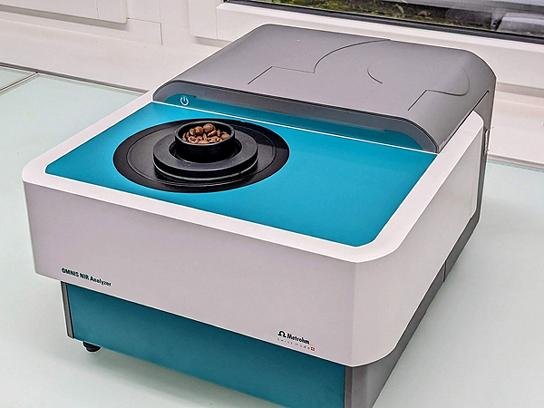
The analysis of up to 168 roasted coffee samples was performed on a Metrohm OMNIS NIR Analyzer Solid, using the small cup OMNIS NIR, 60 mm (Figure 1). Samples of either ground or ground beans were placed in the small cup and analyzed in diffuse reflection mode. Reference values for moisture and caffeine were acquired with the respective primary methods. Caffeine analysis was conducted with an ion chromatograph (IC) and followed ISO 20481 guidelines, and moisture analysis followed AOAC 979.12 guidelines.

OMNIS NIR Analyzer Solid with roasted coffee beans in the small cup OMNIS NIR, 60 mm

Figure 1. OMNIS NIR Analyzer Solid with roasted coffee beans in the small cup OMNIS NIR, 60 mm. Image Credit: Metrohm Middle East FZC

Table 1. Hardware and software equipment overview. Source: Metrohm Middle East FZC

Equipment Article number
OMNIS NIR Analyzer Solid 2.1071.0010
Small holder OMNIS NIR, 60 mm 6.07402.200
Small cup OMNIS NIR, 60 mm 6.07402.210
OMNIS Stand-Alone license 6.06003.010
Quant Development software license 6.06008.002

Results

The acquired NIR spectra (Figure 2) were employed to develop prediction models for the different reference parameters. The relationship between the NIR prediction and the reference values is shown in correlation diagrams in Figures 3–4, along with the respective figures of merit (FOM).

Overlaid NIR spectra of roasted coffee bean samples (whole beans). Data was obtained with an OMNIS NIR Analyzer Solid

Figure 2. Overlaid NIR spectra of roasted coffee bean samples (whole beans). Data was obtained with an OMNIS NIR Analyzer Solid. Image Credit: Metrohm Middle East FZC

Results: Moisture in Roasted Coffee Beans

Correlation diagram and the respective FOMs for the prediction of moisture a) for whole coffee beans and b) for ground coffee beans

Figure 3. Correlation diagram and the respective FOMs for the prediction of moisture a) for whole coffee beans and b) for ground coffee beans. Image Credit: Metrohm Middle East FZC

Results: Caffeine in Roasted Coffee Beans

Correlation diagram and the respective FOMs for the prediction of caffeine a) for whole coffee beans and b) for ground coffee beans

Figure 4. Correlation diagram and the respective FOMs for the prediction of caffeine, a) for whole coffee beans and b) for ground coffee beans. Image Credit: Metrohm Middle East FZC

Conclusion

This article has shown how NIR spectroscopy can be used to quickly analyze roasted, ground, and whole coffee beans (Table 2). Without the use of chemicals, the OMNIS NIR Analyzer accurately measures both parameters (caffeine and moisture content). As expected, the prediction values are slightly better for the more homogenous ground coffee samples.

Table 2. Time-to-result comparison of different methods used to analyze coffee. Source: Metrohm Middle East FZC

Parameter Method Time to result
Caffeine IC System (ISO 20481) 120 min (sample preparation and measurement)
Moisture Oven – Loss on drying
(AOAC 979.12)
13 hours (sample preparation and measurement)

This information has been sourced, reviewed and adapted from materials provided by Metrohm Middle East FZC.

For more information on this source, please visit Metrohm Middle East FZC.

Citations

Please use one of the following formats to cite this article in your essay, paper or report:

  • APA

    Metrohm Middle East FZC. (2026, March 03). Fast, Chemical-Free Monitoring of Roasted Coffee Using Near-Infrared Spectroscopy (NIRS). AZoM. Retrieved on March 03, 2026 from https://www.azom.com/article.aspx?ArticleID=25018.

  • MLA

    Metrohm Middle East FZC. "Fast, Chemical-Free Monitoring of Roasted Coffee Using Near-Infrared Spectroscopy (NIRS)". AZoM. 03 March 2026. <https://www.azom.com/article.aspx?ArticleID=25018>.

  • Chicago

    Metrohm Middle East FZC. "Fast, Chemical-Free Monitoring of Roasted Coffee Using Near-Infrared Spectroscopy (NIRS)". AZoM. https://www.azom.com/article.aspx?ArticleID=25018. (accessed March 03, 2026).

  • Harvard

    Metrohm Middle East FZC. 2026. Fast, Chemical-Free Monitoring of Roasted Coffee Using Near-Infrared Spectroscopy (NIRS). AZoM, viewed 03 March 2026, https://www.azom.com/article.aspx?ArticleID=25018.

Ask A Question

Do you have a question you'd like to ask regarding this article?

Leave your feedback
Your comment type
Submit

While we only use edited and approved content for Azthena answers, it may on occasions provide incorrect responses. Please confirm any data provided with the related suppliers or authors. We do not provide medical advice, if you search for medical information you must always consult a medical professional before acting on any information provided.

Your questions, but not your email details will be shared with OpenAI and retained for 30 days in accordance with their privacy principles.

Please do not ask questions that use sensitive or confidential information.

Read the full Terms & Conditions.