This article examines an urban gas network that experienced pressure fluctuations that manual regulators could not safely control. These issues were compounded by hazardous Zone 0 conditions that made conventional electronic automation challenging and risked methane venting.
The network opted to use an intrinsically safe IS-Pro™ controller, facilitating closed-loop, remote pressure regulation without the need for protective housings. This automated system ensured stable downstream pressure, enhanced safety, and reduced onsite adjustment requirements.
Seasonal Fluctuations Impacted End Users
Natural gas distribution networks are fundamental to the reliable delivery of gas to homes and businesses throughout urban areas. Changes in seasonal demand, refinery maintenance, and geopolitical events can all, however, disrupt gas supply, which can result in price fluctuations and delivery delays.
Gas distribution centers must exercise precise control over a complex network of pressure lines to maintain timely and stable service.
The Challenge
An East Asian energy company operating a bypass leg off the main transmission had to comply with Zone 0 requirements, while continuing to maintain stable downstream pressure.
It was important for the system to regulate gas feed into an urban distribution network, maintaining stable outlet pressure while preventing routine methane venting during setpoint changes.
The company’s existing setup featured a pressure regulator that reduced high inlet pressure to a stable lower pressure suitable for downstream supply. The system leveraged a traditional two-stage approach: the main regulator’s dome pressure was controlled via a mechanical pilot device that drew its setpoint signal from upstream pressure.
Operators were required to manually adjust the pilot screw or use an electric motorized adjustment to change the setpoint, meaning that pressure control relied on regular human intervention with a risk of gas venting during adjustments.
Any device connected to the gas line required Zone 0 certification. To complicate matters further, the installation was outdoors, meaning that larger solutions such as explosion-proof housings or purge cabinets were considered impractical.
The operator required a new control strategy in order to achieve fully automated, closed-loop control that enabled remote setpoint adjustment and removed the need for manual tuning.
Choosing Between Manual, Pneumatic, or Electronic Pressure Regulators
Mechanical and Pneumatic Control
Mechanical dome-loaded regulators could maintain outlet pressure, but these regulators required on-site adjustment. The addition of pneumatic pilots enhanced response time and stability, but true remote feedback was not possible, and there was still a need for manual setpoint tuning.
Both cases required personnel to be sent into a hazardous area to make changes to the setpoint, and occasionally vent gas during adjustment. It was not possible to implement these methods without undesirable venting or the support of real-time monitoring and control from the PLC.
Conventional Electronic Pressure Control
Higher precision, data visibility, and closed-loop control of dome pressure were possible via standard electronic pressure controllers. Most off-the-shelf devices are not designed for direct installation in Zone 0, however, and the limited availability of Zone 0-rated instruments made this path challenging.
The operator would typically require purged or explosion-proof enclosures to use conventional controllers in such an environment, or it would be necessary to relocate the electronics outside the hazardous area, running longer impulse lines and signal wiring.
These options all add bulk, cost, and maintenance complexity without inherently solving venting issues. Instead, the operator required a technology able to automate dome control without sacrificing Zone 0 safety.
The Selection
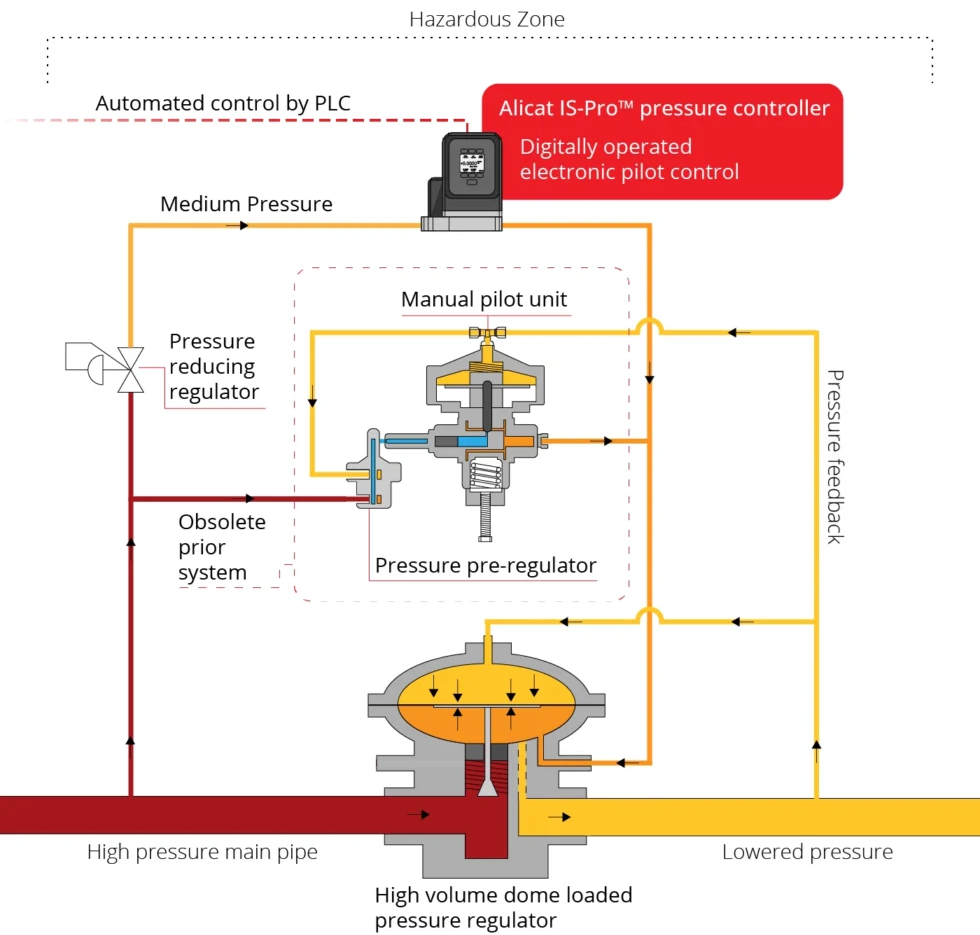
ISPC Series pressure controller providing load pressure in a gas distribution system. Image Credit: Alicat Scientific
Self-Regulating, Remotely Operated, and Intrinsically Safe
The operator opted to implement an IS-Pro™ intrinsically safe pressure controller (ISPC) paired with a dome-loaded regulator assembly to automate gas distribution pressure control along the bypass line.
The IS-Pro is certified for direct installation in Zone 0 (EPL Ga) hazardous environments under IECEx and ATEX, and for North American hazardous location requirements, making it rare among pressure controllers.
The operator opted to keep the traditional mechanical pilot and use this in parallel with the ISPC to integrate automation without sacrificing reliability. The site had been reliant on the pilot-based method for a long time, and continuing to employ this approach ensured that pressure control would continue uninterrupted, should either system become unavailable.
The ISPC supplies electronically modulated load pressure to the dome, allowing precise downstream regulation under normal operation. Should the ISPC lose power or switch to its safe state due to a fault, the mechanical pilot will remain in position and can assume dome control. The ISPC can also operate independently if the pilot is taken offline for maintenance.
This dual-path architecture offered the automation required while continuing to benefit from the robustness of a familiar and field-proven method.
The pilot valves sensed downstream pressure, while pre-regulators reduced the supply pressure for both pilot stages. The ISPC modulates the dome-loading pressure to hold the desired setpoint, continuously comparing measured downstream pressure to its digital target and adjusting pilot pressure where needed to stabilize the outlet.
The ISPC communicates with the site PLC via an RS-485 link, facilitating remote monitoring and setpoint control. Its intrinsically safe design enabled direct installation in the hazardous zone without the need for explosion-proof housings or purge systems.
Outcomes: Automation, Reporting, and Steady Downstream Pressure
Automating the control of a bypass line with the IS-Pro pressure controller allowed fully manual regulation to be replaced with continuous, self-contained proportional pressure control. The system was able to maintain stable outlet pressure without venting methane, enhancing both environmental performance and safety.
Remote control via the PLC meant that operators could adjust pressure targets and log data through the system’s operating lifetime, helping them to rapidly anticipate service and analyze sudden changes. The compact and intrinsically safe configuration streamlined installation and simplified compliance, reducing the need for purging infrastructure and protective housings.
This resulted in the implementation of an efficient, digitally automated pressure control system able to meet the highest standards for hazardous-area operation while delivering reliable network performance under varying load conditions.
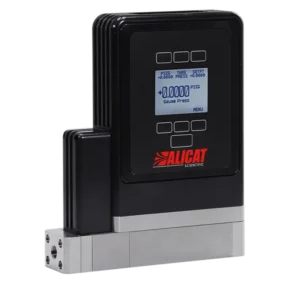
IS-Pro™ pressure controller. Image Credit: Alicat Scientific
Summary
In order to achieve electronic control with a manual, pilot-based regulator system, operators required an instrument that could be integrated into a hazardous, directly line-mounted environment while also delivering precise and automated dome pressure control.
Zone 0 regulation meant that there were stringent requirements surrounding the choice of instrument, limiting options for devices able to operate safely without explosion-proof housings, purge systems, or venting methane during adjustments.
The installation of an IS-Pro™ intrinsically safe controller provided the system with closed-loop remote regulation and a parallel mechanical backup, resulting in consistent pressure stability, improved safety, and resilient redundant control.

This information has been sourced, reviewed, and adapted from materials provided by Alicat Scientific.
For more information on this source, please visit Alicat Scientific.