Abandoned and orphaned wells pose the risk of natural gas leaks with the potential to contaminate aquifers with hydrocarbons, such as methane. Operators undertake plugging and abandonment (P&A) procedures to permanently seal wellbores and prevent fluid leakage, implementing natural gas mitigation from aging or structurally compromised wells. Gas can still escape if seals fail or wellbore cement degrades, however.
To detect such leaks early, operators monitor well integrity, using two key diagnostics: Surface Casing Vent Flow (SCVF) and Surface Casing Pressure (SCP). The first detects gas actively venting from the casing, and the latter identifies pressure buildup in the annular space.
When combined, these measurements offer a comprehensive view of well integrity over time, supporting decisions about re-plugging, pressure relief, or other remediation efforts.
SCP may not develop in some instances, however, even if gas is migrating. For example, this may occur in wells with an open annulus, where the outermost casing is hydraulically connected to the surrounding formation. Pressure will not build unless the gas becomes trapped or encounters resistance; SCVF may be the only observable sign of leakage under these circumstances, making it a key indicator for gas detection.
The detection of pressure buildup via SCP becomes especially crucial when gas migration occurs in partially restricted or closed systems. The relief mechanism may operate independently of instrument precision, but the capacity to reliably detect even modest pressure increases at an early stage is key to operating within established safety limits.
Most well designs feature a Maximum Allowable Annulus Surface Pressure (MAASP), which is the highest pressure that the casing system can safely withstand at the surface.
This value can range from 2500 psi to more than 10,000 psi, depending on factors such as casing strength, formation fracture pressure, cement integrity, and hardware constraints. Pressure relief protocols must be triggered well below this threshold in order to avoid induced formation leaks or casing damage.
The effect of backpressure further complicates monitoring, particularly in SCVF applications. For example, even a modest pressure drop across a flow meter can restrict venting, pushing gas into alternate pathways, or artificially lowering measured flow rates.
A monitoring system must allow gas to flow freely to ensure accurate diagnosis and safe operation. It must do this without adding resistance, while also integrating with existing SCADA infrastructure and operating safely in hazardous environments.
Intrinsically Safe Monitoring
Monitoring surface casing pressure (SCP) and surface casing vent flow (SCVF) necessitates the use of instrumentation able to reliably operate in hazardous environments.
These areas are generally located around the wellhead and are classified as Class I Division 1 or Zone 0, due to flammable gases being present. Conventional flow and pressure instruments typically require explosion-proof enclosures and protected cabling to meet safety standards, adding complexity to system design and deployment in the field.
Alicat® Scientific’s IS-Max™ mass flow meters and IS-Pro™ pressure meters feature ATEX, IECEx, and North American CID1 / Zone 0 hazardous location certifications. These instruments have been specifically designed for direct use in such environments, meeting intrinsic safety requirements and enabling installation at the point of measurement without requiring expensive explosion-proof housings or purging systems.
In outdoor or high-traffic areas, such instruments should still be placed in a protective enclosure or sun shield to ensure that they are guarded against physical impact and direct exposure to sunlight. Rapid deployment across multiple sites is feasible, even with this protection in place, meaning that installation is simpler and saves space compared to conventional explosion-proof systems.
The IS-MAX also combines multiple measurements into a single instrument, reducing system complexity. It can simultaneously monitor volumetric flow, mass flow, barometric pressure, absolute and gauge pressure, relative humidity, gas temperature, and dew point.
The instrument’s multivariate capability streamlines data acquisition by removing the need for separate sensors for each variable. Consistency is improved, and the likelihood of measurement discrepancies between instruments is reduced as a result of all parameters being measured in the same conditions and location.
The meter is able to detect small changes in annular pressure or low-volume vent flows, with accuracy up to ± 0.4 % of reading or ± 0.2 % of full scale. It also supports industrial protocols, such as Alicat ASCII and MODBUS RTU, as well as analog communications suitable for integration with standalone or SCADA logging systems.
A built-in display lets technicians review flow totals or verify system status in the field, without requiring a separate interface.
Case Study 1: Monitoring Without Telemetry Infrastructure
An environmental monitor that was responsible for measuring SCVF at a remote site required a CID1-certified mass flow meter able to operate without digital telemetry infrastructure. There was no serial communication network or SCADA system available at the site, prompting the operator to choose an instrument able to support analog output for basic flow monitoring.
An Alicat IS-MAX meter was deployed and configured to accommodate a flow rate of 50 SLPM at 2.3 bar and 15 °C. The instrument features an onboard digital flow totalizer showing the total vented gas volume and monitoring time elapsed since the last reset, allowing field technicians making site visits to log precise measurements.
This combination of analog output and local display enabled accurate, low-complexity data collection and reporting, despite the absence of modern telemetry.
Case Study 2: Low Flow Monitoring with Minimal Pressure Drop
A gas producer in North America required a surface casing vent in a Class I, Division 2 environment to deliver continuous monitoring of natural gas venting at 25 Sm3 per hour and at pressures below 10 PSIG.
Conventional flow meters introduced excessive pressure drop, hindering natural flow from the annulus and adversely affecting measurement accuracy. This represents a key concern in monitoring surface casing vent flow (SCVF), which can signal well integrity issues or gas migration.
To address these issues, the operator selected a Whisper™ variant of the IS-MAX. This intrinsically safe flowmeter has been specifically engineered for ultra-low differential pressure applications. The IS-MAX features a pressure drop of just 0.07 PSID, enabling precise flow measurement without impacting the well’s natural venting dynamics.
Seamless integration with the central SCADA system was achieved by routing data from the meter via an intrinsically safe barrier to an on-site telemetry shed. This setup facilitated remote monitoring without adding risk to field operations or altering the existing vent line design.
The IS-MAX’s robust performance and its suitability for classified environments maintained compliance with safety and operational standards while enabling reliable, real-time insight.
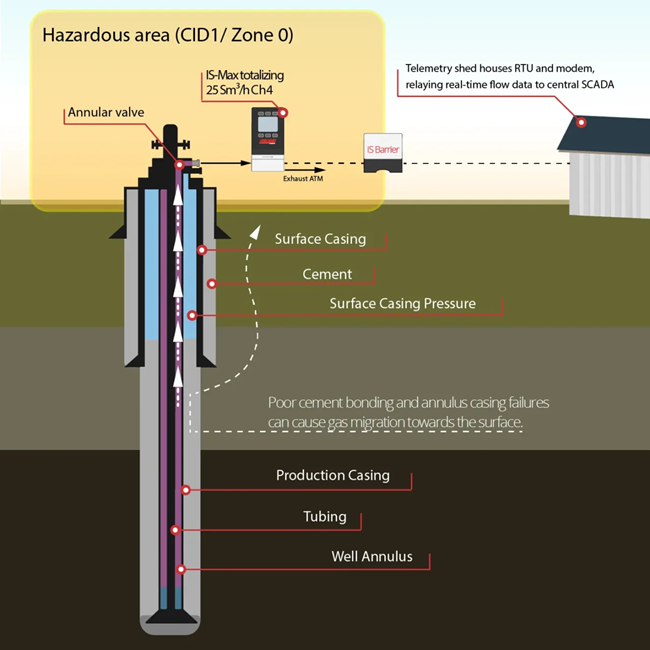
Image Credit: Alicat Scientific
Industry Impact
Effective SCP and SCVF monitoring are key to the effective long-term management of well integrity. Whether performing ongoing surveillance of marginal wells or P&A operations, accurate pressure and flow data allows operators to verify the success of cementing operations, identify sustained venting activity, and prioritize high-risk wells for intervention.
Measured SCVF rates can also be used to estimate gas fluxes escaping the wellbore into the atmosphere or into surrounding formations, supporting risk assessments for natural gas emissions or groundwater contamination.
Environmental regulations are continuing to expand, and emissions accountability is becoming more granular, meaning that high-resolution diagnostics, such as those provided by IS-MAX, are increasingly important to both operational efficiency and compliance.
These instruments allow engineers to accurately measure flow without impacting system pressure, detect leaks earlier, and streamline data acquisition across their well inventory, supporting safer abandonment practices, improved natural gas flow control, and lower remediation costs over time.

This information has been sourced, reviewed, and adapted from materials provided by Alicat Scientific.
For more information on this source, please visit Alicat Scientific.