Pressure vessels are fundamental throughout the oil and gas industry. These vessels are required to operate under extreme pressure and temperature conditions, whether facilitating chemical reactions, storing hydrocarbons, or separating process streams. Inconsistent or imprecise pressure control can result in process inefficiencies, equipment damage, safety risks, and regulatory non-compliance.
For example, under-pressurization can interrupt downstream processes or trigger phase separation issues, while over-pressurization risks vessel failure or the activation of safety relief systems. The pressure control system is, therefore, a key component of the vessel’s design.
Limitations of Conventional Pneumatic Control Systems
Many plants continue to rely on pneumatic control systems built around binary solenoid valves and mechanical regulators. These setups are functional but inherently limited, unable to dynamically adjust to fluctuations in ambient temperature, supply pressure, or source gas composition.
This inflexibility means that valve behavior becomes unpredictable as pressure drifts, introducing instability and errors downstream. Systems with basic pneumatic controls and no proportional valves also suffer from operational delays when switching between feed gases or process lines, increasing the likelihood of flow interruptions, pressure surges, and contamination during transitions.
These limitations can adversely affect the performance of separators, compressors, and downstream instrumentation linked to the vessel.
The Role of Intrinsically Safe Solutions
A regulatory obstacle arises in systems with proportional and electronic control, stemming from electronics’ potential to produce sparks. This means that they must be rerouted or enclosed in potentially bulky protective housings, increasing cost and maintenance complexity while taking up valuable space in already crowded plant settings.
Process engineers must address this challenge by designing systems able to balance responsive and precise pressure control, while complying to safety standards, especially when working in highly regulated hazardous zones. This balance must accommodate both the pressure vessel itself and the critical systems reliant upon it.
Case Study: Integrating a Dual-Valve Pressure Controller
A North American gas company designed a new pressure control system, integrating an intrinsically safe IS-PRO™ dual-valve pressure controller (PCD) to maintain vessel pressure within a Class I, Division 1 explosive location.
This configuration allowed the IS-PRO™ PCD to supply pilot pressure to a dome-loaded pressure regulator (DLPR). This type of regulator employs a pilot signal to control back pressure, as opposed to a mechanical spring.
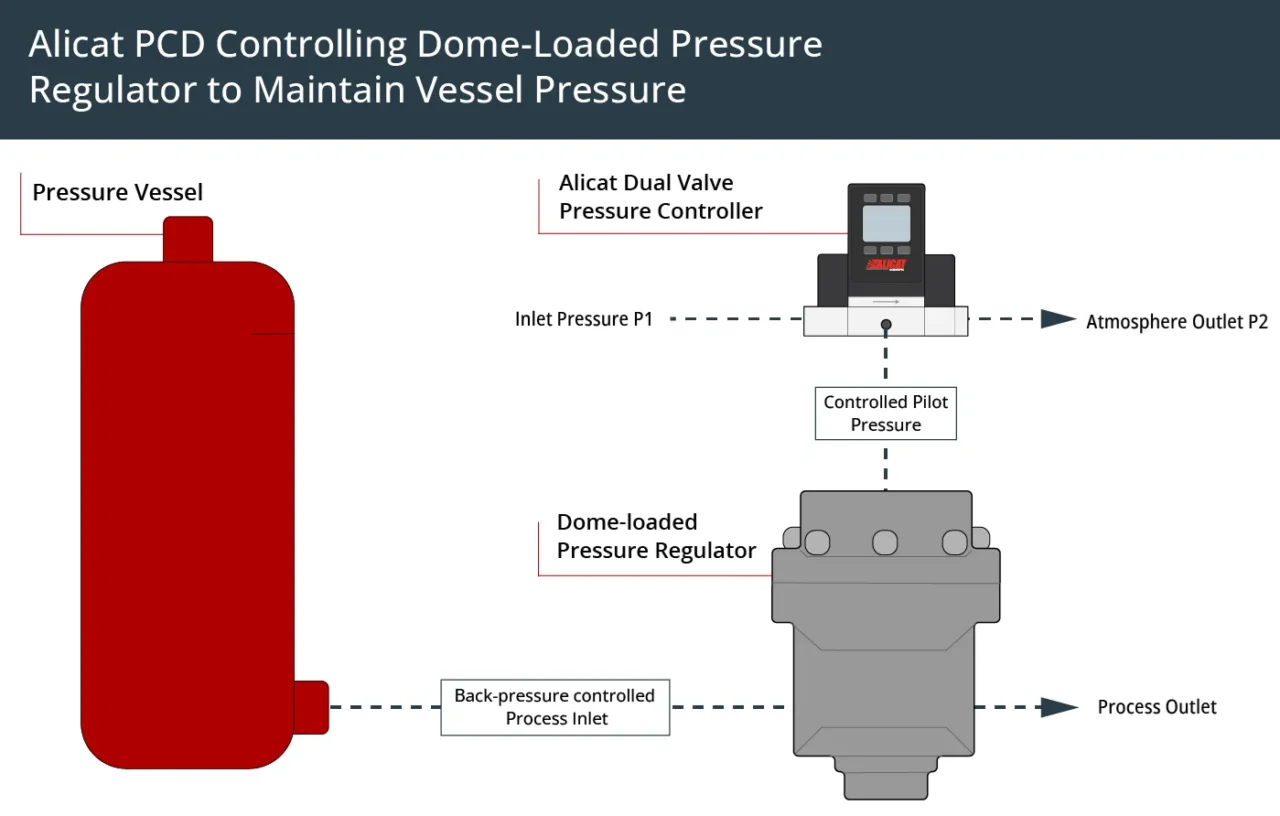
Image Credit: Alicat Scientific
Most notably, this setup offers greater accuracy, faster response times, and improved stability across varying flow rates, making it ideally suited to use in the high-performance and high-risk environments found in oil and gas facilities.
Proportionally adjusting the pilot pressure allows the ISPCD to provide high-resolution, closed-loop control of the DLPR. This enabled automated pressure regulation with no introduction of spark risks in a Class I, Division 1 hazardous location.
The system maintained vessel pressure between 0 and 100 PSIG (0 to ~6.9 bar), accommodating inlet pressures from 120 to 150 PSIG (8.3 to 10.3 bar). The ambient temperature ranged from 20 to 115 °F (−6.7 to 46.1 °C), and exhaust was vented to the atmosphere.
The ISPCD’s compatibility with digital setpoints and its precise control capabilities made it especially well-suited to use with DLPRs, ensuring compliance with intrinsically safe requirements while facilitating reliable pressure management.
System Integration and Measurable Benefits
The capacities of the IS-PRO, such as its ability to measure gauge, absolute, and differential pressures, and its ability to communicate data via digital or analog signals, were key to its seamless integration into the facility’s current SCADA infrastructure. This enabled accurate pressure measurement and proportional control, enhancing overall system efficiency as well as vessel safety.
Pressure vessels must perform reliably under volatile conditions in critical oil and gas operations, meaning that precise pressure control is non-negotiable. The engineer in this case study replaced manual, static control with automated, closed-loop control by integrating the IS-PRO™ dual-valve pressure controller.
This setup ensured consistent pressure regulation and a more efficient process that was better aligned with the demands of contemporary oil and gas infrastructure.

This information has been sourced, reviewed, and adapted from materials provided by Alicat Scientific.
For more information on this source, please visit Alicat Scientific.