Sponsored by InterpowerReviewed by Olivia FrostApr 21 2026
Whether a two-function outlet housing a filter, or an IEC 60320 hospital-grade power entry module with five integrated functions (e.g., inlet, voltage selector, switch, fuse, and filter), such modules, inlets, and outlets have one thing in common: the EMI/ RFI filter.
So, whichever module, inlet, or outlet is required, EMI/ RFI filters help to limit electrical noise from natural disturbances, such as lightning and solar flares, or human-made EMI, including power lines, cell towers, or interference from nearby appliances and equipment. Effectively, filters reduce or shunt away potentially harmful, unwanted EMI/ RFI that disrupts office equipment and devices, as well as larger-scale industrial equipment.
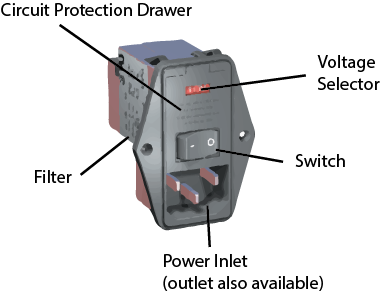

Image Credit: Interpower
In medical applications, filters help reduce incoming noise, which could disrupt sensitive equipment for diagnostic testing, such as CT scanners, X-ray machines, medical-grade treadmills, and ECMO machines. Moreover, the noise generated by the equipment itself may impact other key appliances that are directly attached to the patient. This means that the majority of medical-grade equipment in the patient’s vicinity must not exceed leakage current levels of 200 mA.
Leakage current refers to the current that radiates onto the ground plane owing to the surrounding electrical fields generated by some of the filter’s components. Standard filters tend to demonstrate a leakage current in the range of two to five mA; medical-grade filters have been specifically developed to be rated in microamps (two to five µA) to help further reduce potential leakage.
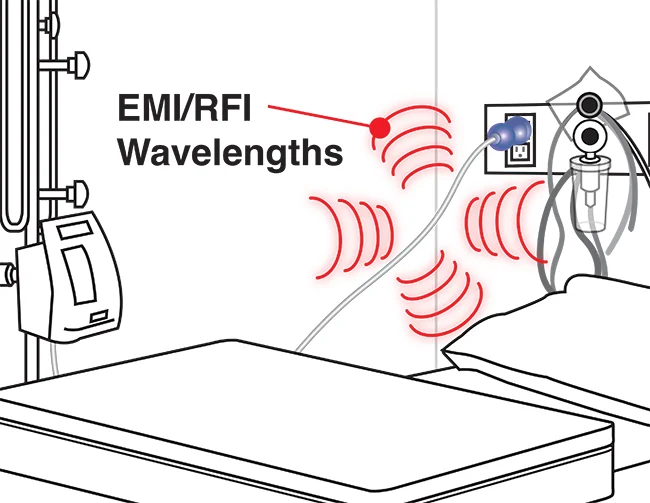
Image Credit: Interpower
Inside an EMI Filter
Filters essentially help to deliver a ‘clean’ electricity supply to the equipment. The circuit components in a filter include inductors, resistors, and capacitors. Medical-grade filters differ as the capacitors between the circuit conductors are removed to limit leakage current values.
Also, the way that inductors, capacitors, and resistors are arranged plays a key role in reducing unwanted EMI, as it is diverted to the ground. This is a vital feature in equipment where leakage current values have stringent protocols to ensure patient safety in accordance with international or country-specific safety standards.
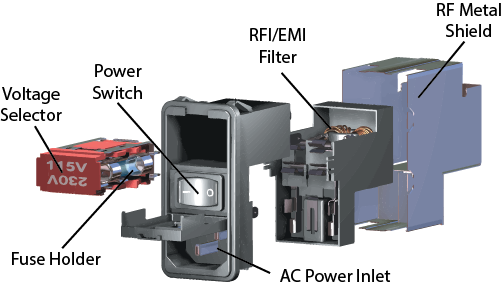
Image Credit: Interpower
Interpower® filtered power entry modules can be purchased with or without a metal shield, which is generally used in high-frequency applications. Whenever a company specifies a module with a filter, it is beneficial to acquire samples of the filters to test across applications to make sure that they will perform to expected current values. This stems from the fact that filter performance specifications are based on an industry-standard 50-ohm test circuit, and certain design elements of any given application may change the way a filter reacts when connecting the circuits
EMI/ RFI can be reduced by avoiding the use of unnecessarily long electrical cords, which often have antenna-like qualities, attracting wavelengths of certain signals.
In regard to medical equipment, if you go beyond the 12–15 feet length for medical cords, it becomes much more difficult to meet the equipment standard requirements for resistance and leakage current for the entire system. You don’t want high levels of EMI/RFI in equipment attached to the patient.
Dan Ford, Technical Support Specialist, Interpower
Another often neglected factor is the calculation of the correct cord length in electrical designs; the EMI/ RFI filter can be impeded by an excessive number of cords containing multiple copper wire conductors.
Voltage Drop and Cord Length Calculation
It is crucial to understand cord calculation and voltage drop when developing electrical designs. The white paper below examines the inherent dangers associated with long cable lengths and discusses the maximum percentage that a cable can be derated and still meet UL and CSA requirements. This will allow customers to get access to the appropriate tools in order to calculate voltage drop for the cords in new electrical designs.

This information has been sourced, reviewed, and adapted from materials provided by Interpower.
For more information on this source, please visit Interpower.