Sponsored by Vitrek, LLCReviewed by Maria OsipovaApr 14 2026
Many military/defense and commercial aerospace test cells are still reliant on aging analog instruments that, though functional, introduce risk due to limited digital data access, legacy components, and calibration challenges. As testing demands evolve, the industry is moving toward compact, digital platforms that improve data visibility by simplifying workflows.
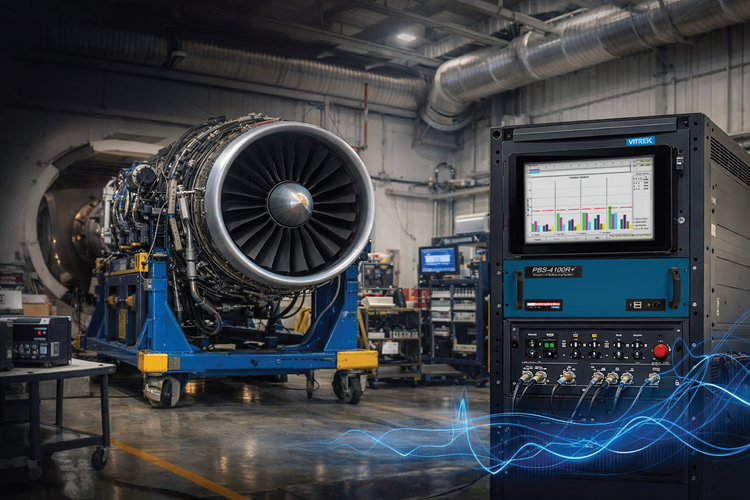
Image Credit: Vitrek, LLC
One Vitrek customer faced such a challenge across multiple engine test cells. Their solution was to replace two conventional systems with a PBS eXpress R+, enabling digital data acquisition, faster setup, and automated reporting.
The Challenge
The customer’s test cells were structured around a mix of aging instrumentation, including TrigTek tracking filters, Endevco 6634C signal conditioners, and a Dactron vibration monitoring system. While operational, these systems had become increasingly difficult to support and lacked the necessary flexibility for contemporary workflows.
Their goal was to practically modernize the system, so it could be integrated into existing environments while delivering expanded capabilities, without a full redesign.
Key requirements included:
- Two-speed (tachometer) inputs and four vibration channels
- (3) 0-10 V DC order-tracked outputs
- Pre-configured engine parameter sets
- In-place calibration
Beyond these specifications, the customer required a system that could scale across multiple test cells and simplify technician workflows without adding complexity.
Phase 1: Replacing Legacy Tracking Filters
MTI Instruments’ (a Vitrek brand) PBS eXpress R+ replaced outdated tracking filters across five test cells. Built on PBS 4100+ technology, the system delivers vibration analysis, one-shot balancing in a compact system, and digital order tracking.
Not only did the system replicate legacy functionality, but it also improved usability and added digital data output. It was also employed in additional test cells, replacing existing signal conditioners and standardizing the settings.
Phase 2: Replacing Dactron Monitoring
With PBS already producing digital vibration data, the customer expanded its role. Vitrek formulated a customized software enhancement to support the monitoring and reporting workflows previously handled by Dactron. This remodeled PBS eXpress R+ into a platform for centralized data acquisition and reporting.
Results
Conventional tracking filters were replaced with digital order tracking, which improved measurement flexibility and consistency across the test cells. Vibration monitoring capabilities were simultaneously expanded into further test environments, enabling the customer to standardize operations across their facility.
By consolidating multiple legacy systems into one platform, the PBS eXpress R+ reduced setup time and overall operational complexity. Transitioning to digital data acquisition also enabled automated reporting, bettering both data accessibility and process efficiency.
In addition, new capabilities - including Ethernet-based control, remote access, and seamless integration with active reporting tools - delivered a more connected and scalable test environment.
Modernizing without Rebuilding
Drop-in replacement: Corresponds to existing test cells while replicating legacy functionality with digital performance.
System consolidation: Replace monitoring systems, tracking filters, and signal conditioners with one platform.
Digital workflows: Automate storage, reporting, and data collection for quicker and more reliable results.
Fast deployment: The system can be implemented quickly with minimal training and disruption. Its application is simple, with minimal disruption to existing operations. The majority of teams are fully operational within days using intuitive software tools such as the Trim Balance Wizard™, reducing training time and accelerating ROI.
Conclusion
The PBS eXpress R+ enabled the customer to modernize their test cells without the disruption, risk, or cost of a full system overhaul. By replacing multiple legacy analog systems with a single, flexible digital platform, they simplified their test architecture, improved workflow efficiency, and enhanced measurement capabilities.
This transition reduced setup time, eliminated reliance on outdated hardware, and introduced automated data acquisition and reporting, creating consistency and repeatability across all test cells.
Of similar importance, the platform provides the flexibility to adapt as testing requirements evolve, supporting new configurations, engines, and data requirements without adding system complexity.
This results in a streamlined, cost-effective, and scalable test environment designed for long-term reliability and future growth.
This information has been sourced, reviewed, and adapted from materials provided by Vitrek, LLC.
For more information on this source, please visit Vitrek, LLC.