In this interview, Lexi Patania, Design and Applications Engineer at Tinius Olsen, discusses how its digital melt flow indexers, such as the MP1500, enhance testing efficiency and precision, adapting to the evolving needs of polymer and plastics analysis.
Melt flow indexing has always played a crucial role in polymers and plastics testing. How is it adapting to the increasingly digital landscape of materials testing in general?
Modernization of the materials testing environment has been on a roll for quite some time. Some examples are what we now consider common: computers that provide digitized data, automation that improves efficiency, and networked environments that share information seamlessly. Melt flow testing’s central role in the behavior analysis of plastics and polymers during processing and production is undergoing the same advancements in how it performs and the detailed data it can provide.
Load cell-based melt flow indexers use integrated sensors and software platforms that can monitor a host of testing factors, like piston displacement, applied load, temperature stability, and extrusion behavior, in real time.
By coupling the motor-driven mechanisms and load cells that apply and control the test force, with real-time feedback on precise loading conditions throughout the test, researchers and engineers can analyze melt behavior more thoroughly than was previously possible.
What are some factors that make the MP1500 such an important evolution in melt flow index testing?
There are three ways that a digital system, like the MP1500, changes the landscape of melt flow testing.
First, from a technology perspective, the instrument can detect very small variations in flow behavior that conventional systems may overlook, thanks to the load cell technology. This improved sensitivity can provide deeper insights into polymer processing characteristics.
Second, it impacts production efficiency. This is because the digital control enables faster test setup and easier adjustments, particularly when laboratories must test materials under multiple load conditions or test various compositions, so mainly non-static testing environments.
Third, and equally as important, is that loads are applied electronically rather than through manual weight placement; the testing process becomes more automated, improving operator safety as well as repeatability across the testing spectrum. (Figure 1)
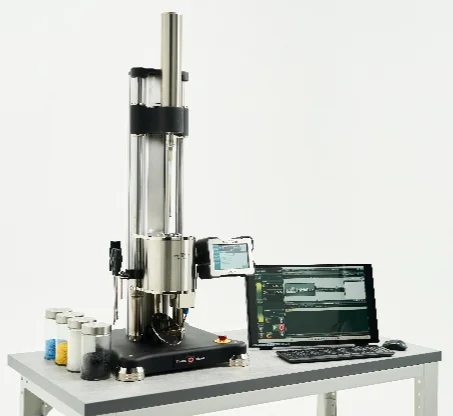
Figure 1. Loadcell-based MFIs, like the MP1500, provide a streamlined, safe workspace with no loose ‘weights’ or unnecessary clutter. Image Credit: Tinius Olsen
This is a big industry shift. What have been the most surprising reactions to the MP1500?
We’ve had the system at several shows since its introduction, and yes, the technological improvements to testing, reliability, accuracy, etc. that I mentioned earlier are all top of mind. But when we start to discuss all the other ways this system can help a materials testing environment, people are getting even more excited.
For instance, if you’ve run one of these machines, you know how important it is to make sure it’s properly cleaned between batches. This is now done simply, automatically. The operator can be facilitating other tasks instead of spending time cleaning the barrel.
There’s also an auto-cutoff feature, where the machine takes care of cutting the sample at the end of the test. Minor? Maybe, but any piece of the process that can help ease the burdens across the testing environment helps streamline the whole operation. (Figure 2)
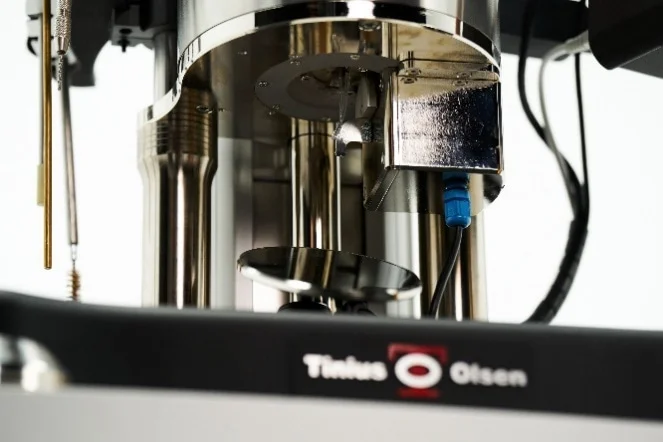
Figure 2. Users are finding ease-of-use features, like the MP1500’s automatic cut-off tool, in digital MFI systems equally as important as data-focused advancements. (pic. in standby mode, awaiting a sample from the barrel). Image Credit: Tinius Olsen
And that’s what people are looking for: ways to optimize both man and machine, run better tests, and evaluate material properties. So, in addition to the digital advancements, it’s even some of the smaller improvements that make the MP1500 so well received.
MFIs have been around for decades across countless industries. With such an existing install base, where do you see the MP1500 making inroads?
Tests that require multiple setups and different composite batches are the first to realize the benefits of a loadcell-based unit. So, labs, industrial research and development, colleges, and universities are constantly battling the physicality and unpredictability of manual intervention. With a digital MFI, many of the operator safety risks are removed, and the results are far more repeatable and predictable.
Another area is companies with a strong forecast for automation. As we’ve seen over the past several years, no industry is immune to the advances of AI, automation, and machine learning. So, while the materials testing environment may be a little slower on the uptake, make no mistake. Digital technology is proliferating on the production floor. Having an MFI that is digitally capable of keeping up with the rest of the facility will be paramount.
But let’s not forget the tried-and-true deadweight MFI. For production facilities with limited testing variables, running multiple machines of the same composite, for instance, these manual machines are doing just fine. The market adoption here is going to be driven by the overall test environment. As machines age and upgrades are needed, digital MFIs can be brought onto the scene.
And these new systems still adhere to ASTM D1238 and ISO 1133, so across the board, when to implement a digital MFI depends on the technology roadmap you’ve set for your materials testing process, as well as your production efficiency.
About the Interviewee:
Lexi Patania, Design & Applications Engineer, Tinius Olsen

This information has been sourced, reviewed, and adapted from materials provided by Tinius Olsen.
For more information on this source, please visit Tinius Olsen.
Disclaimer: The views expressed here are those of the interviewee and do not necessarily represent the views of AZoM.com Limited (T/A) AZoNetwork, the owner and operator of this website. This disclaimer forms part of the Terms and Conditions of use of this website.