An artificial intelligence (AI) platform for end-to-end product development integrates all stages of the R&D lifecycle, including data acquisition, experiment design, analysis, collaboration, compliance, and commercialization, into a unified system.
Unlike traditional systems that operate in silos, it combines the core functionalities of legacy tools such as LIMS, ELN, SDMS, and point analytics solutions into a single, interconnected environment.
This connectivity enables smooth data flow across teams, departments, and locations, removing hurdles that have previously hampered effective collaboration and quick decision-making.
A typical enterprise research and development organization collects data from a variety of sources, including lab instruments, manual input, legacy software, ERP systems, and external databases. Fragmented systems make it difficult to aggregate this data, leading to inefficiencies, inaccuracies, and missed opportunities for innovation.
An AI platform eliminates these pain points by establishing a structured, unified data layer that harmonizes data from all sources while maintaining consistency, accuracy, and ease of access throughout the whole R&D value chain.
As well as being a management platform, it drives innovation. Organizations can use proprietary AI and machine learning embedded in the core to perform predictive analytics, automate routine processes, optimize experimental design, and uncover insights that would be impossible to obtain manually.
The platform transforms raw trial data into actionable intelligence, enabling teams to make faster, more informed decisions and apply AI across all stages of product development.
The platform is organized into three major modules that cover the entire product development lifecycle. The R&D module (ELN + LIMS) helps scientists and formulators collect experimental data, manage samples, and perform AI-assisted formulation operations.
The Quality module (QC-LIMS + QMS) provides quality teams with tools for batch testing, release management, CAPA, and document control, which include both quality control and quality management activities.
The Product Lifecycle Management (PLM) module links product teams to versioning, impact analysis, and market-ready processes.
These three modules flow into a unified data layer, which then powers a proprietary AI/ML engine. This structure helps achieve three key business objectives: increased innovation, increased productivity, and reduced risk.
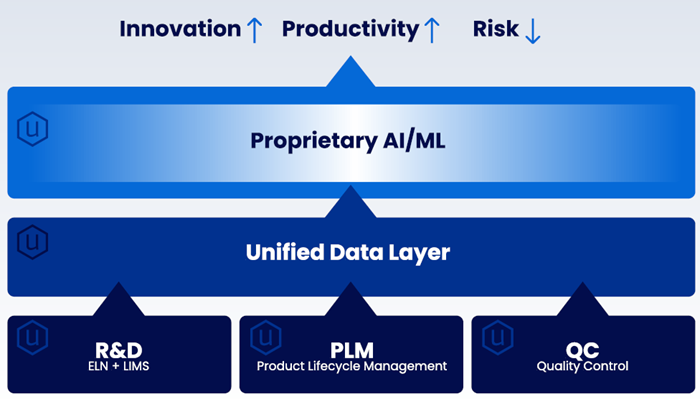
Image Credit: Uncountable Inc.
Why Large Enterprises Need an AI Platform for End-to-End Product Development
For large enterprise R&D labs, the scope and complexity of operations demand a solution that goes beyond what standard technologies can provide.
These organizations usually run many labs across different locations, generate massive amounts of experimental data, and must maintain consistency across geographies, teams, and regulatory environments, all while accelerating product development schedules.
There is now a new urgency: the AI imperative. Enterprise R&D groups are under increasing pressure to use AI to remain competitive. But AI demands connected, high-quality, structured data that fragmented older systems cannot provide.
Organizations that cannot make their data AI-ready will be at a significant disadvantage as competitors use AI to make decisions faster, reduce failures, and innovate at scale.
An AI platform for end-to-end product development satisfies large organizations' operational and strategic needs.
- Scalability and Flexibility: Designed to support growing data volumes, complicated workflows, and different multinational teams without the need to rebuild infrastructure after expansion or acquisition.
- A Single Source of Truth: Centralized data management provides all teams, from bench scientists to R&D executives, with consistent and up-to-date information, reducing redundancy and errors caused by isolated systems.
- Enterprise System Integration: Integrates seamlessly with ERP, CRM, supply chain, and external systems, ensuring R&D data is not isolated from the overall business.
- Compliance and Security at Scale: Advanced compliance features and data security measures reduce the risk of non-compliance in international operations.

This information has been sourced, reviewed, and adapted from materials provided by Uncountable Inc.
For more information on this source, please visit Uncountable Inc.