Merck KGaA, Darmstadt, Germany, is a global leader in science and technology, bringing together three specialized, innovation-focused businesses in the life sciences, healthcare, and electronics sectors. Its electronics division, EMD Electronics, develops chemicals, formulates materials, and synthesizes materials for semiconductor manufacturers.
As technology continues to evolve, scientists at EMD Electronics have increasingly adopted advanced analytics, including artificial intelligence (AI) and machine learning (ML), to accelerate the development of new chemicals that meet customer requirements.
To fully leverage these analytical capabilities for discovery and product development, however, EMD Electronics needed a way to aggregate and organize data into a format that was both machine-readable and meaningful to scientists.
Although their raw data files could be processed technically, they lacked the context, structure, and presentation needed for effective analysis.
To overcome this challenge, EMD Electronics partnered with Revvity Signals and Scitara to implement a connected, cloud-native solution that unifies and structures research data. This strategic collaboration streamlined and automated data integration, creating the foundation for advanced analytics and AI-driven insights.
The Challenge of Interpreting and Using Fragmented Data
As part of the effort to develop new materials for semiconductor chips, scientists at EMD Electronics rely on a wide range of experimental techniques to evaluate potential material candidates. However, the company faced challenges in collecting and managing the resulting data.
For example, during atomic layer deposition, in which thin layers of material are deposited onto wafers, a range of metrology instruments, including ellipsometers and infrared spectrophotometers, analyze the materials and generate data on characteristics such as thickness and electrochemical properties.
The EMD Electronics team needed a unified, structured system capable of integrating data from these diverse sources so the information could be used to its fullest potential.
They also required a more effective and dynamic way to visualize their data, replacing raw numerical output with intuitive graphical representations. In addition to improving data interpretation and supporting better decision-making, these visualization tools would also enhance collaboration.
Connecting the Lab with Automated Data Capture and Transfer
To address these challenges, EMD Electronics adopted a streamlined, automated approach to data integration. By implementing Scitara's integration technology, the team can collect data directly from scientific instruments, while Signals Notebook captures non-instrument-generated data from experimental research.
This integrated approach ensures that both instrument-generated and manually entered data are consistently structured and stored in a secure, centralized repository. To put this strategy into practice, EMD Electronics established a systematic, step-by-step process for data transfer and integration:
Step 1: Data Collection. Whether instrument data is stored on-site or in the cloud, Scitara's integration technology collects and transfers raw data to Signals Notebook for interpretation. The platform supports flexible, bidirectional data exchange across multiple systems, enabling seamless integration of diverse data sources.
Step 2: Simultaneous Data Routing. As data is transmitted to Signals Notebook through the joint solution developed by Revvity Signals and Scitara, it is simultaneously directed to a relational database where it can be organized and structured. At this stage, the EMD Electronics team develops an ontology layer that defines relationships and context across datasets, enabling richer data interpretation and integration.
Step 3: Data Structuring. After passing through the ontology layer, the data is prepared for downstream analytics. Scientists can access and select relevant datasets directly within Signals Notebook, enabling more informed experimental design and deeper data exploration.
Step 4: Scientific Analysis. With structured and integrated data available, scientists can build dashboards and conduct advanced analytics. This supports flexible, dynamic exploration, allowing users to "plot anything versus anything else," while enabling data-driven decision-making throughout research workflows, including applications involving AI and ML.
Now we can send something to our Signals Notebook at the same time that we send it to the relational database, and then it is up to the scientists if they want to pull it into their experiment or not.
Kyle Mouallem, Semiconductor R&D Digitization Lead, EMD Electronics
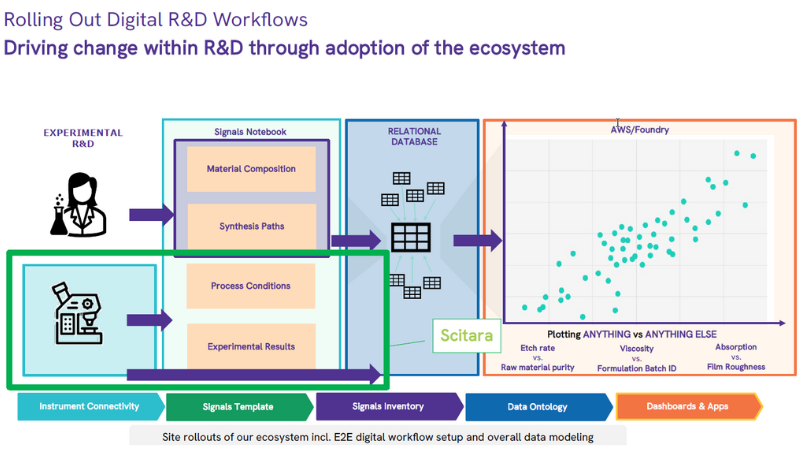
EMD Electronics uses Scitara’s integration technology to send data simultaneously to Signals Notebook and a relational database. The structured data is then automatically transferred to a data analysis platform. Image Credit: Revvity Signals Software Inc.
Key Results and Benefits
The implementation of Signals Notebook together with Scitara's integration technology has enabled scientists at EMD Electronics to spend more time analyzing and interpreting data instead of managing it.
Researchers can now capture every data point generated from laboratory measurements and create visualizations, including graphs, that make it easier to communicate findings with customers while improving collaboration and interpretation. Because the data is now unified and properly structured, it can also be used effectively with AI and ML applications.
Looking Forward to Predictive Insights and Continuous Optimization
By integrating laboratory instruments with Signals Notebook through the joint solution developed by Revvity Signals and Scitara, EMD Electronics has established the essential infrastructure for a modern laboratory, built around automated processes that integrate data from every available source.
Through the structuring, standardization, and contextualization of research data, the company has enabled advanced analytics, including data visualization, AI, and ML.
In the future, EMD Electronics plans to expand these capabilities even further by incorporating additional AI functionality, including extracting and analyzing data from results screens on legacy instruments that do not support data export, as well as deploying AI agents for predictive insights and continuous optimization.
As all the information flows, [it] is audited and controlled. We are now connecting the lab IT with the corporate network and the cloud solution, which is becoming more and more standard.
Scitara Corporation

This information has been sourced, reviewed, and adapted from materials provided by Revvity Signals Software Inc.
For more information on this source, please visit Revvity Signals Software Inc.