A sulfonate-functionalized porous framework enables rapid sodium-ion transport while stabilizing both battery electrodes during high-rate, long-term cycling.
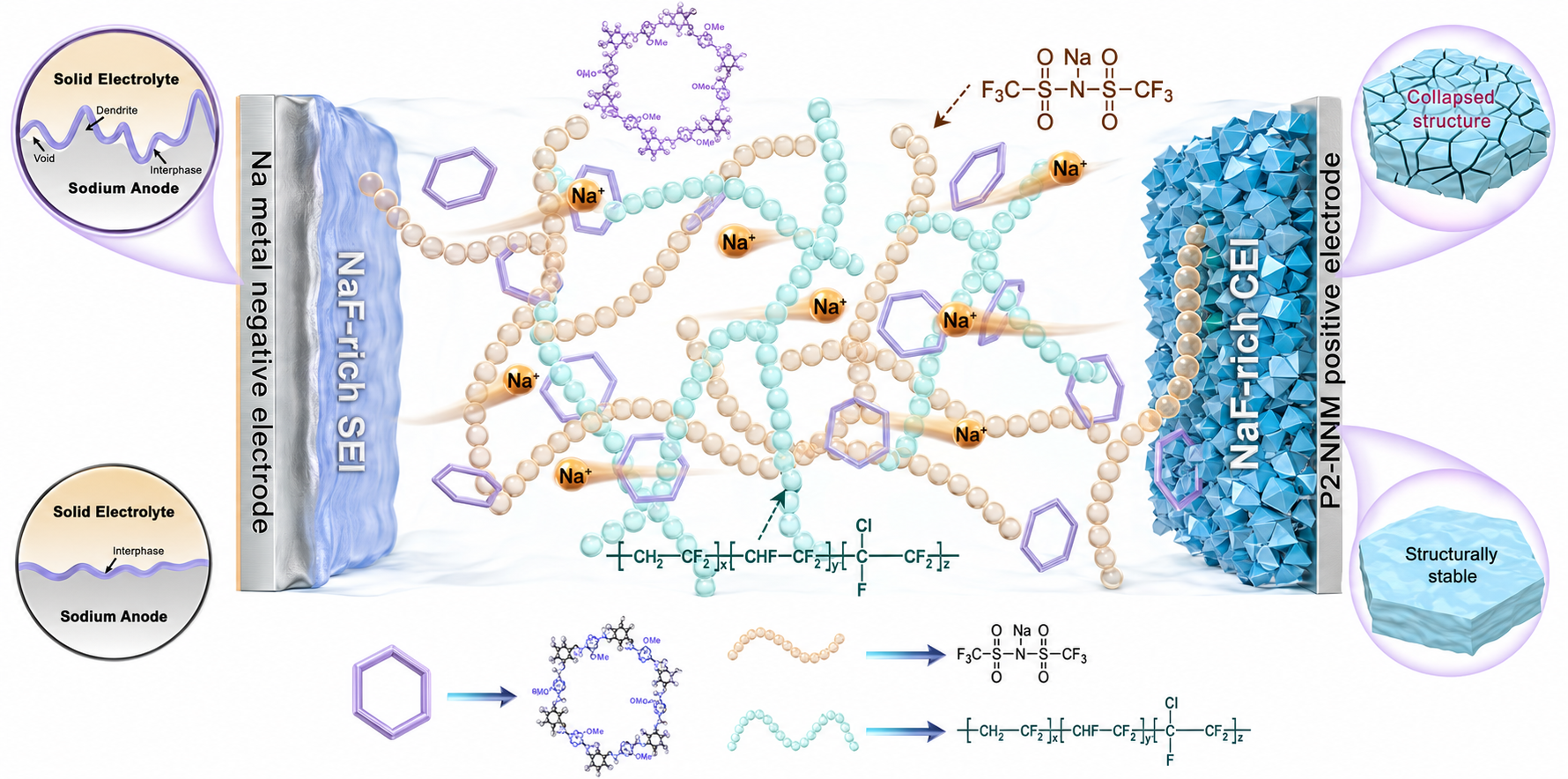
Schematic of TpPa-SO3-Na COF-based solid-state sodium batteries and structural characterization of TpPa-SO3-Na material. (a) Schematic illustration of the COF/PNSE composite electrolyte film in Na||NNM solid-state batteries. Paper: Engineering ion migration and interface chemistry via covalent organic framework-enhanced polymer electrolytes for fast-charging sodium solid-state batteries
In a recent research article published in the journal Nature Communications, researchers developed a sulfonate-functionalized covalent organic framework-enhanced polymer electrolyte that significantly improves ionic conductivity and interfacial stability for fast-charging sodium solid-state batteries.
Challenges in Solid-State Sodium Batteries
Solid-state sodium batteries are promising for safe, cost-effective energy storage due to sodium’s abundance and favorable electrochemical properties. However, their practical deployment is hindered by challenges in achieving both fast ion transport and stable electrode–electrolyte interfaces, especially under fast-charging and prolonged cycling conditions.
Traditional polymer electrolytes often suffer from slow Na+ mobility owing to high polymer crystallinity and weak ion coordination, limiting their ionic conductivity. Incorporation of inorganic fillers has shown some benefits but also faces issues such as particle agglomeration and mechanical mismatch, which promote dendrite formation and interface degradation.
Covalent organic frameworks (COFs), crystalline polymers with ordered nanopores and tunable functionalities, have emerged as promising fillers that can provide continuous ion transport channels and enhance mechanical robustness.
However, sodium-ion systems require COFs with appropriately engineered pore sizes and chemical groups to facilitate effective Na+ conduction and interface stability, an area of design still underexplored.
Design and Synthesis of COF/PNSE Electrolytes
In this work, the authors synthesized a covalent organic framework, TpPa-SO3H, via a Schiff-base condensation reaction between 1,3,5-triformylphloroglucinol and 2,5-diaminobenzenesulfonic acid, and then converted it to TpPa-SO3Na via sodium-ion exchange using sodium acetate. The product formed ordered hexagonal pores functionalized with dense −SO3-Na+ groups designed to serve as directional Na+ transport sites.
Characterization techniques, including X-ray diffraction (XRD), scanning electron microscopy (SEM), transmission electron microscopy (TEM), and elemental mapping, verified the high crystallinity, morphology, and chemical uniformity of the COF.
This COF was then incorporated into a fluorinated PNSE polymer matrix, which offers high dielectric properties and polar groups (C–F, C–Cl) that aid polymer reinforcement and further ion dissociation. The resulting COF/PNSE composite electrolyte was fabricated with interpenetrating networks to combine mechanical strength and ionic pathways for efficient sodium-ion conduction.
Molecular dynamics (MD) simulations were employed to analyze Na+ transport dynamics at the molecular level within the composite electrolyte compared with the COF-free polymer matrix.
Electrochemical tests included ionic conductivity measurements, cycling and rate tests, linear sweep voltammetry (LSV) for electrochemical stability windows, and operando electrochemical impedance spectroscopy to probe kinetic processes during cycling.
Morphological and chemical changes at electrode–electrolyte interfaces were studied using X-ray absorption spectroscopy (XAS), X-ray photoelectron spectroscopy (XPS), and scanning electron microscopy after extended cycling. Additionally, 1 Ah-class pouch cells were assembled to demonstrate scalability.
Ion Transport and Interface Analysis
The synthesized TpPa-SO3Na COF exhibited high crystallinity, with sharp XRD peaks and well-defined ionic channels, as confirmed by TEM and elemental mapping. When incorporated into the PNSE polymer, the composite electrolyte exhibited a high ionic conductivity of 1.2 mS cm-¹ at 30 °C, far exceeding that of the polymer alone.
Molecular dynamics simulations showed Na+ ions preferentially accumulated near the −SO3 groups in the COF pores, creating continuous, directional conduction pathways, while the polymer-only system displayed random ion coordination and poor mobility. The COF also enhanced mechanical strength, while the composite promoted formation of a gradient, NaF/Na2O-rich solid electrolyte interphase (SEI) that suppressed dendrite growth on the sodium anode.
Symmetric sodium cells with the composite electrolyte operated stably over 6,750 hours at 0.1 mA cm-² and 0.2 mAh cm-², with low polarization of approximately 85 mV. In separate measurements, the electrolyte achieved a critical current density of 1.9 mA cm-². At the cathode interface, the COF/PNSE composite electrolyte promoted a gradient, fluorine-rich cathode electrolyte interphase (CEI) containing NaF/Na2O nanocrystals that inhibited transition metal dissolution and electrode degradation under high voltage. This enabled Na||NNM coin cells to deliver 82.5 mAh g-¹ at 1 A g-¹, with 77.2% capacity retention after 1,000 cycles, 83.5% after 2,000 cycles, and stable cycling up to 4.2 V with 92.7% capacity retention after 180 cycles.
Operando impedance and distribution-of-relaxation-times (DRT) analyses confirmed reduced interfacial resistance and enhanced ion transport. Scaling to a 1 Ah hard-carbon||O3-NFM pouch cell showed 87.3% capacity retention after 488 cycles, demonstrating scale-up potential. This design addresses transport and interfacial challenges, advancing fast, durable solid-state sodium batteries.
Implications for Fast-Charging Na Batteries
This study presents a structurally integrated composite electrolyte comprising a sulfonate-functionalized covalent organic framework embedded within a high-dielectric fluorinated polymer matrix for sodium solid-state batteries.
The engineered COF provides ordered nanopores and functional groups that greatly facilitate Na+ conduction by enabling uniform ion migration pathways and enhancing reinforcement of the polymer matrix. This design yields a high ionic conductivity of 1.2 mS cm-¹ at 30 °C and gradient, NaF- and Na2O-rich interphases at both electrodes that suppress dendrite growth and transition metal dissolution. Electrochemical evaluations demonstrate exceptional cycling stability, high-rate capability, and good capacity retention in both coin cells and a laboratory-scale 1 Ah pouch cell.
The work provides a materials-design strategy for the further development of high-rate, long-life, and durable sodium-metal batteries, while supporting future efforts to improve their practical energy-storage performance.
Source:
- Mu, Y., Li, C., et al. (2026). Engineering ion migration and interface chemistry via covalent organic framework-enhanced polymer electrolytes for fast-charging sodium solid-state batteries. Nature Communications. DOI: 10.1038/s41467-026-75417-7, https://www.nature.com/articles/s41467-026-75417-7