Sponsored by PAC L.P.Reviewed by Ify IsiborOct 27 2026
For those working in labs that conduct flash point testing for aviation fuel compliance, this topic is more important than ever. The flash point methods used, the analyzer run, and even the instrument settings used in the background can all directly influence whether results are valid under ASTM D1655 and D7566.
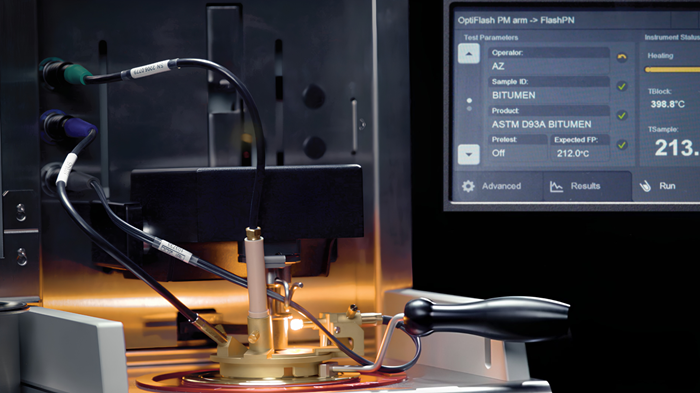
Image Credit: PAC L.P.
As flash point instrumentation becomes increasingly automated and feature-rich, there is an increasing misunderstanding about method equivalence, associated results, and what constitutes a referee method result. The ASTM guidelines are clear: flash point approaches are not interchangeable.
Correlated Results Are Not Permitted
Some current flash point analyzers incorporate software that automatically transforms test findings from one method to an approximated equivalent of another. In some situations, a result obtained by ASTM D93 or D7094 may show on a report as a "D56 equivalent." While this may be useful operationally, ASTM D1655 Section 11.1.3 explicitly states:
“Correlated flash point test results are not allowed.”
The specification emphasizes that only the apparatus specified for each test method may be used. Even if a correlated value is quantitatively similar to another method, it is not regarded as a legitimate result for conformance to specification.
Why Different Methods Produce Different Results
The explanation for this is simple: flash point is not a fixed physical constant, like density or boiling point. Rather, it is an operationally defined attribute influenced by the test apparatus's design, ignition source, heating rate, sample cup geometry, and test process.
ASTM and IP flash point methods use similar terminology to acknowledge this reality:
“Flash point values are not a constant physical chemical property of materials tested. They are a function of the apparatus design, the condition of the apparatus used, and the operational procedure carried out.”
Simply put, changing the procedure changes the measurement.
Understanding the Bias Between Methods
ASTM has also shown measurable bias amongst flash point methods compared to ASTM D56, which is still the approved reference method under ASTM D1655 and D7566.
According to ASTM D1655, Table 1, footnote K:
- ASTM D93 and D7094 can read temperatures up to 1.5 °C higher than D56
- IP 170 and IP 534/ASTM D7236 can read temperatures up to 0.5 °C higher
- ASTM D3828/IP 523 can read temperatures up to 0.5 °C lower
These conclusions are based on ASTM's own 2020 research on several aviation fuels.
What a D56 Referee Result Really Means
ASTM D56, the TAG closed cup tester, serves as the referee technique for aviation fuels and SAF. This means that in the event of a conflict, the test method will take precedence.
A flash point result should only be represented as a D56 referee result if the entire test was carried out with D56 apparatus and procedures. Results from Abel, Pensky Martens, small-scale, and micro-flash point instruments are still valid for routine testing, but they are not D56 results and should not be referred to as such.
Confidently Supporting Compliance
As laboratories navigate changing aviation fuel specifications and flash point testing regulations, maintaining method integrity and clear reporting becomes increasingly vital.
PAC's OptiFlash is designed to facilitate compliance flash point testing across ASTM and IP methods, allowing laboratories to maintain trust in method-specific reporting, operational consistency, and alignment with standards.

This information has been sourced, reviewed, and adapted from materials provided by PAC L.P.
For more information on this source, please visit PAC L.P.