Researchers use ultrasound and CO2 to reshape pores in cement paste, then test the effects on strength, sound transmission, and CO2 uptake.
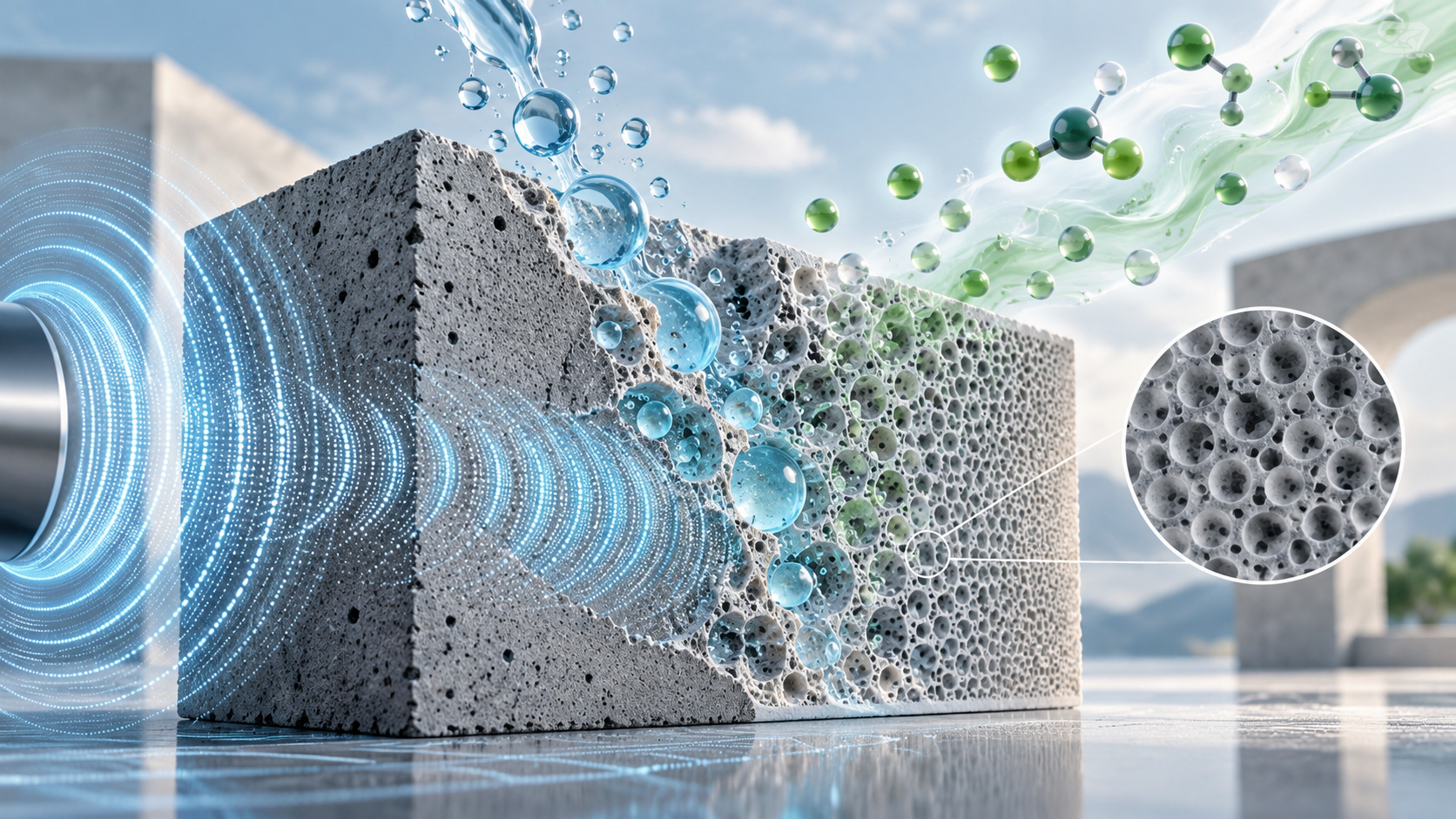
Paper: Multifunctional submicron-scale porous water-foamed cementitious materials. AI-generated abstract conceptual image created using ChatGPT/OpenAI
*Important notice: This news reports on an unedited version of an accepted paper and is awaiting final editing. Therefore, the paper should not be regarded as conclusive or treated as established information.
A recent article in press in Nature Communications reports a water-foaming strategy that uses ultrasound and CO2 carbonation to engineer submicron-scale pores in cementitious materials.
The resulting material combines high specific compressive strength, greater high-frequency sound transmission loss, strong retention of compressive strength after water saturation, and CO2 uptake.
The findings describe a route to developing multifunctional cementitious materials using cement and water, with ultrasound and carbon dioxide applied during processing.
Controlling pore structure in cementitious materials
Foamed concrete is widely used in lightweight construction and insulation because its porous structure lowers density and can improve thermal and acoustic performance.
Conventional foaming methods often generate unstable bubbles and irregular pore distributions. Large pores and thin pore walls can compromise compressive strength, while producing uniform submicron pores remains difficult. Many existing methods also rely on added foaming agents, stabilizers, or complex processing steps.
The researchers addressed these limitations by combining ultrasound and CO2 carbonation during fresh cement paste mixing. Ultrasound improves particle dispersion and CO2 transport, while carbonation strengthens the fresh flocculated structure - the loose network formed by cement particles in water - and confines water within it.
Tests that varied ultrasound and CO2 input found that both contributed to water stabilization, with the combined treatment producing a stronger effect than either treatment alone. As the cement hydrates and the material dries, the confined water leaves behind a network of fine pores.
The researchers aimed to determine whether this method could refine the pore structure while preserving total porosity. The team examined how processing conditions affected pore characteristics, hydration, compressive strength, strength retention after water saturation, and acoustic transmission loss.
Engineering submicron porosity through ultrasound and carbonation
The researchers prepared cementitious specimens using cement, water, ultrasound, and CO2 injection.
The main UC15 comparison used a water-to-cement ratio of 0.80, an ultrasonic frequency of 20 kHz, an ultrasonic power of 1500 W, a CO2 injection rate of 1.5 L/min, and a treatment time of 15 minutes. UC15 denotes ultrasound-assisted carbonation applied for 15 minutes. This approach eliminated the need for separate foaming agents, stabilizers, or hydrogel additives.
The team varied the ultrasound frequency, water-to-cement ratio, and processing conditions to determine how each factor influenced pore formation and material properties.
To distinguish pore refinement from reduced total porosity, they used mercury intrusion porosimetry (MIP) to characterize pore-throat dimensions and helium pycnometry to measure absolute porosity. MIP characterizes mercury-accessible pore structure, while helium pycnometry estimates the total void fraction.
The researchers then measured compressive strength and specific compressive strength, which accounts for material density. They also assessed water absorption and the softening coefficient to evaluate how water exposure affected mechanical performance. Acoustic tests measured sound transmission loss at selected frequencies.
To investigate the underlying mechanisms, the team analyzed cement hydration, microstructure, and crack development. They also quantified CO2 uptake during mixing and curing to assess whether the material could combine structural performance with CO2 uptake.
Refining pores to improve mechanical and functional performance
The UC15 specimens developed a highly refined pore network, with 96.8% of the pores in the MIP distribution measuring less than 200 nm. MIP measured an accessible porosity of 47.38%, while helium pycnometry recorded an absolute porosity of 51.34%. These results show that adding ultrasound to carbonation mainly refined the pore structure without substantially reducing the total void volume relative to MC15.
Compared with the MC15 reference, UC15 reduced the average pore-throat radius by 24.18%, length by 16.61%, and area by 28.83%. UC15 achieved a compressive strength of 23.90 ± 0.20 MPa, compared with 9.02 ± 0.23 MPa for the density-matched foamed concrete control. Its specific compressive strength reached 22.5 kN·m·kg-¹, an increase of up to 162%.
UC15 retained much of its dry compressive strength after saturation. Its water-absorption ratio still exceeded 40%. Its softening coefficient, the ratio of saturated to dry compressive strength, reached 91.3%, compared with 65.1% for conventional foamed concrete. Acoustic emission and digital image correlation analyses indicated that the refined pore network delayed crack localization and propagation under mechanical loading.
In acoustic tests, UC15 showed greater high-frequency sound transmission loss (STL). The UC batches recorded higher STL than the conventional-carbonation and foamed-concrete batches from 1500 to 4500 Hz. For UC15, STL reached 33.98 ± 0.38 dB at 2000 Hz and 49.76 ± 0.41 dB at 4000 Hz. Those values were 131.8% and 107.0% higher than the control, respectively.
The researchers attributed the higher high-frequency STL in UC15 to viscous and thermal energy dissipation within the fine, tortuous pores. They linked the mechanical performance to smaller effective flaw sizes, more distributed stress transfer, and denser reaction-product packing associated with faster hydration.
Ultrasound-assisted carbonation accelerated hydration and early structural build-up, while thermogravimetric analysis indicated CO2 uptake equivalent to 2.93% of the cement mass during mixing and 7.11% cumulatively after 28 days of curing. No extra CO2 was supplied during curing; specimens were exposed only to ambient atmospheric CO2.
Toward multifunctional cementitious materials with simpler preparation
The study shows that ultrasound-assisted carbonation can create cement-paste materials with submicron-scale pores and high specific compressive strength for a lightweight porous material. By refining pore dimensions and maintaining substantial total porosity, this approach addresses a key challenge in foamed concrete design.
The macroscopic results matched the pore-scale changes: the refined network showed greater strength, better strength retention after saturation, and better high-frequency acoustic performance than the controls. Changes in cement hydration and CO2 uptake show that the processing route altered cement reaction development and produced measurable CO2 uptake.
The method also simplifies material preparation by using cement and water as the material constituents, with ultrasound and CO2 used during processing and no additional foaming agents or stabilizers.
Researchers must assess its performance at larger production scales, energy efficiency, suitability for continuous manufacturing, and long-term durability. They also need to evaluate its compatibility with reinforcement and aggregate-containing systems.
The work describes a strategy for engineering multifunctional cementitious materials through controlled pore formation.
Further testing at a larger scale and in aggregate-containing or reinforced systems will determine whether ultrasound-assisted carbonation can produce stronger porous construction materials that combine high-frequency sound attenuation with CO2 uptake. The paper identifies insulating panels, precast elements, and lightweight structural components as possible applications that need such testing.
Disclaimer: The views expressed here are those of the author expressed in their private capacity and do not necessarily represent the views of AZoM.com Limited T/A AZoNetwork the owner and operator of this website. This disclaimer forms part of the Terms and conditions of use of this website.