Materials and chemical manufacturers have spent the past 10 years demonstrating that AI can strengthen product development.
The supporting evidence now extends beyond academic publications and small-scale pilot programs. Companies are applying AI to improve formulations, determine which experiments deserve priority, enhance material performance, lower expenses, and respond more quickly to changing customer expectations and regulatory demands.
The more important question is what comes next.
Many product development groups already accept that AI can provide value. The greater obstacle is encouraging a wider range of scientists to use it regularly, interpret its recommendations, and trust those recommendations enough to take action. This is not simply a matter of creating a more accurate model. It involves adoption, workflow design, and scientific decision-making.
Decisions in product development can have significant consequences. One proposed experiment may use limited laboratory capacity, costly raw materials, specialist testing resources, or several weeks of a scientist’s time. A recommendation only has practical value when the product expert can understand its basis and determine whether the experiment is worth conducting.
Traditional product development workflows are increasingly insufficient for this level of complexity. When an important ingredient is no longer available, costs rise unexpectedly, or a reformulation becomes necessary, teams must evaluate a connected set of constraints. Performance, price, supply, regulatory compliance, and development speed influence one another.
The next stage of AI in materials development will depend on how effectively these systems fit into the real working practices of scientists.
Product Development Teams Face Growing Pressure
Materials and chemicals teams are expected to solve increasingly difficult problems within shorter timeframes.
They must weigh performance, manufacturability, cost, supply security, customer specifications, and sustainability objectives at the same time. A formulation might need to retain its strength while becoming less expensive. A coating could require greater durability while satisfying stricter environmental standards. A polymer may need to incorporate recycled feedstocks without introducing unacceptable variation. A raw material might become unavailable, unaffordable, or prohibited in an important market.
These compromises continue to change. Supply networks shift, regulations develop, and customers increasingly demand products tailored to specific needs.
AI can help teams manage these pressures, but it must be accessible throughout the product development organization. A system understood by only a small group of specialists is unlikely to improve the productivity of an entire R&D department.
Companies are also facing the loss of experienced scientists through retirement. Years of formulation expertise, process knowledge, customer understanding, and practical judgment may disappear more quickly than new employees can acquire equivalent experience. New team members need to become productive rapidly, yet the relevant information is often scattered among reports, spreadsheets, technical data sheets, laboratory notebooks, and the recollections of senior staff.
Predictions Are Not Enough
Public conversations about AI in materials science often emphasize prediction: estimating properties, proposing candidates, or exploring extensive chemical and formulation spaces.
Prediction remains essential, but it represents only one part of industrial product development.
Scientists also need to understand the data behind a recommendation, the constraints used, the trade-offs evaluated, and the reason one experiment was selected instead of another. They must decide whether the proposal can be carried out in the laboratory, whether it is compatible with manufacturing, whether it satisfies customer expectations, and whether it deserves investment in the next experimental cycle.
Many AI tools find this difficult. They can generate an apparently reasonable answer without giving scientists enough context to evaluate or trust it. In materials and chemicals, plausibility alone is insufficient.
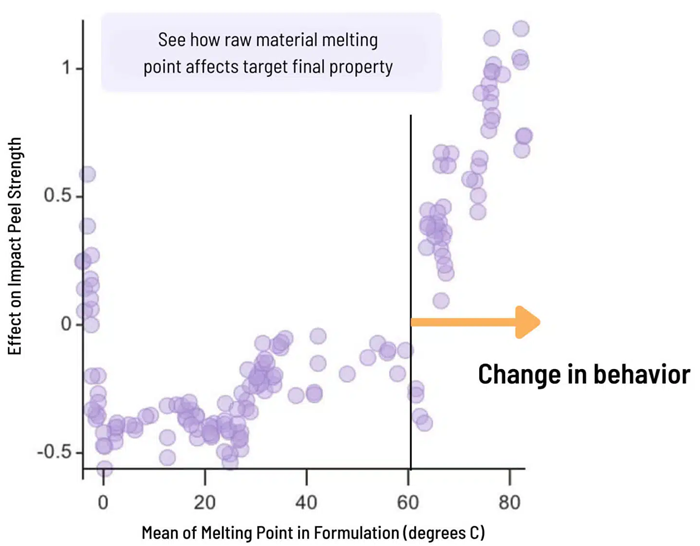
Image Credit: Citrine Informatics
AI creates the greatest value when it enables a scientist to select the next experiment with increased confidence.
For that to happen, AI systems must provide more than a list of recommendations. They must make their reasoning visible, maintain the expert’s authority over the decision, and allow the workflow to be examined and modified.
Adoption Depends on Knowledge Access
Every materials company holds information that is difficult to reuse effectively. Some knowledge is stored in structured systems, including material records, property tables, formulation databases, technical reports, technical data sheets, and safety data sheets. Other information exists in less organized formats such as project histories, internal presentations, email attachments, and older spreadsheets. Additional expertise remains with experienced scientists who understand which constraints are significant and which experimental paths are unlikely to succeed.
When this information cannot be located easily, teams duplicate previous work, overlook valuable historical results, repeat questions, and reconstruct knowledge that already exists elsewhere in the organization.
AI adoption becomes easier when relevant knowledge is brought directly into the working process.
Scientists should be able to determine whether comparable experiments have already been performed. They should be able to locate useful documents without knowing which system or folder contains them. They should also be able to incorporate earlier findings into a new project instead of beginning with an empty workflow.
This capability is particularly valuable as organizations attempt to retain institutional knowledge. AI will not replace experienced product specialists, but it can help record, preserve, and distribute more of their expertise.
Image Credit: Citrine Informatics
The Catalyst AI workflow accelerator within the Citrine Platform allows product experts to query their data.
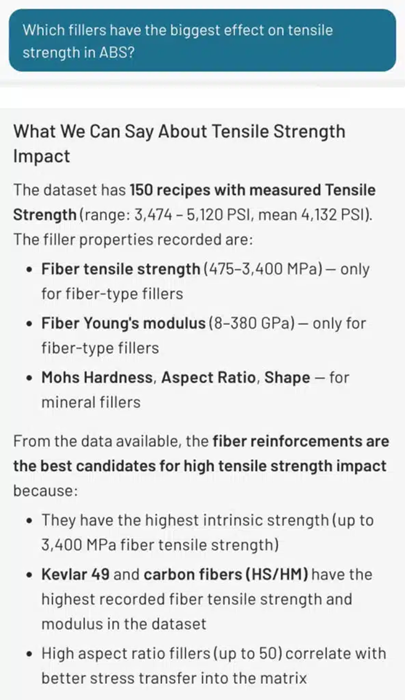
Ask Catalyst about your data. Image Credit: Citrine Informatics
Model Quality Remains Important
Making AI easier to adopt does not lessen the importance of high-performing models. Instead, it increases the value of model quality.
Materials and chemicals challenges differ substantially from one another. A high-dimensional formulation task may require a different method from molecular design or from an investigation of processing–property relationships.
No single model architecture will perform best on every type of project.
The next generation of materials AI therefore needs a more flexible modeling layer. It should compare multiple model families, use richer representations of material systems, and identify the approach most effective for the specific task.
This flexibility is especially important for complicated product development problems in which composition, processing, structure, and properties affect one another. Spreadsheet-based representations can be useful, but they may not describe the complete structure of a materials problem. Approaches such as graph neural networks, transformers, and other advanced architectures can model different relationships and may be more appropriate for particular scientific questions.
Pre-trained chemical embeddings offer another advantage. Models trained on scientific literature and molecular datasets can begin with chemically meaningful representations instead of learning entirely from the limited data available in a single project.
The practical goal is not to attach a more sophisticated name to the algorithm. The goal is to identify better experiments more efficiently.
Internal Citrine benchmarks found that untuned Apex models, without additional expert knowledge, matched or exceeded expertly tuned best-in-class models 95% of the time.
For complex, high-dimensional optimization tasks, untuned Apex models reached target properties up to twice as quickly as existing best-in-class models.
For product development groups, these improvements are consequential because each unnecessary experiment consumes time, materials, testing resources, and scientific attention.
Scientific Judgment Must Remain Central
The future of AI in materials development is not a system that makes decisions independently while removing scientists from the process.
A more productive approach gives scientists a stronger foundation for decision-making. AI can gather relevant data, propose experiments, identify probable performance drivers, and reveal trade-offs. The scientist remains responsible for deciding what to accept, modify, or test.
That distinction is essential for broad adoption.
Scientists are more inclined to use AI when they can understand how a workflow was constructed. They need visibility into the included data, the assumptions applied, the definition of the targets, and the reason a particular experiment was recommended. They also need to modify the workflow when their product knowledge reveals an important omission.

Image Credit: Citrine Informatics
Natural-language interfaces can be useful in this context. Their value is not novelty; it is the ability to reduce the gap between scientific objectives and AI-supported action.
When a product expert can describe a goal in ordinary language and then examine the resulting dataset, model, search space, target properties, and proposed experiments, AI becomes more practical for day-to-day product development.
A natural-language workflow does not replace specialist knowledge. It provides a faster route for that knowledge to enter the system.
From Product Objective to Experiment
Consider a scientist developing a revised lubricant formulation. The product must provide low oxidation, achieve a viscosity index above a defined threshold, meet a cost limit, and maintain a pour point below a specified value. The existing base oil is no longer available.
Under a conventional process, converting this product objective into an AI workflow would require several stages. The team would need to locate relevant historical information, prepare the dataset, establish target properties, define the search space, select or train a model, and assess the candidate recommendations.
Each task is feasible on its own, but the combined process introduces considerable friction. That friction becomes especially problematic when development teams are busy, deadlines are approaching, and scientists must add AI to an already demanding workload.
A workflow accelerator changes the initial step. The scientist describes the product objective, and the system generates an initial AI workflow. The user can then inspect the workflow, revise it, and judge whether the proposed experiments are scientifically sensible.
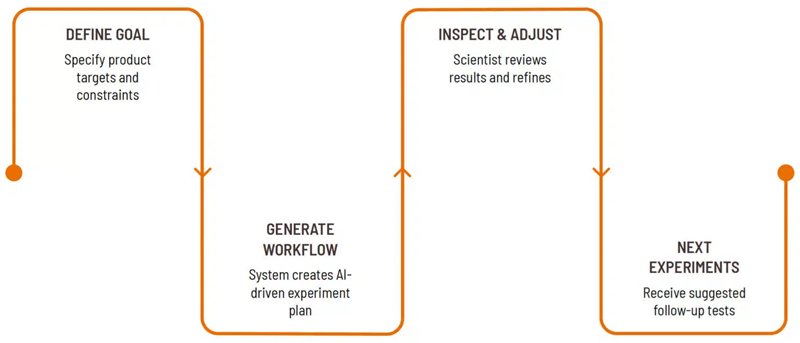
Image Credit: Citrine Informatics
This is the approach Citrine is pursuing through Catalyst. Catalyst is intended to help scientists progress from a product objective to proposed next experiments within minutes. It examines the available information, constructs the dataset, develops the AI model, establishes the search space and target properties, and explains the basis for its recommendations.
Transparency is central to this process. Catalyst is intended to support scientific decisions rather than operate as an opaque automation tool. It helps scientists work more quickly while preserving expert judgment.
Cross-Team Learning Multiplies Gains
AI delivers greater productivity benefits when organizations stop treating every project as completely separate.
If a team conducted a relevant experiment three years earlier, that result should contribute to the current decision. If a senior scientist understands that a specific ratio is important, the insight should be represented in the model. If a technical report contains the key to solving a new formulation problem, the report should be easy to find when another scientist raises the relevant question.
AI can support this kind of learning between teams.
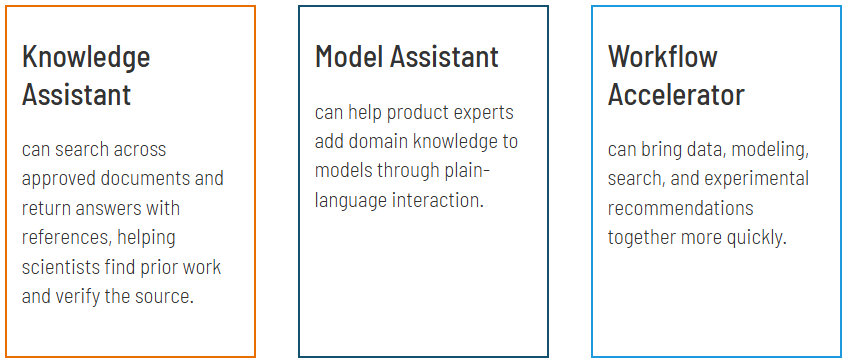
Image Credit: Citrine Informatics
Together, these capabilities allow organizations to reuse knowledge that might otherwise remain divided among departments, systems, and individuals.
The benefit is not limited to productivity. It also strengthens organizational resilience. Companies that can transfer knowledge across teams are better prepared for changes in raw materials, customer specifications, or personnel.
The Next Stage of Materials AI
AI in materials and chemicals has moved beyond asking whether models can produce useful predictions. Citrine customers are already deploying AI at scale, with hundreds of models put into use each month across specialty chemicals, polymers, and advanced materials.
The next challenge is achieving wider adoption.
That will require high-quality models, but it will also require workflows that scientists can build, interpret, and trust. Organizations need systems that reveal earlier knowledge, explain recommendations, preserve expert input, and reduce the time between defining a product goal and taking experimental action.

Image Credit: Citrine Informatics
Catalyst and Apex represent this broader transition. Catalyst makes AI workflow creation more accessible, while Apex improves the quality of the models supporting those workflows. Together, they help materials and chemicals teams move from product objectives to stronger experimental decisions more quickly.
The companies that gain the most from AI will not necessarily be those with the most advanced models. They will be the organizations that make those models useful to a larger number of scientists, across a wider range of projects, and with greater confidence in the next experiment.

This information has been sourced, reviewed, and adapted from materials provided by Citrine Informatics.
For more information on this source, please visit Citrine Informatics.