This article explores how the Citrine Platform applies advanced artificial intelligence to help polymer manufacturers address sustainability challenges while maintaining performance and profitability.
Through case studies and real-world implementations, it shows how AI-driven solutions can dramatically shorten development timelines, reduce costs, and accelerate sustainability initiatives across the plastics industry.
Enabling Product Innovation Through AI
In today's fast-expanding polymer market, producers face increasing pressure to develop sustainable goods while maintaining performance standards and minimizing costs.
The Citrine Platform addresses these issues by equipping product specialists with cutting-edge AI solutions that need little learning yet offer maximum impact.
Citrine distinguishes itself by its capacity to learn efficiently from tiny datasets while incorporating expert knowledge - a significant benefit in specialized polymer applications where substantial data may not be available.
This capability enables polymer scientists and engineers to take products to new heights and address important sustainability issues without having to digitize vast historical datasets.
AI SaaS + Technical Services
Citrine Informatics provides a comprehensive AI solution, combining user-friendly, no-code AI technologies with expert support. This hybrid strategy provides speedy value extraction for current projects while also enabling scalable AI-driven experimentation for future organizational growth.
Established Excellence
Citrine, founded in 2013 has a decade of experience implementing AI in materials science and polymer applications. This unique experience translates into speedier deployment and more consistent results for customers.
The Customers
Citrine has established itself as the preferred AI partner for prominent corporations in many parts of the polymer and chemical industries. Organizations who require the greatest levels of performance, reliability, and ROI from their technology investments rely on the Citrine platform.
Image Credit: Citrine Informatics
Challenges in The Polymer Industry
Today's polymer makers confront enormous challenges from all angles. Regulatory changes, supply volatility, and shifting consumer expectations create a complex operating environment that requires creative solutions. Companies that do not adjust swiftly to these issues risk losing market share and profitability.
Supply Chain Disruptions
Ongoing supply challenges lead to uncertainty in raw material availability and pricing, requiring producers to identify and evaluate alternate inputs while preserving product performance quickly.
Regulatory Pressures
The phase-out of PFAS and pthalates and the adoption of EU recycled plastic packaging standards demand extensive reformulation activities with tight deadlines and difficult performance requirements.
Market Demands
Increasing consumer need for sustainable plastics, combined with ongoing pressure to compete on performance, creates a complex innovation landscape.
The polymer industry is at a critical turning point where sustainability regulations and performance demands are both increasing. Companies require tools that enable innovation without sacrificing quality.
Move Faster
The solution to these complex challenges lies in using advanced AI to accelerate product development cycles, minimize trial costs, and optimize formulations for both sustainability and performance.
How Informatics Drives Polymer Innovation
Materials informatics, enabled by specific AI systems such as the Citrine Platform, is changing the way polymer firms approach product development and process optimization. Manufacturers may significantly cut time-to-market and improve sustainability indicators by integrating data and predictive modeling.
1. Formulation Optimization
The Citrine Platform allows materials scientists to undertake intelligent reformulation with 50 to 80 % fewer tests while still attaining the desired attributes. This strategy greatly decreases the time to market for innovative sustainable formulations.
2. Process Engineering
The platform optimizes both formulations and production processes. Polymer engineers can constrain permissible processing steps and parameters to assure scale-up viability, as well as discover ideal processing parameters to reduce energy consumption and process time while increasing yields.
3. Improved Customer Relationships
The platform improves interactions with downstream consumers through:
- Using statistics to demonstrate the effectiveness of additives
- Quickly responding to client demands with validated solutions
- Accelerating time-to-market with exactly what clients desire
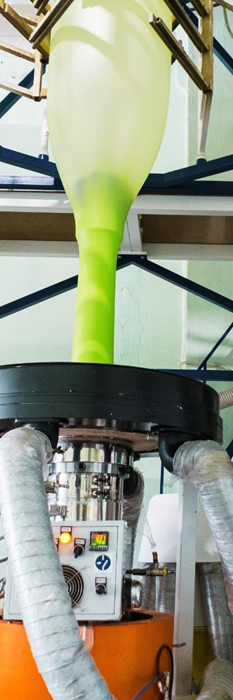
Image Credit: Citrine Informatics
How Citrine Drives Polymer Sustainability
The Citrine Platform provides unique capabilities that address the most important sustainability issues in the polymer sector. Manufacturers may meet regulatory standards, reduce environmental impact, and develop next-generation sustainable products more effectively by integrating artificial intelligence (AI).
Accelerate Substitution
- Removal and replacement of harmful inputs (e.g., PFAS, VOCs)
- Replacement of bio-based inputs for petro-based chemicals
- Incorporation of more post-consumer recyclates while retaining performance
Reduce Process Energy
- Reduction of energy budgets by optimizing recipe parameters
- Development of new catalysts for more efficient and lower temperature processes
Advance OEM Products
- Light-weighting of materials for transportation and aerospace/defense
- Extension of product lifetime through improved durability
- Reformulation to reduce post-consumer waste
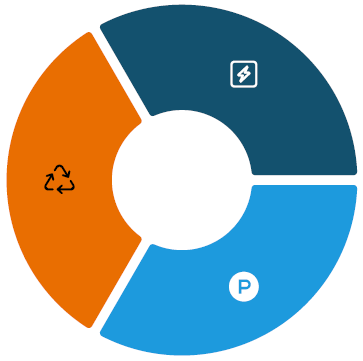
Image Credit: Citrine Informatics
Business Benefits of Sustainable Polymer Development
Citrine's approach to sustainable polymer production has major financial advantages in addition to its environmental impact.
- Rapid and cost-effective regulatory compliance
- Brand differentiation through sustainability leadership
- Premium pricing for eco-friendly formulations
- Risk mitigation against future regulatory changes
- Increased customer loyalty among environmentally conscious buyers
Case Studies: Sustainability Success Stories
The case studies below show how major organizations in the polymer value chain have used the Citrine Platform to achieve significant sustainability improvements while retaining business performance.
- 90 % Reduction in Fossil Inputs: A leading thermoplastic resin maker replaced 90 % of fossil-derived inputs with bio-based polymers in less than half the development time, significantly enhancing sustainability and product performance.
- 20-50 % GHG Reduction: A specialty chemical producer reduced greenhouse gas emissions by 20-50 % by advancing the development of cellulosic esters as sustainable alternatives for fossil-based polymers and regenerated copolyesters.
- 10 Kg Vehicle Weight Reduction: A global materials leader used the Citrine Platform to reduce the density of an automotive polypropylene grade by 4 % while preserving cost and performance, resulting in a 10 kg weight reduction for consumer vehicles.
- 44 Tons of CO2 Reduced: A medical device company re-developed medical-grade clamps to optimize for product cost and CO2 footprint. This reduced CO2 emissions by 44 tons while decreasing product costs and development time by 50-60 %.
One major materials provider believes that the Citrine Platform will deliver $50 million in value over four years by reducing time-to-market and costs while furthering their sustainability objectives.
These findings demonstrate how AI-driven development may address both environmental goals and corporate objectives, generating value across various dimensions. The Citrine Platform enables businesses to make these enhancements while maintaining product performance and profitability.
Simple Iterative AI-Driven Experimentation Workflow
The Citrine Platform simplifies polymer development with a methodology that blends materials scientists' expertise with powerful AI. This method significantly decreases the number of experiments needed while enhancing results.
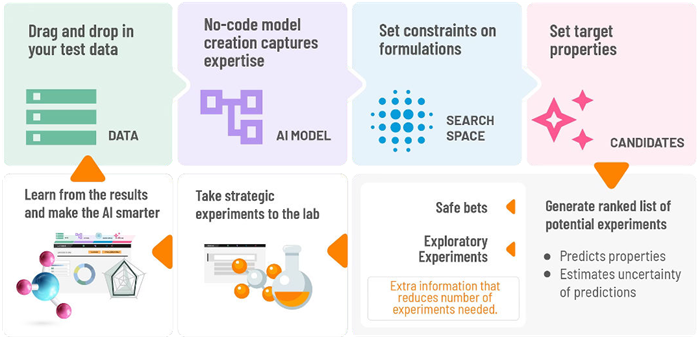
Image Credit: Citrine Informatics
Key Advantages over Traditional Methods
- Reduced experiments by 50-80 %
- Optimized multiple competing properties simultaneously
- Incorporated sustainability metrics directly into optimization
- Clear visibility into property-formulation relationships
- Preserved and transferred knowledge across projects and to new employees
How is the Citrine Platform Different?
- Chemically-aware
- Automatically translates chemical formulas and molecular structures into extra data
- Works on small datasets
- Transfer learning, domain knowledge integration, and chemical featurization allow projects to start at 20 data points
- No coding required
- The platform's intuitive interface makes advanced AI capabilities available to materials scientists without requiring specialized data science expertise
Competitive Advantage: How to Win at AI Adoption
Companies of all sizes can use the Citrine Platform to acquire a competitive edge in sustainable polymer development.
The goal is to learn how to tailor AI capabilities to your specific business environment and challenges.
1. Small Companies
Use AI to reduce research costs and tailor products to niche markets
- Compete with larger players by accelerating development cycles
- Maximize R&D efficiency with limited resources
- Develop specialized, maintainable solutions for targeted applications
2. Medium-Sized Companies
Agile decision making; test and scale quickly; leapfrog the competition.
- Balance innovation with practical implementation
- Scale successful sustainability initiatives quickly
- Outpace larger competitors by making faster decisions
3. Large Companies
Use large datasets and transfer learning across teams
- Maximize value from extensive historical data
- Transfer knowledge across business units and geographies
- Create centers of excellence for sustainable polymer development
Regardless of company size, the Citrine Platform accelerates long-term polymer development by merging AI capabilities and domain expertise.
Citrine’s decade of experience integrating AI in materials science assures that businesses can swiftly achieve meaningful economic gains while also advancing their sustainability objectives.
Access Citrine’s Resources: Case Studies, White Papers & Webinars
Citrine offers comprehensive tools to help polymer producers gain a better knowledge of AI-driven sustainable development. Explore the digital materials, which mix technical depth with practical insights.
Case Studies
Discover real-world examples of how top firms have successfully used the Citrine Platform to achieve specific sustainability goals while preserving or boosting commercial performance. Download full case studies and learn from their successes.
Image Credit: Citrine Informatics
White Papers
Access Citrine’s detailed white papers on AI applications in polymers and practical implementation methodologies. These technical papers and guidelines provide useful information for technical teams and strategic planners.
Image Credit: Citrine Informatics
Webinars
Watch on-demand webinars where professionals discuss the most recent trends, best practices, and new solutions for AI-powered sustainable polymer development.
Image Credit: Citrine Informatics
Summary: Accelerating Sustainable Polymer Development
The polymer sector is facing unprecedented problems in reconciling sustainability regulations, performance demands, and cost restraints. The Citrine Platform is a tried-and-true solution that helps manufacturers effectively traverse these hurdles while adding value to their businesses.
AI Accelerates Sustainable Reformulation
The Citrine Platform allows polymer manufacturers to reformulate products using sustainable inputs 50-80 % faster than existing approaches. This acceleration is crucial for meeting regulatory deadlines, responding to market demands, and staying ahead of the competition.
Easy Platform Adoption
The platform is designed for material scientists, not data scientists. Its user-friendly interface and workflow integration enable rapid adoption without considerable retraining, allowing teams to derive value from AI capabilities.
Experienced Implementation Team
Citrine's team has a decade of expertise deploying AI in polymer companies of all sizes and categories. This experience assures a successful deployment and maximizes the return on investment.
Companies that use the Citrine Platform have seen tremendous gains in sustainability while also lowering costs and reducing time-to-market. The platform helps manufacturers turn sustainability concerns into business benefits.
This information has been sourced, reviewed, and adapted from materials provided by Citrine Informatics.
For more information on this source, please visit Citrine Informatics.