In today’s fast-changing chemicals industry, the ability to answer customer needs rapidly and accurately distinguishes market leaders from their competitors.
As brands place greater emphasis on sustainable, bio-based alternatives that still deliver reliable performance, technical service teams are under increasing pressure to develop innovative answers faster.
Conventional formulation development, which often depends on lengthy iterative testing, extended stability evaluations, and trial-and-error experimentation, is no longer sufficient for the speed of current market requirements.
This article examines how artificial intelligence is reshaping formulation development and helping chemical suppliers achieve significantly greater customer responsiveness. At the same time, AI can reduce development expenses and shorten the path from concept to market. Through platform-based AI modeling, companies can develop reusable predictive assets that allow technical service teams to assess formulation options, forecast performance, and confidently propose optimized solutions within days instead of months.
Application Models: Building Reusable AI Assets for Customer Success
AI-enabled formulation platforms fundamentally change how experimental data and specialist knowledge are used. Rather than treating each customer request as an isolated project, the data can be converted into reusable predictive models that are rapidly adapted to different customer situations.
In traditional one-off development work, valuable knowledge often remains confined to laboratory notebooks or the experience of individual scientists. Application models, by contrast, become shared organizational resources that increase in value through repeated use across the team.
Creating An Application Model
1. Build the Foundation
Organize and maintain historical experiment results, ingredient characteristics, and processing conditions in a centralized platform.
2. Train Predictive Models
Machine-learning methods detect relationships and recurring patterns between formulation inputs and performance outcomes.
3. Define Search Spaces
Limits on permitted ingredients, concentration ranges, and processing conditions help ensure that the recommendations are commercially realistic.
4. Deploy for Customer Response
Technical service teams use application models to compare ingredient alternatives quickly and produce recommendations supported by experimental data.
Deploying An Application Model
This method changes the economics of customer technical service. A model developed for one customer engagement can be reused immediately when similar requests arise. If another customer presents related but different requirements, the technical team can modify the targets and constraints within the existing framework. New recommendations can then be generated in hours rather than recreated from the beginning.
Because the same model can support many subsequent projects, its return on investment grows each time it is applied.
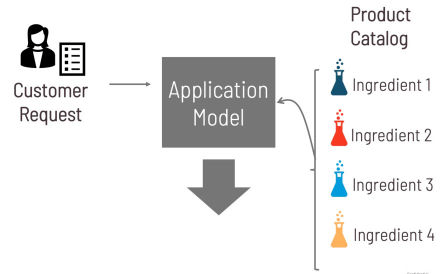
Image Credit: Citrine Informatics
Response
- Which product is expected to perform best?
- What quantity should be used?
- What will the cost be?
- What level of performance can be achieved?
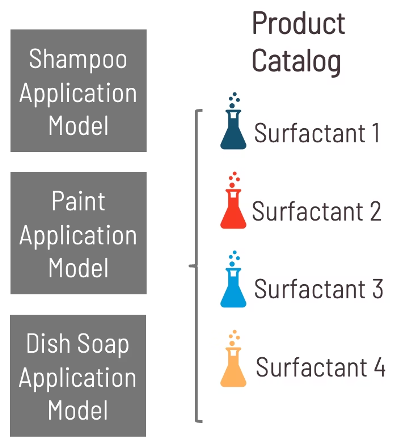
Multiple application models can be connected to the product catalog. Image Credit: Citrine Informatics
The Customer Challenge: Balancing Sustainability with Performance
Real-World Scenario
A typical request to surfactant suppliers may come from a major shampoo brand seeking to reformulate a popular product with plant-based surfactants. The change is intended to meet rising consumer interest in natural ingredients, but the reformulated product must still preserve the performance characteristics customers already expect.
Non-negotiable requirements include:
- Keeping viscosity within the established specifications
- Maintaining the product’s rheological profile
- Ensuring stability over the intended storage period
- Meeting or surpassing current performance benchmarks
The central question for the surfactant supplier is therefore which plant-based surfactant will work best within the specific formulation matrix and what concentration should be selected.
A conventional approach would involve extensive experimental planning, several rounds of testing, and weeks or months of work before a confident recommendation could be provided.
Delayed responses to reformulation requests often result in business opportunities being lost, while rushed recommendations without acceptable testing risk product failures and damaged customer relationships.
Step 1 – Create the Application Model
Using historical results, together with knowledge of the customer’s formulation and specifications, a model can be developed to predict the properties requested by the customer. In this example, those properties include viscosity, rheology type, stability, and cleaning performance. Additional experiments can be conducted to improve model accuracy and confirm the reliability of its predictions.
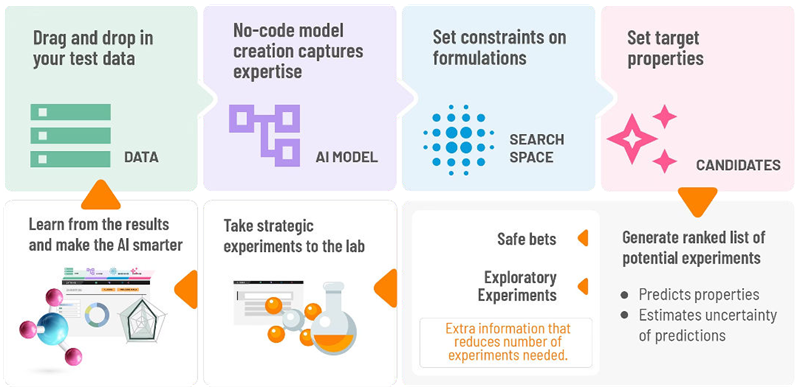
Image Credit: Citrine Informatics
Data Integration
Historical results are uploaded, including ingredient compositions, processing conditions, and measured properties. Ingredients in the product catalog should also be characterized thoroughly.
Molecular Characterization
Chemical structures are converted into SMILES strings, allowing the platform to calculate more than 127 molecular descriptors.
Model Training
AI methods identify connections between ingredient characteristics, molecular features and resulting formulation performance.
Model Refinement
When a customer request extends beyond the current capability of the model, a small number of additional experimental batches may be required.
Step 2 – From Data to Insights
Comprehensive Property Tracking
For every ingredient included in the model dataset, the platform records:
- Molecular structure represented by Simplified Molecular Input Line Entry System (SMILES) strings for computational processing.
- Physical characteristics such as molecular weight, density, and solubility parameters.
- Chemical features, including functional groups and reactive sites.
- Performance properties relevant to particular applications.
At the same time, the measured properties of completed formulations are recorded systematically. This produces a detailed dataset connecting molecular inputs with formulation outcomes.
By capturing information in both directions–from molecular characteristics and formulation composition through to final product properties–the AI can identify subtle structure–property relationships that may not be apparent through human observation alone.
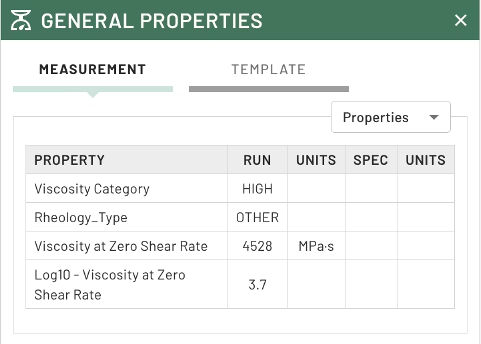
Image Credit: Citrine Informatics
Shampoo Final Properties Stored
When molecular structures are represented as SMILES strings, the platform can automatically calculate more than 127 molecular descriptors. These descriptors summarize important structural features, functional-group characteristics, and physicochemical properties.
Ingredient Properties Stored
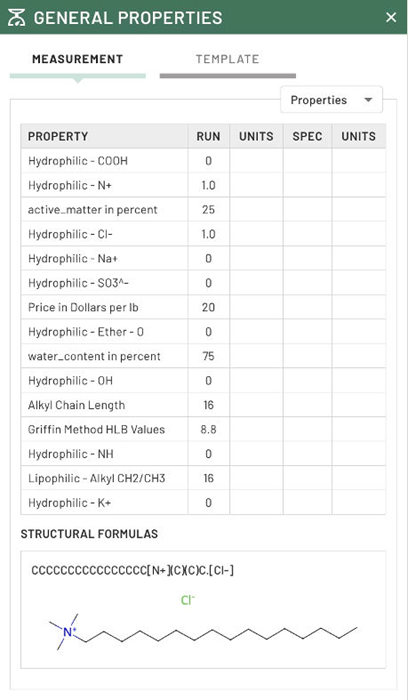
Image Credit: Citrine Informatics
The predictive strength of AI-based formulation platforms comes from their ability to link molecular structure with large-scale product performance. Traditionally, this connection has often depended on the knowledge accumulated by experienced formulators.
Data Visualization and Pattern Recognition
A major early benefit of platform-based formulation development is the ability to display complicated relationships within experimental datasets. Spreadsheet-based methods can make multidimensional patterns difficult to detect, whereas AI platforms automatically produce visualizations that support faster interpretation and hypothesis development.
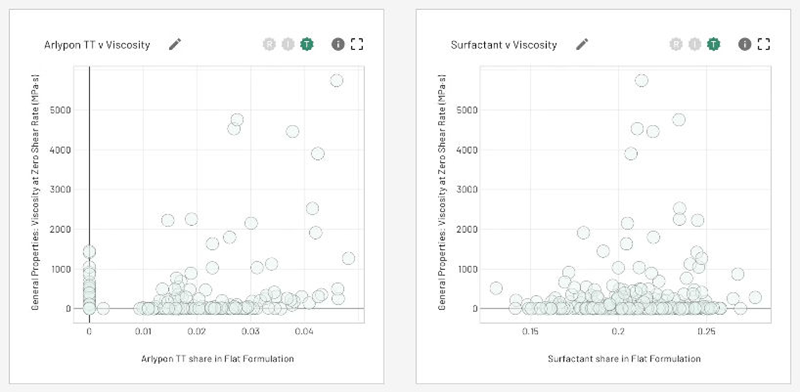
Image Credit: Citrine Informatics
In the shampoo example, visualization of surfactant concentration against viscosity reveals a non-linear pattern. Viscosity increases consistently as the surfactant proportion approaches approximately 22%, but then declines unexpectedly at higher concentrations. Finding this relationship through manual plotting and analysis could take considerable effort, while automated exploration makes the pattern visible almost immediately.
Trend Identification
Detect non-linear behavior and identify optimal operating ranges across multiple variables at once.
Correlation Analysis
Expose unexpected relationships among molecular characteristics, processing conditions, and performance results.
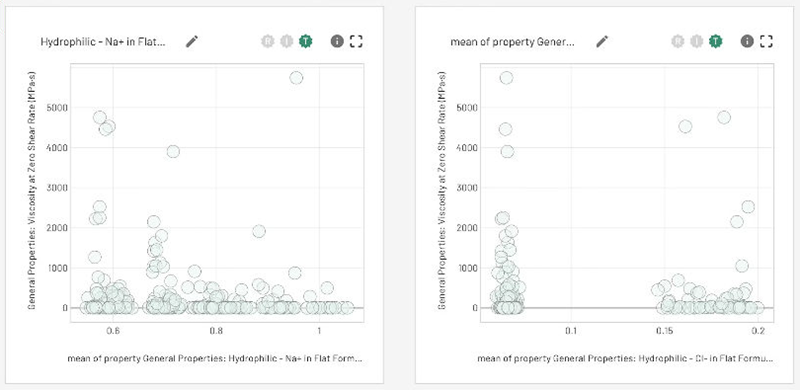
Image Credit: Citrine Informatics
These visual tools have several applications. They help teams understand formulation behavior more quickly, support quality control by highlighting unusual results, improve communication between R&D personnel and business stakeholders, and increase confidence in AI models by showing their connection to real experimental data.
Step 3 – Check the Model and Learn from It
Feature Importance Analysis
A common concern when AI is used for technical decisions is the perceived “black box” behavior of machine-learning systems. Advanced platforms address this issue with interpretability functions, including feature-importance analysis. This analysis identifies the inputs that have the greatest influence on predicted results.
For example, when formulation stability is being predicted, the platform can rank the relative contribution of ingredient molecular descriptors, concentration ranges, process conditions, and interaction effects. This visibility provides several important benefits for R&D leadership:
- Validation: Experienced formulators can confirm whether the AI is assigning appropriate weight to factors consistent with established chemical principles.
- Discovery: The analysis may reveal previously unexpected variables that affect performance and generate new scientific insights.
- Confidence: A clearer understanding of how the model reaches its conclusions helps establish trust.
- Improvement: Feature-importance results can direct additional data collection toward the areas most likely to improve predictions.
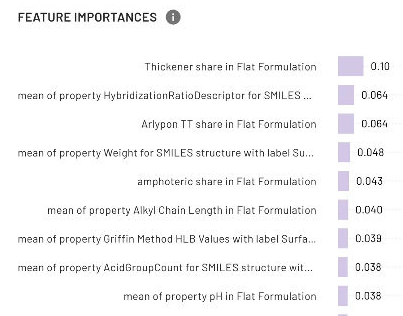
Image Credit: Citrine Informatics
We understand our own laboratory more than before. It's fun to work in this way.
Oliver, Technical Application Lead, Dorfner
Transparency and Trust: AI As a Flashlight, Not a Black Box
The image of a “flashlight in a dark room” effectively illustrates the value of this approach. AI does not replace expert knowledge; instead, it strengthens that knowledge by exposing patterns and relationships that might otherwise remain hidden in complex, multidimensional datasets. The real promise of AI in formulation development lies in enhancing human capability rather than replacing it.
Step 4 – Strategic Search Spaces
Search spaces are structured collections of constraints that limit possible formulations to options that are technically feasible, commercially practical, and compliant with applicable regulations.
Ingredient Constraints
Define the ingredients that may be used, including required substitutions such as plant-based surfactants and prohibited materials such as parabens or sulfates. Separate search spaces can also be created to reflect differences in regional regulations.
Concentration Bounds
Set lower and upper concentration limits for individual ingredients and ingredient categories to support a practical formulation.
Process Parameters
Specify acceptable ranges for mixing conditions, temperature programs, pH-adjustment procedures, and other manufacturing variables.
Practical Example: Shampoo Reformulation
For the plant-based shampoo project, the search space includes:
- All plant-based surfactant alternatives available in the supplier’s portfolio.
- A maximum of 10 total ingredients to maintain formulation simplicity.
- The exclusion of parabens and sulfates to meet clean-label requirements.
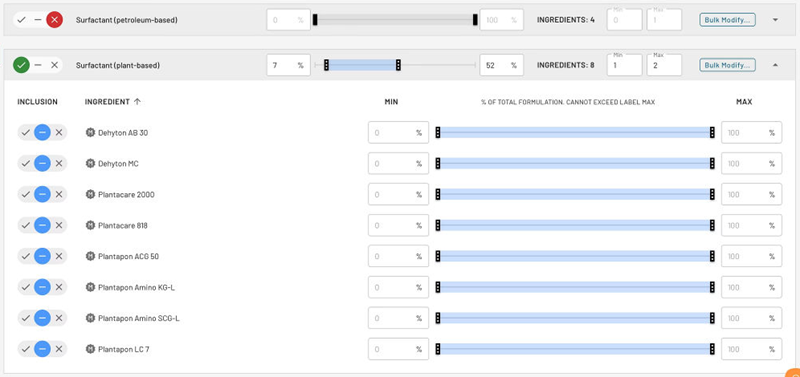
Image Credit: Citrine Informatics
Step 5 – Set Targets and Run The Model
When a customer request is received, the technical services team can use the Citrine Platform to perform the following activities:
A: Model Explore – Quick Property Predictions
Model Explore can be used to predict the properties of newly proposed formulations. For example, after replacing petroleum-based surfactants with plant-based alternatives, the model can assess whether the formulation is likely to remain stable and maintain an appropriate viscosity.
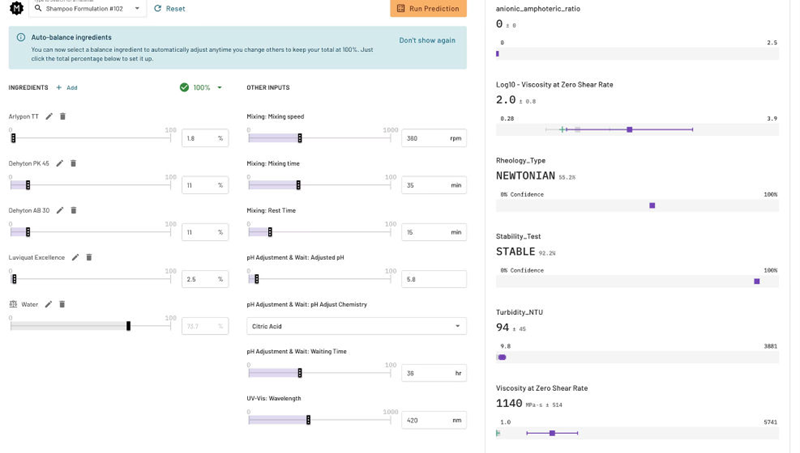
Image Credit: Citrine Informatics
B: AI-Guided Experimentation for New Frontiers
Some requests may extend beyond the model’s existing capabilities, creating substantial uncertainty in a particular region of the search space because only limited experimental data are available. In that situation, the customer’s desired properties can be entered as targets, and the AI model can evaluate the relevant search space to propose experiments.
The suggested experiments may be intended to achieve the requested targets, identify promising options for future development, or improve the model’s predictive strength in the area of interest. After the experiments are completed and the model has been retrained, it can produce more precise recommendations regarding optimal surfactant performance, the appropriate quantity, and the technical performance that can realistically be achieved.
Proven Results: Industry Case Study Demonstrates Transformative Impact
The potential benefits of AI-based formulation development are reflected in practical business results across the chemicals and consumer products sectors. A representative case study demonstrates the flexibility and scalability of the platform approach.
Stepan Company: Scaling AI Across Multiple Projects
Stepan® is a global supplier of specialty and intermediate chemicals, including chemical ingredients and formulations.
The company first tested AI-supported formulation development through a liquid dishwashing project. The enthusiastic response from the business manager–“I’d love to have 10 of these projects going”–shows how the platform can support more meaningful technical discussions with customers while improving internal productivity.
Because the model framework can be reused, Stepan can respond more quickly to a wide range of customer reformulation needs. This changes technical service from a cost center into a source of competitive advantage.
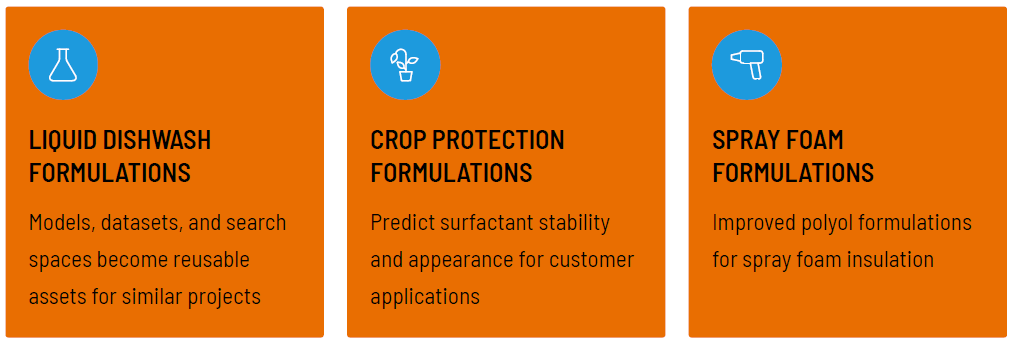
Image Credit: Citrine Informatics
I’d love to have 10 of these projects going. I want more application data to drive deeper conversations around subjects our customers care about.
Stepan, Business Manager for the Liquid Dishwash Project
The Path Forward: Accelerating The Materials Innovation Journey
Strategic Imperatives for R&D Leadership
For R&D directors and technical service leaders assessing this opportunity, several strategic priorities deserve consideration:
- Platform thinking: Treat AI adoption as the development of reusable assets rather than a series of isolated projects.
- Data readiness: Begin organizing historical experimental information now to increase near-term ROI.
- Cultural preparation: Encourage openness to AI-supported workflows and data-informed decision-making.
- Pilot selection: Choose high-value customer relationships where faster and stronger responsiveness can create a competitive advantage.
- Expertise partnership: Work with vendors that have demonstrated implementation experience to support faster adoption.
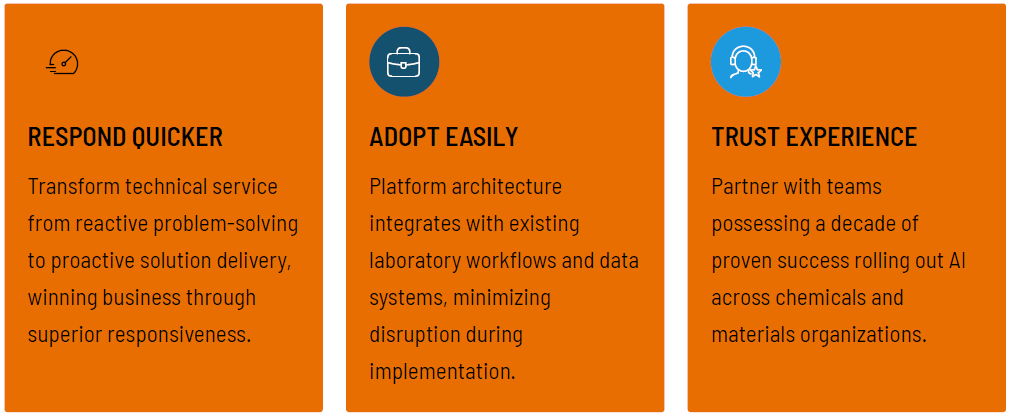
Image Credit: Citrine Informatics
Ready to Accelerate Materials Innovation?
Discover how Citrine Informatics can reshape application-engineering processes and generate measurable commercial value by contacting the Citrine team to explore how AI can improve technical service capabilities.

This information has been sourced, reviewed, and adapted from materials provided by Citrine Informatics.
For more information on this source, please visit Citrine Informatics.