Raw material volatility; ingredient restrictions; global trade disruptions; customer demands that are in constant flux: for specialty chemicals producers, change is not an occasional disruption, but is rather a fixed operating condition.

Image Credit: dongfang/Shutterstock.com
Specialty producers face pressure to respond quickly, without affecting performance, margin, or customer commitments. This is becoming harder to accomplish when using conventional product development workflows.
When a critical ingredient is no longer available, a price shock emerges, or a reformulation is needed, teams must make decisions within a tightly interconnected system of constraints. Performance, cost, availability, regulatory considerations, and speed all move in unison.
This is why resilience has begun to emerge as a product development capability.
The companies best able to navigate change are not necessarily testing every possible alternative at the bench. Instead, they are using AI to narrow the field, understand trade-offs sooner, and focus costly testing on the options that hold the most promise.
Resilience in Specialty Chemicals Is Greater Than Supply Continuity
Across many organizations, resilience is still primarily considered a supply chain concern. For specialty chemicals producers, however, it also presents challenges to formulation and decision-making.
Raw material disruption doesn't stop at sourcing. It affects:
- The alternatives that can really be used
- The ability to meet performance targets
- The speed at which teams are able to reformulate
- Whether it is possible to absorb or mitigate increases in cost
- The risk that a small number of key ingredients entails
This means resilience relies not only on supply visibility but also on the ability to make faster, more optimized formulation decisions under evolving conditions.
Why Conventional Approaches Struggle
Specialty chemicals teams typically work in formulation spaces that are highly constrained. Changing a single ingredient can simultaneously affect multiple target properties; a lower-cost replacement may introduce new trade-offs; a seemingly available replacement might not be feasible if customer performance needs are fully considered.
In such an environment, trial and error is both too slow and too expensive. More complexity is not the answer; better ways to explore existing complexity are.
This is where AI can be most helpful.
What AI Makes Possible for Specialty Chemicals Producers
AI gives those working in product development a practical way to learn from historical data, predict the performance of untested alternatives, and identify stronger candidates before final validation even begins.
In practice, that can support multiple resilience workflows that have high value:
1. Faster Response to Supply Shocks
When a critical ingredient is no longer available, researchers should know which options remain and the impact of those options on performance, cost, and risk. AI can also help quickly hone in on the search space and recognize suitable replacement paths.
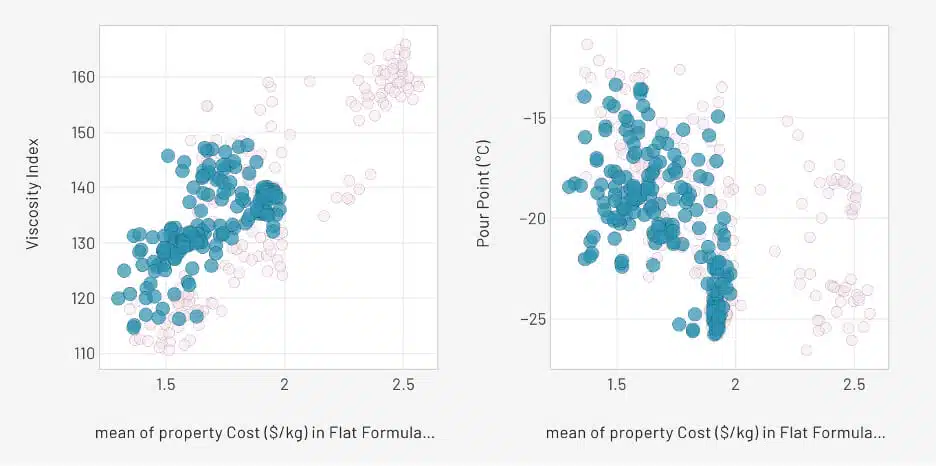
Understanding how formulations with and without a specific base oil perform. Image Credit: Citrine Informatics
2. Improved Visibility into Ingredient Criticality
Not all raw materials are equally important: some ingredients can be replaced more readily, while others have a disproportionate effect on product performance. AI can help teams understand which raw materials cannot be replaced, enabling them to make better decisions about stock levels, sourcing risk, and contingency planning.
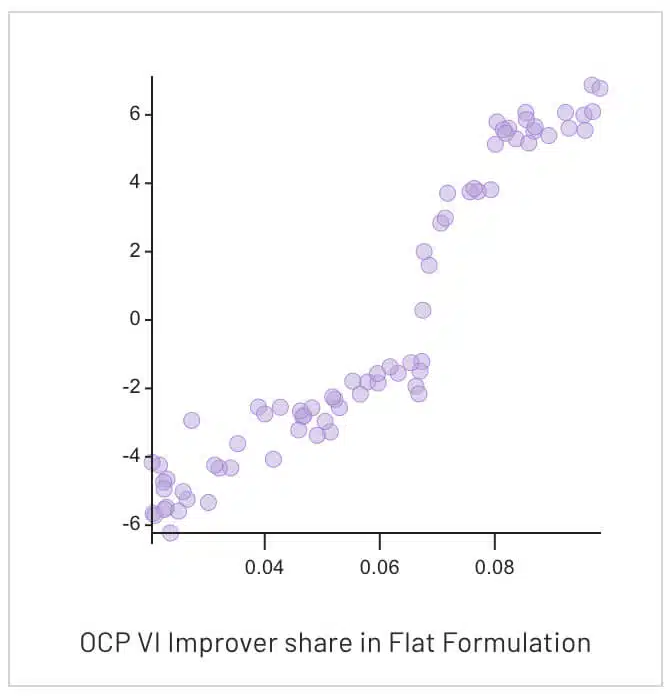
Understanding how the share of a particular ingredient affects important properties. Image Credit: Citrine Informatics
3. Better Response to Price Volatility
When a key ingredient is significantly more expensive, researchers should know how formulation recommendations can shift. AI can help assess lower-cost possibilities while maintaining critical properties.
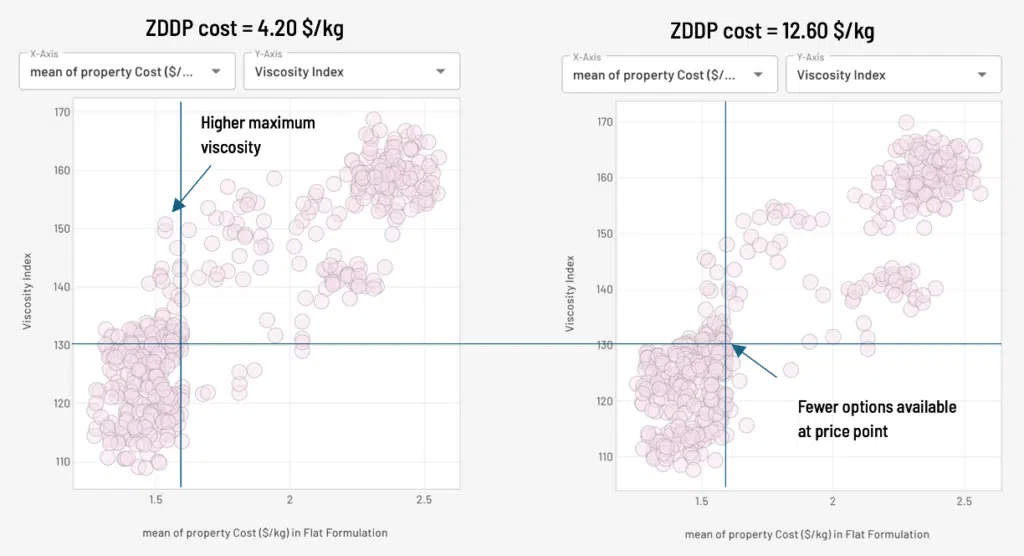
Image Credit: Citrine Informatics
4. More Focus on Experimental Work
Rather than testing every option, researchers can use AI to focus lab resources on candidates with a higher likelihood of success. This minimizes wasted effort and enables teams to move more quickly under tight timelines.
From Resilience Theory to Practical Decision-Making
The benefits of AI are not abstract. They are directly relevant to the questions that specialty chemicals producers ask every single day:
- Which ingredients generate the highest amount of risk in the portfolio?
- Where is a more robust plan B needed?
- What should happen when an ingredient disappears from the search space?
- How should one respond when a key input becomes significantly more expensive all of a sudden?
- How is it possible to adapt more quickly without multiplying final testing costs?
Those are precisely the types of questions AI is well-suited to deal with.
It is helpful to think about all of this with three connected resilience challenges in mind:
- Supply shock: What happens if a key ingredient becomes unavailable?
- Ingredient criticality: Which raw materials are not replaceable when it comes to product performance or feasibility?
- Price sensitivity: How should formulation decisions evolve when a critical input becomes more costly?
Altogether, these are not distinct edge cases. They are practical frameworks for knowing how resilient a product portfolio is.
The Strategic Shift
Resilience is about building the capacity to assess alternatives quickly and confidently before disruption makes it mandatory.
That means transitioning from:
- Reactive reformulation, to prepared optionality
- Isolated expertise, to repeatable decision support
- Broad testing programs, to experimentation that is more targeted
- Static assumptions about ingredients, to dynamic knowledge of both risk and trade-offs
For specialty chemicals producers, that can mean greater responsiveness, lower risk, and a stronger ability to protect performance and profitability alike while change is underway.
What Leaders Should Understand
For leaders who are responsible for product development, portfolio performance, and operational risk, the opportunity is obvious.
AI helps teams:
- More quickly screen alternatives
- Know which ingredients are most important
- Assess the effects of supply and price changes in a systematic way
- Make better decisions before a crisis emerges
The aim is to make expert judgment more scalable, more repeatable, and more supported by solid data.
Finishing Remarks
Change is not going to stop. The question is whether specialty chemicals producers are able to respond with the necessary speed and confidence when it comes
AI doesn’t take complexity away from formulation work. But it can help teams deal with complexity in a more effective manner, make better trade-offs, and act more quickly when resilience is most important.

This information has been sourced, reviewed, and adapted from materials provided by Citrine Informatics.
For more information on this source, please visit Citrine Informatics.