Sponsored by ServomexReviewed by Olivia FrostNov 19 2026
Each year, industries consume substantial amounts of oxygen and nitrogen, both of which are collected from the surrounding air.
Image Credit: SergeiShimanovich/Shutterstock.com
Two principal methods are utilized to separate these two primary gases from air. These processes are cryogenic separation and (vacuum) pressure swing adsorption [(V)PSA]. ASU applications are discussed in the Cryogenic Air Separation Customer Process brochure. This white paper focuses on the much simpler (v)PSA technology.
Pressure Swing Adsorption (PSA) is a gas separation technology that exploits the ability of adsorbent materials to preferentially adsorb specific gas molecules under pressure. By alternating between high and low pressures, PSA systems can selectively separate gases from a mixture, providing a dependable and energy-efficient alternative to cryogenic or membrane-based separation techniques.
How It Works
- Adsorption Phase: A gas mixture is passed through a vessel containing an adsorbent (such as zeolite or activated carbon). Target gases are adsorbed at elevated pressure.
- Depressurization: The pressure is lowered, resulting in desorption of the adsorbed gases.
- Regeneration: The adsorbent undergoes regeneration and is ready for the subsequent cycle.
- Cycle Repeats: Several beds operate in staggered cycles to maintain continuous output.
The primary applications are Nitrogen and Oxygen Generation. PSA technology is commonly utilized in medical and industrial oxygen/nitrogen concentrators, generating 90–95% pure oxygen or nitrogen from ambient air. The oxygen or nitrogen is then employed in a broad range of applications such as waste combustion, wastewater treatment, chemicals manufacturing, metals processing, and healthcare.
Oxygen production using PSAs begins with the filtration and subsequent compression of air. The air is then sent to a Zeolite adsorption column. Here, at high pressure, the Zeolite adsorbs N2, CO2 and water while the oxygen passes through. When the column reaches total saturation, the pressure is lowered, venting the N2 and regenerating the Adsorption bed.
As this regeneration is occurring, the process switches to the second adsorption column, enabling continuous operation, with each column being switched as it becomes exhausted.
Although a different adsorption column type is utilized for nitrogen production, the process otherwise remains the same. A PSA variant is the Vacuum-Pressure Swing Adsorber, commonly abbreviated as VPSA, VSA, or PVSA. The process resembles a PSA, except that a VPSA uses vacuum blowers to decrease the desorption pressure, creating a vacuum in the scrubbing columns.
This reduced pressure also decreases the inlet pressure required by the scrubbers. A key advantage of this method is that desorption process efficiency is substantially enhanced, as the Zeolite can be regenerated more thoroughly. This allows a greater percentage of oxygen to be extracted from the air during each scrubbing cycle.
However, the lower discharge pressure means that air compressors generally need to increase the delivery pressure. Together with the higher production expenses, this requirement partially offsets the benefits of the process.
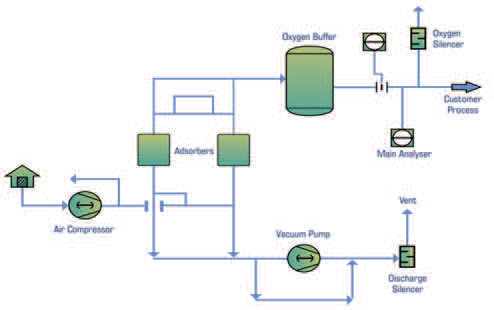
Figure 1. Image Credit: Servomex
The SERVOTOUGH Oxy 1810 can be coupled with a flowmeter/flow switch arrangement to provide a mechanism for monitoring the state of the process.
Process Measuring Points
Table 1. Source: Servomex
Installation
location |
Gas measured |
Measuring range |
Application |
Servomex
analyzer |
| (O2 PSA) Scrubber exit |
Oxygen |
0-100% |
Process control |
SERVOTOUGH Oxy 1810 |
(O2 PSA) Concentration
at delivery point |
Oxygen |
0-100% |
Process control |
SERVOTOUGH Oxy 1810 |
| (N2 PSA) Scrubber exit |
Oxygen |
0-10% |
Process control |
SERVOTOUGH Oxy 1810 |
(N2 PSA) Concentration
at delivery point |
Oxygen |
0-10% |
Process control |
SERVOTOUGH Oxy 1810 |
Application Oxygen Concentration Measurement - Oxygen PSA Skid
An oxygen PSA skid typically contains one oxygen analyzer, although it may occasionally feature two. It measures final product quality, typically 90-95% oxygen. However, it can be enhanced by using lower flow rates. Some systems feature an analyzer after the separators to monitor process efficiency.
Both are monitoring oxygen quality (with a small amount of nitrogen). Ensuring good quality of the final product is crucial, as poor quality could compromise the operation of the plant using the oxygen product.
Application Oxygen Concentration Measurement - Nitrogen PSA Skid
A nitrogen PSA skid typically contains one oxygen analyzer, although it may occasionally feature two. Its purpose is to measure final product quality, which is generally 0-10% oxygen; however, it can be enhanced by operating at lower flow rates. Some systems feature an analyzer after the separators to monitor process efficiency.
Both are monitoring oxygen quality (with a small amount of nitrogen). Ensuring good quality of the final product is crucial, as poor quality could compromise the operation of the plant using the nitrogen product.
SERVOTOUGH Oxy 1810. Image Credit: Servomex
Servomex Solution
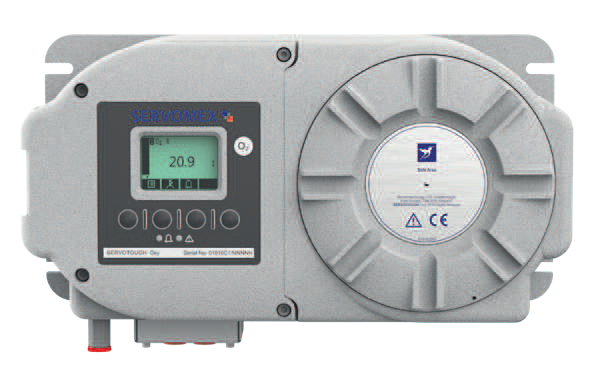
The Oxy 1810 is a digital Paramagnetic analyzer equipped with several value-adding features. The technology itself is non-depleting and does not require any reference gases. An integral flow and pressure sensor monitors sample flow to support preventative maintenance and compensate for variations in vent or barometric pressure. The fully heated sample compartment delivers unmatched measurement stability, while digital communications offer intelligent diagnostics.

This information has been sourced, reviewed, and adapted from materials provided by Servomex.
For more information on this source, please visit Servomex.