The role of AI in polymer development has moved beyond suggesting new experiments. Its utility now also depends on connecting synthesis records, analytical results, application testing, and process history so scientists can understand how a polymer performs and how that performance changes at scale.
In this interview, Will Tashman discusses where AI can support polymer R&D, why connected data matters, and how teams can share useful information without exposing proprietary compositions.
How would you describe the role AI is starting to play in polymer development? Where is it creating real value?
AI can contribute at every stage of polymer R&D. It starts with the polymerization itself, modeling kinetics, chain extension, or cross-linking. From there, it can help predict how the resulting materials perform once formulated or processed into a final product.
The polymer manufacturers we work with want their materials to perform better for customers. AI creates value when it helps them shorten R&D cycles, understand what drives performance, or find promising areas they wouldn’t have explored otherwise.
That’s where interest in AI turns into practical value. The goal isn’t to add a model to the workflow. It’s to help scientists make better decisions about what to try next.
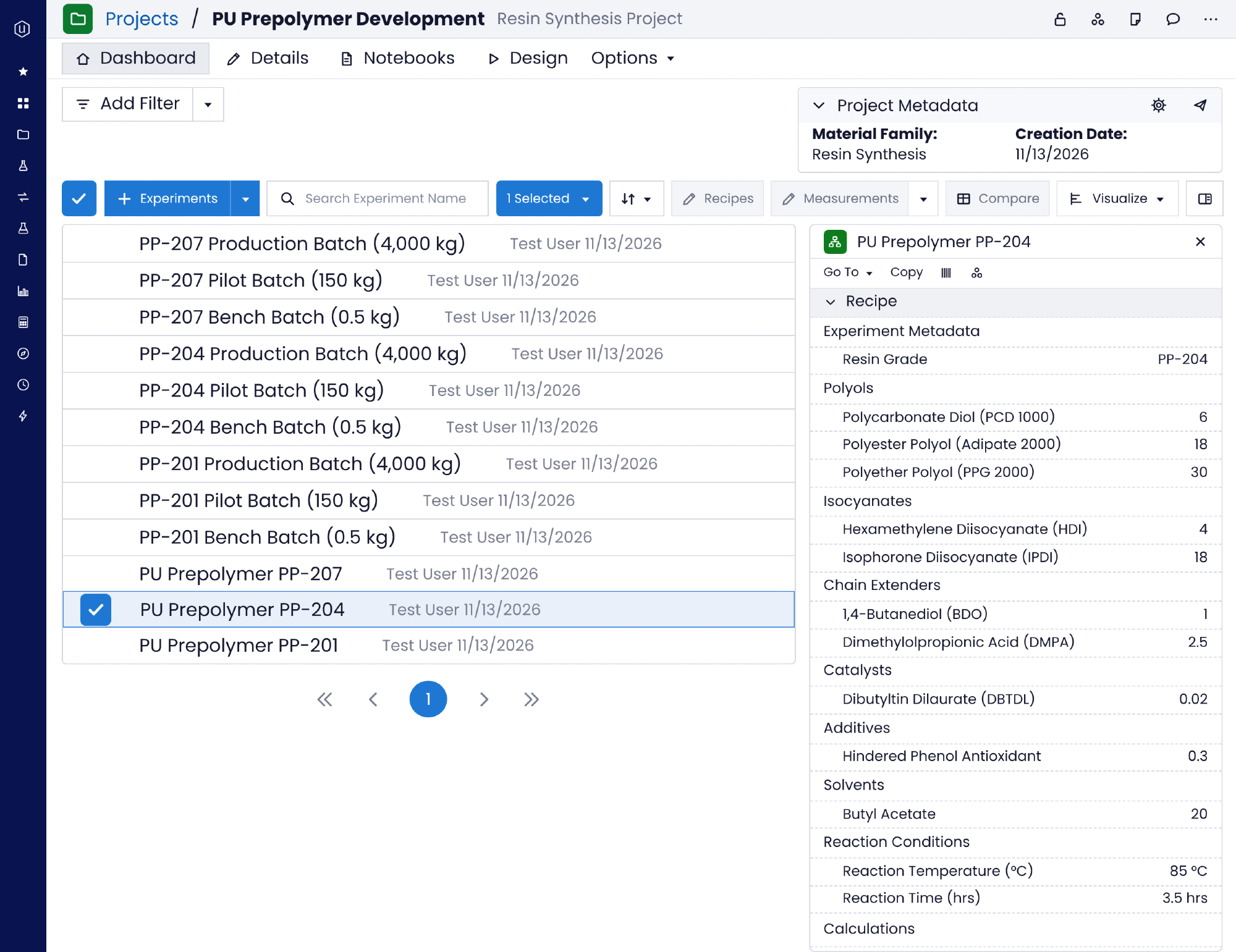
One project view with every batch listed and the full recipe for the selected PU prepolymer. Image Credit: Uncountable
Polymer programs generate synthesis records, reaction conditions, analytical results, and downstream property data. What makes bringing that information together difficult, and how should teams assess whether their data is ready for AI?
Much of the difficulty comes from how the work is distributed. Scientists may record reactions in spreadsheets or notebooks, while different teams conduct analytical testing, interpret the results, and prepare reports. The information belongs to the same development program, but it is captured in separate places and often in different formats.
For polymers, that separation is particularly important because analytical testing is central to understanding the material. Scientists can check properties such as solids content and viscosity, but techniques such as GPC, FTIR, and DSC often require specialists to both run the instruments and interpret the results. If that work happens in a separate system, the synthesis team may receive a summary without a direct connection to the underlying data and its interpretation.
Our aim is to bring those activities into the same environment: the scientist designing the reaction, the analytical team receiving the testing request, and the people reporting the results should be working with connected information. Analytical experts still apply their judgment, but their results and conclusions return directly to the scientist responsible for synthesis.
For AI readiness, a useful starting point is to ask whether those connections exist. Can the team connect a reaction to the testing performed on its output, access the relevant results, and retain the expert interpretation alongside them? Bringing that information into a structured, connected environment provides a much stronger foundation for analysis than leaving it scattered across documents and teams.
How can AI-assisted experimental design help teams explore reaction space more efficiently? What should chemists understand when a suggested experiment does not look intuitive?
Traditional experimentation often starts with a hypothesis, followed by a study designed to make the results easily interpretable. Within this methodology, a scientist might change one variable at a time or vary two factors in a grid, allowing people to see the effect of a change clearly.
However, polymer development can involve 10, 15, maybe even 20 variables, including monomers, additives, catalysts, and reaction-process parameters. Exploring that space through individual ladder studies quickly becomes inefficient and may prove unfeasible.
More advanced experimental designs can help teams cover a broader space with fewer experiments. Our screening tools use a sphere-packing approach to distribute experiments across the space being investigated, with the aim of getting more useful information from each experiment. Teams can then move toward more focused studies as they identify promising regions and shift from exploration to optimization.
Those designs can take some getting used to, as scientists accustomed to grids or familiar formulation designs may find it challenging to see several factors change at once. The important distinction is between an experiment that is easy to interpret by eye and a set of experiments designed to support efficient statistical analysis.
That does not mean simple ladder studies disappear. It means using the right approach at the right stage: broader, mathematically designed screening when exploring a complex space should be followed by more focused studies when the team has narrowed its direction.
Polymer composition is often closely protected intellectual property, but applications teams still need properties such as glass transition temperature, solids content, and flash point. How should teams manage that handoff and analyze performance without exposing composition?
A resin or polymer can be central to a company’s intellectual property while also driving decisions across its wider R&D organization. Teams therefore need a way to share enough information for downstream work without automatically exposing the underlying composition.
At Uncountable, we typically support this through a resin publishing process. The polymer team develops its reactions within its own permission-controlled environment. When a resin is ready to share, the team can make it available to an applications group while choosing which information that group can see.
That might include the resin’s identity and selected measured properties, such as glass transition temperature, solids content, or NCO content, without revealing its composition. The applications team can then use the material and interpret its performance without repeatedly requesting information from the synthesis team.
The key is preserving traceability across that boundary. Polymer scientists with the appropriate permissions can investigate how composition affects downstream formulation performance. Formulators can analyze how polymers with particular measured properties behave in their applications, without needing access to the proprietary recipe. Where broader access is appropriate, permissions can allow it.
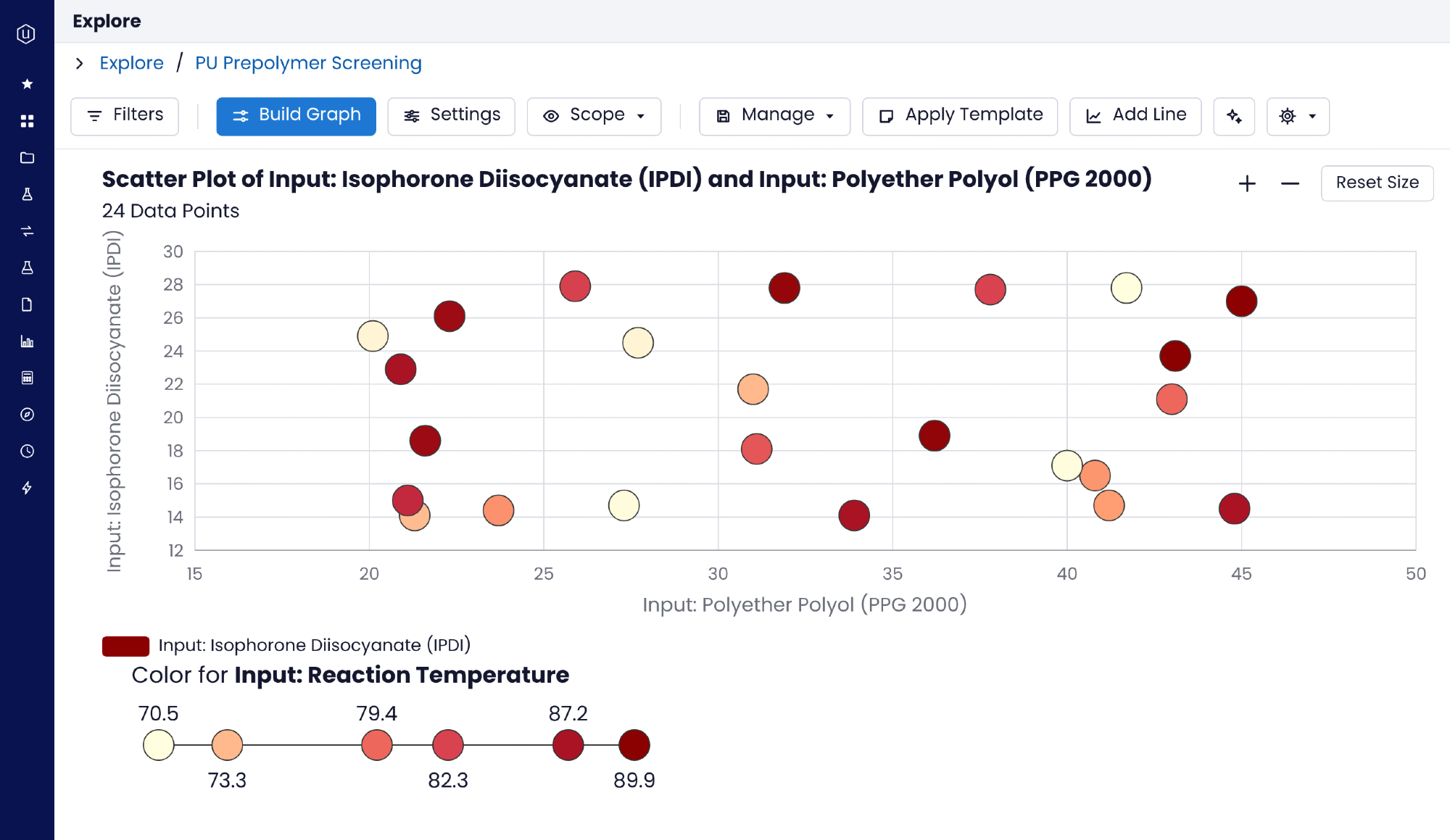
Coverage plot for the 24 design points, so you can see how evenly the screen spans the design space before running it. Image Credit: Uncountable
A polymer that performs well in a bench reactor may behave differently at pilot or production scale. How can connected data help teams account for process history and identify scale-up risks earlier?
This is one of the main challenges we want to help solve. By capturing scientific processes in a structured way, teams can analyze how they evolve as they move from laboratory work to pilot plants and full production.
As scale changes, the important factors can change too. Some processes become more controlled, while other sources of variation become more significant. Differences between reactors or production environments can also affect performance, even when the reason for a shift is not immediately clear.
Connecting process information with batch results allows teams to compare how related materials perform at different scales. Over time, they can investigate whether particular recipes show changes in solids content, for example, or whether certain reactions exhibit greater exothermic behavior as scale increases.
The value comes from building scientific understanding across those stages rather than treating each stage as an isolated exercise. That information can support models and help teams recognize patterns associated with scale-up difficulties.
Ultimately, the objective is to make a polymer that not only performs well in the laboratory but also has a better chance of succeeding at pilot and production scales.
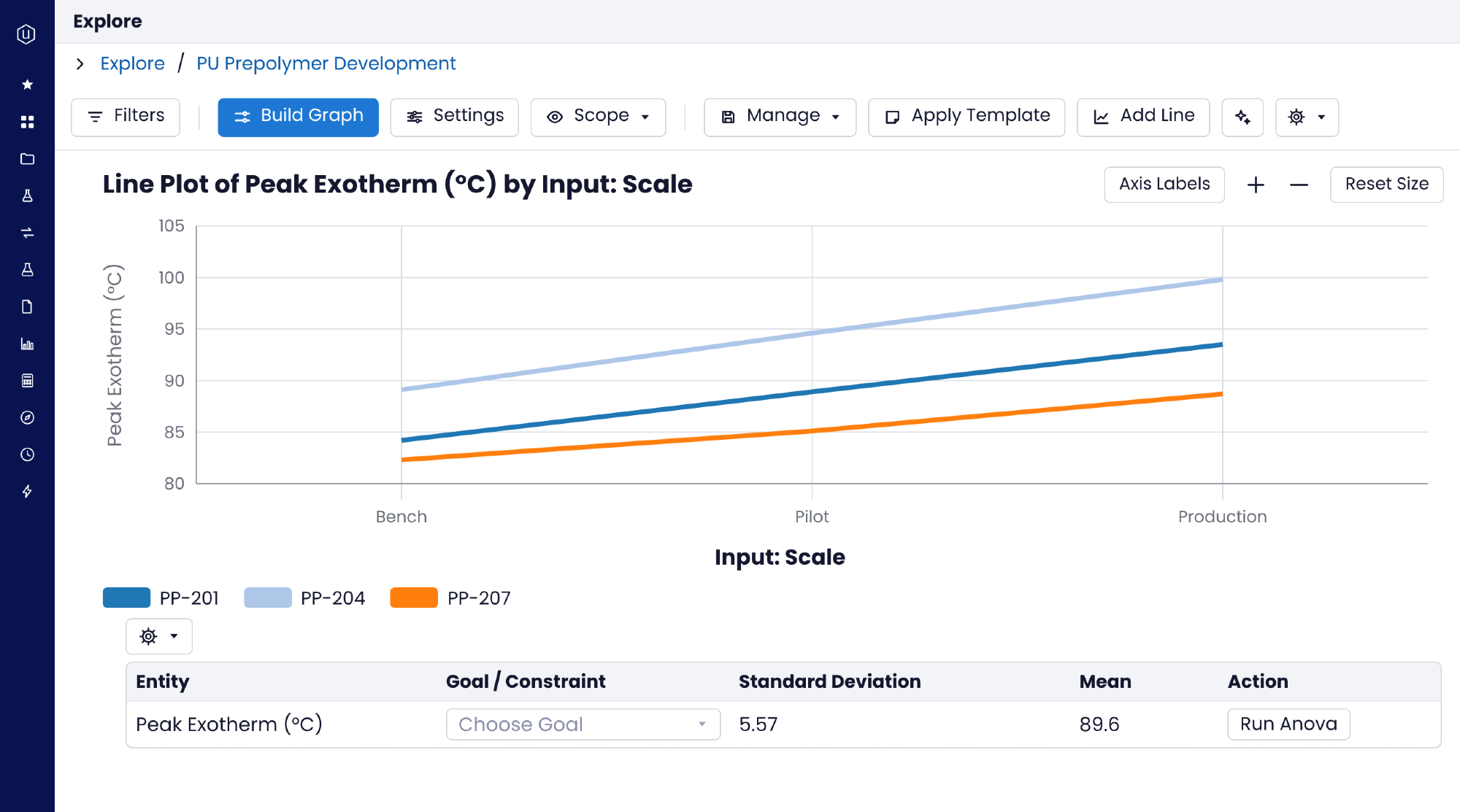
Peak exotherm compared across the three PU prepolymer grades, so scale-up risk shows up before the plant run. Image Credit: Uncountable
Looking ahead, which developments in AI and materials informatics do you expect to change how polymers are designed, tested, and commercialized?
I expect changes across the development process, starting with how teams explore their raw material space. Better experimental and analytical tools can help scientists investigate a broader range of monomers, surfactants, solvents, catalysts, and additives.
I also expect teams to shorten the time between running a reaction and reaching a useful conclusion. More connected workflows and greater automation between synthesis and analytical teams can make results available sooner, with the detail scientists need to interpret them.
Scale-up is another important opportunity. Making something that works in the laboratory is an achievement, but understanding how to manufacture it reliably can take a substantial part of the overall development timeline.
For us, our role is to help shorten both ends of that process: the initial exploration needed to identify a promising material and the later work required to turn it into a product that can be manufactured consistently, meet quality requirements, and deliver value to customers.
About Will Tashman 
Will Tashman holds a Bachelor of Science in Materials Engineering from the Massachusetts Institute of Technology (MIT). In 2016, he co-founded Uncountable, a company that uses machine learning to help chemical and materials manufacturers accelerate experimental development and bring new products to market faster.

This information has been sourced, reviewed, and adapted from materials provided by Uncountable Inc.
For more information on this source, please visit Uncountable Inc.
Disclaimer: The views expressed here are those of the interviewee and do not necessarily represent the views of AZoM.com Limited (T/A) AZoNetwork, the owner and operator of this website. This disclaimer forms part of the Terms and Conditions of use of this website.