Reliable water handling is not optional in orbit. When a custom pump manufacturer required a bearing material capable of withstanding years of continuous operation in one of the harshest lubrication environments imaginable, INSACO's materials expertise and precision grinding capabilities provided the answer.
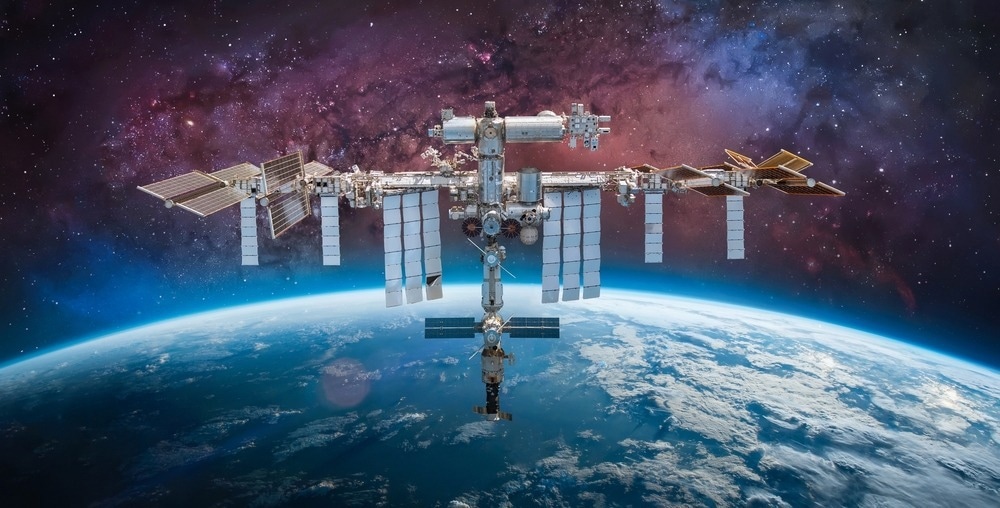
Image Credit: Dima Zel/Shutterstock.com
Pumps designed for crewed spaceflight operate under constraints with no real analog in terrestrial engineering. They must run for years without maintenance, tolerate zero-gravity operation, and fail in ways that are, ideally, never catastrophic.
When a custom pump design and manufacturing company, specializing in fluid-handling systems for aerospace, chemical, gas turbine, and other mission-critical applications, was tasked with developing a water and wastewater pump for the International Space Station (ISS), it ran into a problem rooted in basic tribology: water is a poor lubricant.
The Challenge
Conventional fluid film bearings rely on the lubricating fluid to maintain a thin, continuous film between rotating and stationary surfaces, preventing metal-to-metal (or ceramic-to-ceramic) contact. Oil and other hydrocarbon-based lubricants do this well because of their viscosity and film strength.
Water, however, does not. Its low viscosity and poor boundary-lubrication properties make it prone to breaking down under load, which leads to accelerated wear, surface galling, and premature bearing failure, an unacceptable outcome for a system supporting a crewed spacecraft's life-support needs.
The pump manufacturer needed a bearing material that could maintain a stable wear interface using water as the sole lubricant, hold tight enough tolerances to function as a precision fluid-film bearing, and do so reliably over the multi-year, maintenance-limited operational life expected of ISS hardware.
Precision Machining to Flight Tolerances
Material selection solved half the problem; achieving it in hardware solved the other half. The bearing geometry required dimensional tolerances of ±0.0002 inches, a tolerance band that leaves no room for surface or form deviations that would compromise the fluid film's stability in a system this sensitive to clearance.
INSACO produced the bearing using its precision grinding capabilities, with in-house dimensional accuracy verification using its quality control processes at each stage of production. For a component destined for a life-support system with no on-orbit repair option, this verification step was as critical as the machining itself.
From Ground Testing to Orbit
Before deployment, the bearings underwent extensive land-based dry-run testing to validate performance under simulated operating conditions. Following successful qualification, the parts were integrated into the pump system and deployed on the International Space Station, where they continue to support the water and wastewater handling requirements essential to the crew's life-support systems.
The ISS water pump program is a clear example of how materials science and precision machining intersect to solve problems with no off-the-shelf solution. By pairing an engineered silicon carbide grade, selected specifically for its wear resistance and self-lubricating microporosity, with tight-tolerance precision grinding, INSACO helped its customer meet a reliability requirement that conventional bearing materials simply couldn't satisfy in a water-lubricated system.
The result is a component quietly doing mission-critical work, hundreds of miles above Earth, with no room for error and no possibility of a quick fix.
This information has been sourced, reviewed, and adapted from materials provided by INSACO Inc. - Machining of Hard Materials.
For more information on this source, please visit INSACO Inc. - Machining of Hard Materials.