From SparkNanoReviewed by Danielle Ellis, B.Sc.Dec 2 2025
In this interview, AZoMaterials speaks with Dr. Paul Poodt, CTO, and Alexander Bouman, Business Development Manager, at SparkNano about how spatial atomic layer deposition (ALD) is improving lithium-ion battery performance and enabling industrial-scale roll-to-roll coating solutions.
This interview summarizes the recent webinar presented by Dr. Paul Poodt and Alexander Bouman - you can watch the webinar here.
Can you please introduce yourselves and your roles at SparkNano?
Alexander Bouman: I focus on commercializing our spatial ALD solutions and guiding customers through the journey from lab-scale R&D to full-scale manufacturing. My background is in chemical engineering, and I’ve previously worked at Philips Lighting and Thermo Fisher Scientific on scanning electron microscopy.
Dr. Paul Poodt: I'm the CTO and co-founder of SparkNano. I’m also a part-time Associate Professor at Eindhoven University of Technology. My research has centered on spatial ALD for thin-film deposition, and I’ve been closely involved in developing this technology for industrial applications such as batteries, photovoltaics, and flexible electronics.
Why is spatial ALD gaining momentum in the lithium-ion battery industry?
Paul Poodt: Spatial ALD addresses several key challenges in lithium-ion batteries, such as electrode degradation, limited cycle life, and poor interface stability. With spatial ALD, we can apply ultra-thin, conformal coatings that stabilize electrode-electrolyte interfaces and suppress issues like dendrite formation – all without compromising performance.
What specific battery challenges can these coatings solve?
Paul Poodt: As we shift to high-capacity materials like silicon anodes and high-nickel cathodes, stability becomes a bottleneck. Our ALD coatings act as protective layers, improving electrochemical performance and extending cycle life. The spatial ALD processes are also compatible with temperature-sensitive materials, which is crucial when you’re dealing with modern electrodes.
How does SparkNano’s spatial ALD process differ from conventional ALD?
Alexander Bouman: The key difference is scalability. Traditional ALD is slow and done in vacuum chambers, making it impractical for high-volume production. Spatial ALD, by contrast, separates precursors in space instead of time, enabling continuous roll-to-roll processing at atmospheric pressure. We can reach speeds up to 100 meters per minute, which is an important requirement for battery manufacturing.
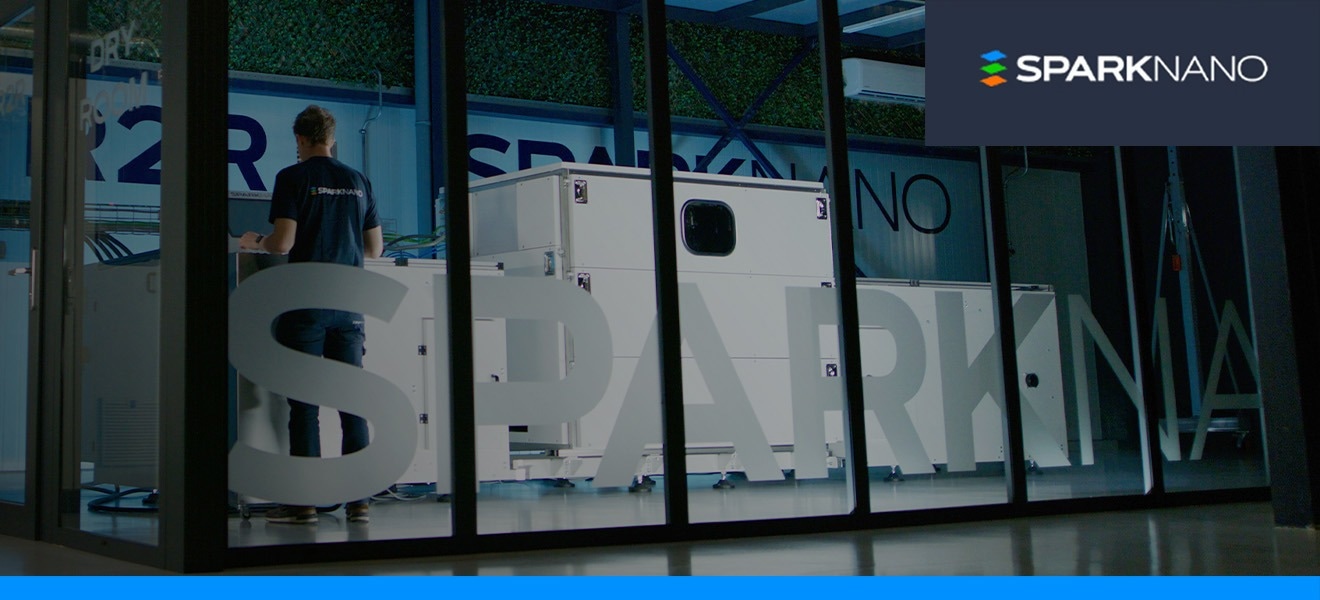
Image Credit: SparkNano
You mentioned lithium fluoride coatings – why are they important?
Paul Poodt: Lithium fluoride is excellent for passivating both anode and cathode interfaces. It’s chemically stable and ionically conductive, improving cycle life and Coulombic efficiency. We developed a new process, in collaboration with Air Liquide, using a precursor called LIEBE that enables the fast, low-temperature, and clean deposition of LiF films without hazardous gases such as HF or SF6.
How do you verify the conformality of these coatings on porous electrodes?
Paul Poodt: We used SEM-EDS on graphite anodes and observed fluorine signals on the surface of every particle – even deep within the electrode layer down to the battery electrode foil. That confirms conformal coverage, which is essential for functional performance. Achieving that with a fast, atmospheric-pressure plasma process is quite significant.
Watch the Webinars Now
What kind of performance gains do these coatings deliver?
Alexander Bouman: Typically, we see a 10 % improvement in capacity retention. That can double the battery lifetime in real-world scenarios. For heavy-duty applications, such as buses and trucks, this could reduce the levelized cost of energy storage (LCOES) by up to 40 %. It offers substantial economic and environmental benefits.
How do you support customers in scaling from lab to fab?
Alexander Bouman: We offer a seamless transition from our LabLine R&D tool to our SparkNano Omega roll-to-roll platform. Both utilize the same spatial ALD core technology, allowing processes developed in the lab to be fully transferable to large-scale production. This modular, scalable approach saves time, cost, and risk for our customers.
Are you exploring other materials beyond lithium fluoride?
Paul Poodt: Yes, we’re working on coatings such as aluminum oxide, niobium oxide, titanium oxide, and even lithium phosphates like LiPON. These are highly relevant for conventional and solid-state batteries. We’re also exploring doped LiF films to enhance ionic conductivity further.
What’s the future outlook for spatial ALD in battery manufacturing?
Alexander Bouman: We see spatial ALD becoming a cornerstone in next-generation battery production. It offers high throughput, low material waste, and excellent film quality. Our mission is to help manufacturers implement this technology in high-volume settings – from consumer electronics to EVs and grid-scale storage.
About Dr. Paul Poodt
Dr. Paul Poodt is the Chief Technology Officer at SparkNano and a part-time Associate Professor at Eindhoven University of Technology. He earned his PhD in Physics from Radboud University  Nijmegen, with a specialization in thin film deposition and surface science. He is widely regarded as a pioneer in spatial atomic layer deposition (ALD), with a focus on scalable coatings for clean energy technologies. Before co-founding SparkNano, he held senior research positions at TNO and Holst Centre. Dr. Poodt has published extensively and holds multiple patents in the field of ALD and nanocoatings.
About Alexander Bouman
Alexander Bouman is Business Development Manager at SparkNano, where he leads the commercialization of spatial ALD solutions across the battery and clean energy sectors. He holds a Master of Science in Chemical Engineering from Eindhoven University of Technology. Before joining SparkNano, he held technical and commercial roles at Philips Lighting and Thermo Fisher Scientific, where he focused on electron microscopy and nanomaterials. At SparkNano, he helps bridge the gap between R&D and industrial-scale deployment of ALD systems, supporting clients through technology integration and process scaling.

This information has been sourced, reviewed and adapted from materials provided by SparkNano.
For more information on this source, please visit SparkNano.
Disclaimer: The views expressed here are those of the interviewee and do not necessarily represent the views of AZoM.com Limited (T/A) AZoNetwork, the owner and operator of this website. This disclaimer forms part of the Terms and Conditions of use of this website.