When placed in the furnace and heated, molybdenum disilicide (MoSi2) heating elements can sometimes take on unusual shapes. The characteristic “hairpin” design may flex or bend slightly - this is a result of electromagnetic forces at work during operation. Some level of distortion is expected and considered normal.
The pictured Deltech furnace had been relined, new elements inserted, heated to the recommended 1500 degrees Celsius to condition the molydisilicide heating elements, and then ramped up to an operational temperature of 1650 degrees Celsius.
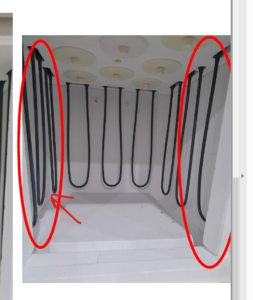
Normal element deformation. Image Credit: Deltech, Inc
The distortion can be severe, as shown in the image below.
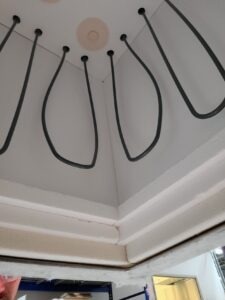
Extreme element deformation. Image Credit: Deltech, Inc
This type of flare is frequently produced by poor element anchoring. Anchoring necessitates the employment of element holders in combination with straps attached to the element terminals. The effects seen can occur if the element is poorly put in the holder, such as not being centered, or if the strap is too tight.
Molydisilicide heating elements with diameters of 3/6, 4/9, 6/12, and 9/18 mm can be anchored as stated. However, Deltech Furnaces also uses buss bars to secure the elements and provide electrical connections.
Improper installation or overtightening can also place unnecessary stress on the elements.
If you notice significant deformation, take time to inspect the element installation, the holder or buss bar, and strap positioning. Connections should be tight enough to secure the element and prevent arcing – but without applying direct torque to the element itself.
Getting this right takes some practice. To build confidence with the process, check out Deltech’s element installation and replacement videos available at the end of the Tutorials page.
So, what should you do with distorted elements? Once all mechanical stress has been removed, try repeating the element conditioning process to see if they return to their original shape.
Conditioning typically involves ramping the furnace temperature at a rate of 60 to 100 °C per hour up to 1550 °C. Hold at that temperature for at least 20 minutes, then either ramp down or cut power to the elements.
For the most accurate guidance, refer to the Deltech handbook that came with your furnace. Instructions are customized for each individual furnace – not just by model.

This information has been sourced, reviewed and adapted from materials provided by Deltech, Inc.
For more information on this source, please visit Deltech, Inc.