Accurate gas analysis is central to the production of purified terephthalic acid (PTA). PTA is a key components in the manufacture of polyethylene terephthalate (PET), the most commonly used polyester fiber.
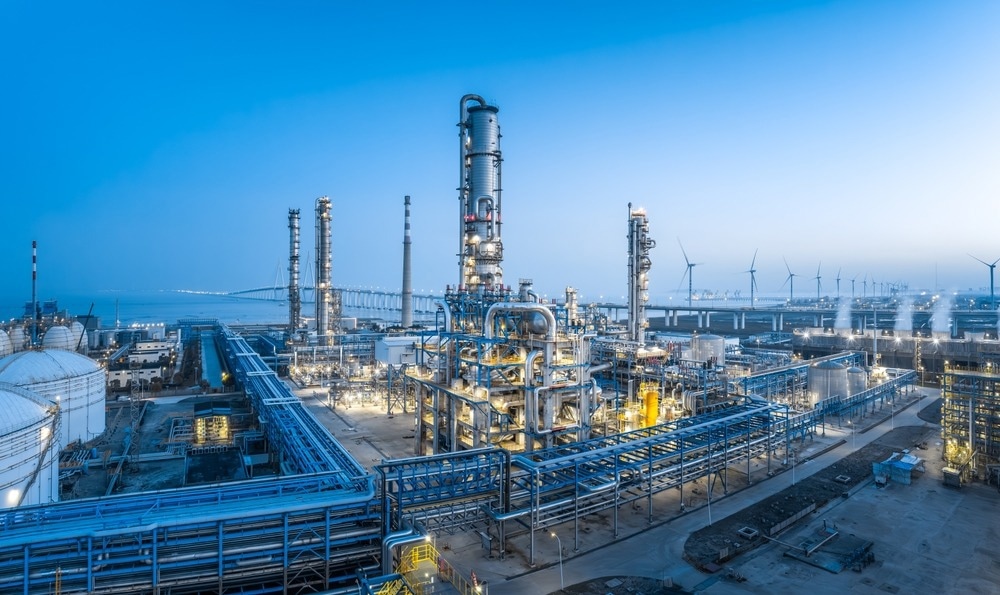
Image Credit: dongfang/Shutterstock.com
PET is also a recyclable thermoplastic resin that has been awarded US FDA approval for use as food and drink bottles and containers, meaning that global demand for PTA continues to grow, most notably in rapidly expanding economies such as those located in Asia.
Gas analysis has a vital role to play in the PTA production process, providing the measurements that underpin safety, process efficiency, and product quality.
The PTA Manufacturing Process
PTA is manufactured from p-xylene. This is done via the careful and specific oxidation by air in a reactor at elevated temperature and high pressure. Highly flammable liquid acetic acid is employed in this reaction, functioning as a solvent. The crystalline PTA product is separated from the reaction liquor in separate crystallizer vessels prior to recovery and purification.
Gas analysis serves two essential purposes in the PTA plant, within the oxidation reactors and the crystallizers.
Air is initially passed into the oxidation reactors. This helps to oxidize the p-xylene methyl groups to terephthalic acid, simultaneously generating carbon monoxide (CO) and carbon dioxide (CO2).
Some oxygen (O2) will remain unreacted, meaning that the residual O2 level in the off-gas is the most important gas analysis measurement that must be monitored. This should be maintained at approximately 4-5 % O2.
Should the O2 level become too high, a dangerous situation develops in the reactor, which could lead to the sudden, runaway oxidation of the flammable materials and a potential explosion.
An O2 level that is too low may lead to insufficient oxidation, however, resulting in a low product yield and poor efficiency. The O2 level must be accurately monitored with the fastest possible response time in order to achieve optimum results.
This application benefits from the use of a paramagnetic O2 analyzer, because this sensing technology is highly specific to oxygen and has the capacity to deliver high levels of accuracy in the reaction conditions. It also offers a rapid response to shifting concentrations of O2 in the reactor.
Paramagnetic cells are each comprised of two nitrogen-filled glass spheres that are mounted on a rotating suspension within a magnetic field. Light shines on a centrally located mirror before being reflected onto a pair of photocells.
O2 is naturally paramagnetic, meaning that it is drawn into the magnetic field, displacing the glass spheres and causing the suspension to rotate. This motion will then be detected by the photocells, generating a signal to a feedback system.
This signal sends a current through a wire mounted on the suspension, essentially resulting in the creation of a motor effect. Current produced is directly proportional to the gas mixture’s O2 concentration, enabling the capture of an accurate and linear percentage reading.
This technology is non-depleting, meaning that there is no need to replace paramagnetic cells, and its performance does not deteriorate over time. These features of paramagnetic cells offer considerable benefits in terms of sensor lifespan and ongoing maintenance costs.
A well-designed sample conditioning system is also needed to ensure that the analyzer can accommodate the high-temperature, high-pressure off-gas. This off-gas will contain significant levels of corrosive acetic acid vapor and trace p-xylene.
Many plants also necessitate current CO2 and CO measurements in the off-gas, because this provides additional insight into the progress of the oxidation reaction. An infrared gas analyzer is well-suited to performing this measurement, and this would ideally be configured to provide simultaneous CO2 and CO measurements.
Acetic acid vapor in the crystallizers is driven off as the PTA product crystallizes out of the solvent liquor. This vapor is extremely flammable, meaning that it is important to measure residual O2 in the crystallizer vapor in order to provide early warning of any potential explosion risk.
Monitoring CO2 in this vapor is also useful because it can indicate the occurrence of post-oxidation. Paramagnetic and infrared sensing provide the most effective gas analysis solution for these O2 and CO2 measurements.
Gas Analysis Requirements
Reactor off-gas is generally comprised of:
- Approximately 90 % nitrogen
- 4 % oxygen
- 3 % carbon dioxide
- 2 % acetic acid
- 1 % water vapor
- <1 % carbon monoxide
- Trace amounts of p-xylene, other organics, and acidic catalyst
This off-gas is typically present at a pressure of 20 barg and a temperature of 50-150 °C, meaning that the required hazardous area classification may be Zone 1 or 2, depending on the specific plant conditions.
Gas analysis measurements are typically specified on a dry basis with required ranges between 0-10 % for O2, 0-5 % for CO2, and 0-2 % for CO. Response speed is essential for gas analysis in this application, most notably in terms of the O2 measurement. This must be below 60 seconds for the overall T90 of the complete system.
It is also important that the system functions with minimal errors. A voting system may be used to monitor O2 concentration and ensure reactor safety. Voting systems employ multiple analyzers, with the process relying on the measurement agreed upon by most of the analyzers.
For instance, no action would be taken in a three-analyzer voting system if one analyzer detects a significant change but is outvoted by the other two. If two of the three analyzers (or all of them) detect a change, however, this reading is considered to be correct, and action may be taken. This action could range from informing the process operator to automatically stopping the process.
Voting systems offer an additional layer of reliability in safety applications. They also enable the detection of potential analyzer issues at an early stage without endangering the process. For example, should two analyzers agree on a measurement while the third analyzer differs, this could indicate a potential issue that can be investigated and corrected prior to this issue affecting the process.
A single infrared analyzer is usually sufficient for the other measurement requirements. Off-gas applications in the crystallizer are generally similar, meaning that they will employ identical analytical solutions.
For both reactor and crystallizer measurements, it is important that the sample conditioning system be well-designed to ensure a rapid overall response time. This is also key to ensuring that the system can accommodate significant levels of condensate in the sample, removing these before measurement.
Sampling in the reactor off-gas stream must also correctly handle the high pressures involved. For example, it may be useful to use a water-washing ‘lute’ system made from highly corrosion-resistant materials such as titanium or Hastelloy to accommodate the presence of acetic acid and possible catalyst traces.
A gas analysis supplier with appropriate experience and expertise can provide the ideal analyzer and sample system packages to meet specific plant requirements.
Acknowledgments
Produced from materials originally authored by Keith Warren and Karen Gargallo from Servomex Group Limited.

This information has been sourced, reviewed and adapted from materials provided by Servomex.
For more information on this source, please visit Servomex.